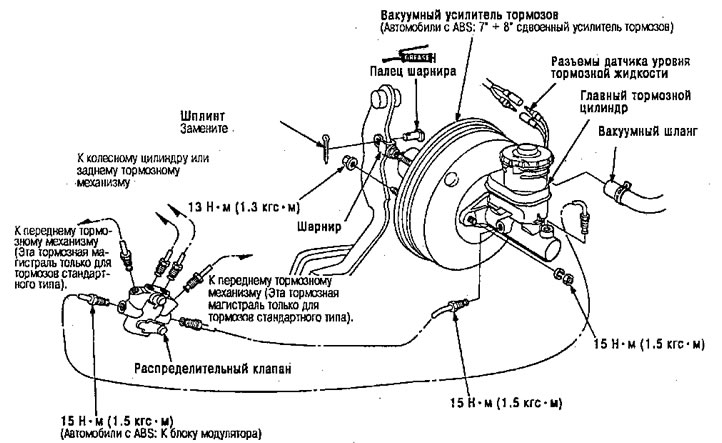
Removal/Installation
Attention:
- Be careful not to bend or damage the brake lines when removing the master cylinder.
- Do not allow brake fluid to come into contact with the vehicle; this may damage the paint, if brake fluid gets on the paint, wash it off with water immediately.
- To prevent liquid from leaking, cover the hose connections with a rag or paper towel.
Note: LHD type is shown, RHD type is symmetrical.
1. Disconnect the fluid level sensor connectors.
2. Remove the filler cap from the master cylinder.
3. The brake fluid can be pumped out through the top of the master cylinder filler tank using a syringe.
4. Disconnect the brake lines from the master cylinder.
5. Remove the washers and nuts securing the brake cylinder.
6. Remove the brake master cylinder from the brake booster.
7. Disconnect the vacuum hose from the brake booster.
8. Remove the cotter pin and pivot pin from the joint.
Caution: Do not disconnect the joint by removing it from the brake booster pushrod. If the pin is loose, adjust the pushrod length before installing the brake booster.
9. Remove the four booster mounting nuts.
10. Pull the amplifier forward until the hinge appears from behind the partition.
11. Remove the amplifier from the engine compartment.
12. Install the booster and master cylinder in the reverse order of removal.
Attention:
- When connecting the brake lines, make sure there is no displacement between the brake line and other parts.
- Be careful not to bend or damage the brake lines when installing the master cylinder.
Note: If replacing the master cylinder or brake booster, check and adjust the tappet clearance before installing the master cylinder.
13. Fill the master cylinder reservoir and bleed the brake system.
14. After installation, check the height and play of the brake pedal and adjust if necessary.