
Note: For assembly order for Type C, see below.
Warning: Never use an air hose or dry brush to clean brake components. Use a vacuum cleaner to avoid inhaling brake dust. Dirty brake discs or pads reduce braking efficiency. When reusing pads, always install them in their original position to prevent loss of braking efficiency.
Attention:
- Never allow brake fluid to come into contact with your car, it may damage the paint, if it does come into contact with the paint, wash it off immediately with water.
- To prevent liquid from leaking, cover the hose connections with a rag or paper towel.
- Wash all parts with brake fluid and let dry, blow out all channels with compressed air.
- Before assembly, check that all parts are free of dust and foreign particles.
- Always replace parts with new ones.
- Make sure that no dust or other foreign matter can enter the brake fluid.
- Do not reuse drained fluid.
- Use only pure DOT-3 or 4.
Note:
- Apply brake fluid to the piston, piston seal and brake bore.
- When disassembling, always replace all rubber parts with new ones.

Use the recommended rubber lubricant supplied with the mechanism seal kit.

Use the recommended seal lubricant supplied with the mechanism seal kit.
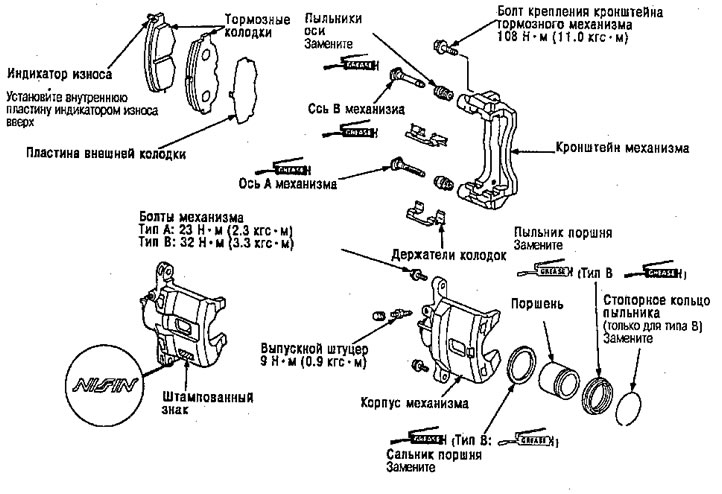
Note: NISSIN brake mechanism and AKEBONO can be distinguished from each other by the "NISSIN" mark applied to the NISSIN brake mechanism housing.
1. Wash the piston and brake mechanism in brake fluid and inspect for wear and damage.
2. Apply the recommended grease to the seal (type B: Recommended rubber lubricant) in the mechanism seal kit, and install the seal into the cylinder groove.
3. Apply the recommended rubber lubricant (type B: Recommended Oil Seal Grease) in the brake mechanism oil seal kit to the oil scraper lips of the oil seal and into the new piston dust boot and install it into the brake mechanism. For type B brake mechanism: securely install the new dust boot clamp onto the piston dust boot.
Caution: Be careful not to damage the brake cylinder wall.
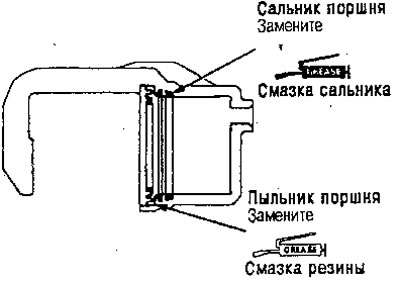
Type A:
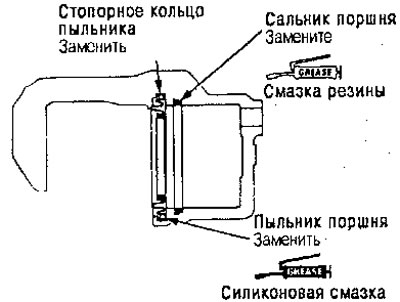
Type B:
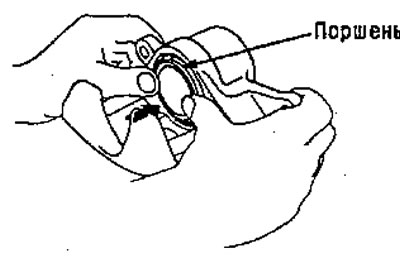
4. Apply brake fluid to the brake mechanism and piston, then install the piston into the cylinder with the concave end facing inward.
5. Apply the recommended seal lubricant from the brake seal kit to the sliding surfaces of the axles and to the inside of the new axle boot.
6. Correctly install the axle dust boots into the brake mechanism bracket grooves.
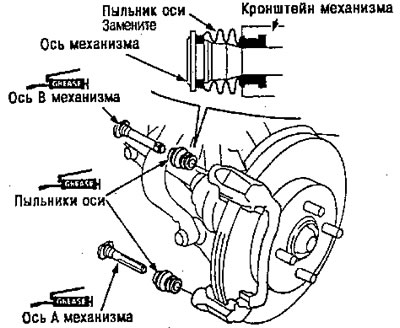
7. Install axle A and axle B into the brake mechanism bracket.
8. Correctly install the axle boots into the grooves in the axles.
9. Install the brake pads to their original position.
10. Push the piston so that the brake mechanism sits on the pads and install the brake mechanism.
11. Tighten the brake mechanism bolts.
12. Connect the brake hose to the brake mechanism with new sealing washers and tighten the union bolt.
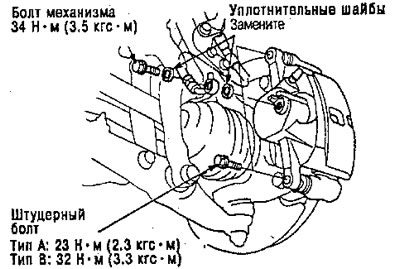
13. Fill the brake fluid reservoir and bleed the brake system.
14. Believe the following.
- Check hoses, tubes and connections for fluid leaks and tighten if necessary.
- Check the brake hoses for kinks or twists.
(Material obtained from the website: HondaBook)