
Contents: Removal ⇊ Installation ⇊
Removal
1. Remove the fuel tank filler cap.
2. Remove the air filter.
3. Disconnect the throttle cable from its rod (see Section 7).
4. If the vehicle is equipped with an automatic transmission, disconnect the transmission control cable from the throttle linkage (see Chapter 7B).
5. Mark all vacuum hoses and their connection points, remove the hoses.
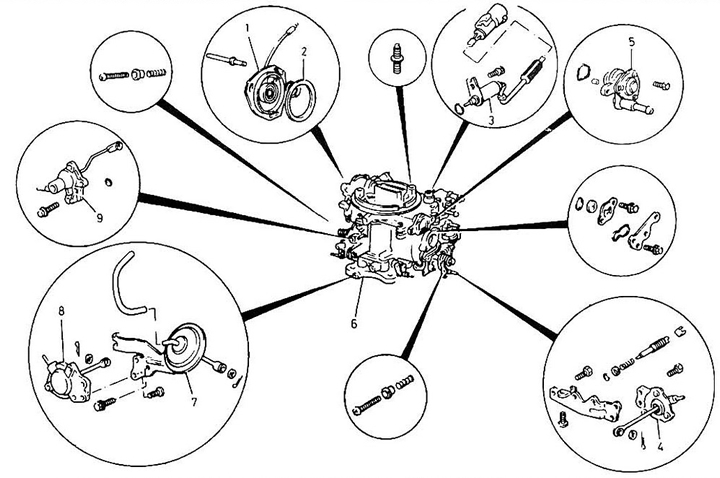
Fig. 9.5 (bottom) Typical carburetor: 1 - air damper cover; 2 - gasket; 3 - shut-off electromagnetic valve; 4 - idle speed control diaphragm; 5 - ventilation cut-off diaphragm; 6 - body; 7 - secondary camera control aperture; 8 - throttle control diaphragm; 9 - air damper opening diaphragm.
6. Disconnect the fuel hoses.
7. Label the wires and disconnect them.
8. Disconnect the carburetor fasteners and remove it from the intake manifold. Plug the manifold with a rag to prevent dirt from getting in.
Installation
9. Remove the remains of old gaskets from the mating surfaces. Remove the rag from the manifold. Wash the surfaces with solvents or gasoline.
10. Install a new gasket on the manifold.
11. Install the carburetor and tighten its fasteners.
12. To prevent carburetor warpage, tighten fasteners in ¼ turn increments in a crisscross pattern to the specified torque.
13. Carry out further assembly in the reverse order of disassembly.
14. Check and adjust idle speed if necessary (see Chapter 1).
15. If the vehicle is equipped with an automatic transmission, adjust the valve control cable (see Chapter 7B).
16. Start the engine and carefully check for leaks.