
The intake system consists of an air filter, intake pipe, throttle body, idle speed control system, cold start control mechanism and intake manifold. The throttle body for multipoint injection is two-chamber. The lower part of the body is heated by liquid from the engine cooling system. The throttle body for two-point injection is single-chamber.
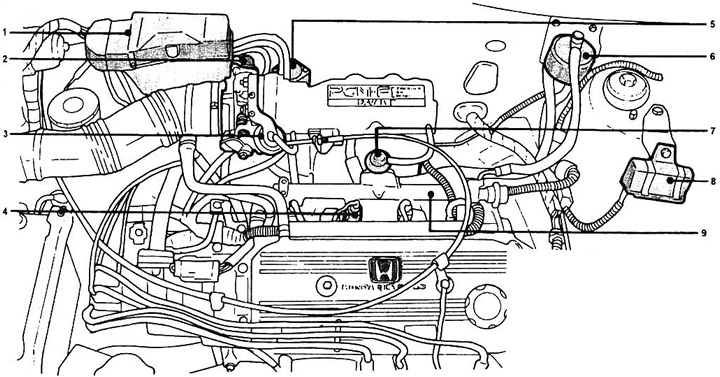
Fig. 11. 1 Components of the emission control system and fuel system: 1 - control unit; 2 - throttle position sensor; 3 - throttle body; 4 - nozzle; 5- additional air supply valve; 6 - fuel filter; 7 - fuel pressure regulator; 8 - injector resistance; 9 - intake air temperature sensor.
The mixture composition during engine idle operation is regulated by a system consisting of an electronic module and actuator electromagnetic valves. When the engine idle speed decreases, for example when an additional load is turned on, the valve opens an additional bypass air passage channel, thereby restoring the normal idle speed.
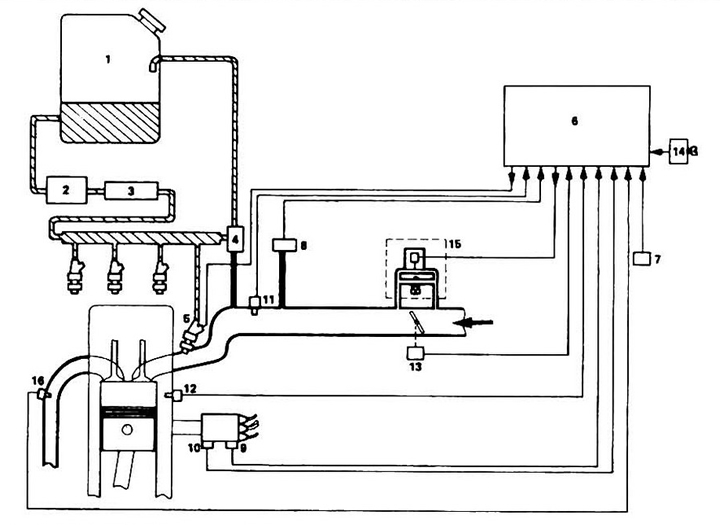
Fig. 11.2 PGM-FI system diagram (multipoint): 1 - fuel tank; 2 - fuel pump; 3 - filter; 4 - fuel pressure regulator; 5 - nozzle valve; 6 - EMU; 7 - atmospheric pressure sensor; 8 - absolute pressure sensor; 9 - piston position sensor; 10 - TDC sensor; 11 - air temperature sensor; 12 - coolant temperature sensor; 13 - throttle position sensor; 14 - CO level adjustment potentiometer; 15 - additional air bypass (warming up and idle speed adjustment); 16 - oxygen content sensor.
This same valve controls the processes of starting and warming up the engine at low temperatures.
When an automatic transmission is installed on a vehicle, additional loads occur during cold start, reducing the engine crankshaft speed. To compensate for this phenomenon, an idle speed compensation valve is used in the transmission.
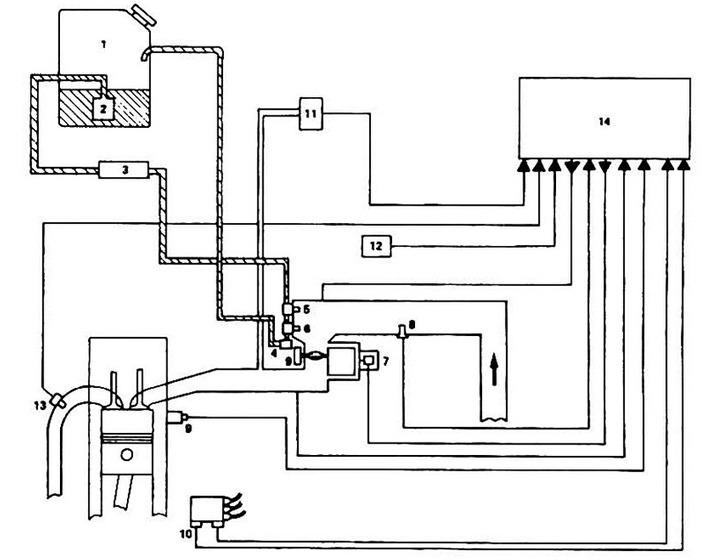
Fig. 11.3 PGM-FI system diagram (two-point): 1 - fuel tank; 2 - fuel pump; 3 - filter; 4 - pressure regulator; 5 - main nozzle; 6 - additional nozzle; 7 - additional air control valve; 8 - air temperature sensor; 9 - coolant temperature sensor; 10 - shaft rotation angle sensor, TDC sensor; 11 - absolute pressure sensor; 12 - atmospheric pressure sensor; 13 - oxygen content sensor; 14 - EMU.
Electronic control module
The electronic module consists of an eight-bit processor and various sensors:
Crankshaft position sensor mounted in the distributor. The sensor has two rotors (TDC and "cylinder number") and sensors at their ends. The "cylinder number" rotor determines the position of the first cylinder as a basis for further injection control pulses, the "TDC" rotor controls the ignition timing.
The absolute pressure sensor, installed on the intake manifold, transforms the pressure into electrical signals and sends them to the processor. Together with the "TDC" and "cylinder" sensors, the injection duration is determined.
The atmospheric pressure sensor sets the fuel supply compensation when the atmospheric pressure changes.
The coolant temperature sensor sets fuel delivery compensation based on engine temperature.
The air temperature sensor sets fuel supply compensation when the ambient temperature changes.
The throttle position sensor is the main sensor that controls fuel delivery.
The oxygen sensor generates signals proportional to the oxygen content in the exhaust gases.
Start-up mixture enrichment system (combination with starter activation).
Fuel supply system
The fuel supply system consists of a fuel pump, pressure regulator, and injectors (four for multi-point and two for two-point injection schemes), additional resistance of injectors and main relay.
Fuel passes through the intake filter into the pump, through the check valve into the main filter and from there to the injectors. Excessive pressure increase in the system is prevented by the check valve.
The fuel pressure regulator ensures a constant pressure differential between fuel and air in the intake manifold. This differential is 2.5 bar.
The injectors are controlled by an electric valve. When voltage is applied to the solenoid, the needle valve moves away from the seat and fuel enters the atomizer. The amount of fuel supplied to the engine is determined by the valve opening time or, what is the same, the duration of voltage supply to the solenoid. The accuracy of fuel dosing depends on the state of the electrical parameters of the fuel supply system.
The text can be found on the website Hondabook.ru