
Contents: Some important information about the…⇊ Driver's airbag operation ⇊ Seat backrest position for safety ⇊ Position of head restraints to…⇊ Ensuring the safety of children ⇊
Some important information about the features of the airbag
The airbags are only deployed if the vehicle is subjected to a sufficiently strong frontal impact. The force of the impact that triggers the additional safety system is approximately equivalent to a collision of the vehicle at 40 km/h with a stationary vehicle of the same weight and size. The airbags do not inflate in a moderate frontal impact or in impacts with the vehicle (even very strong ones) from behind, from the side, or when the vehicle rolls over.
Airbags are single-use safety devices. They cannot protect you from repeated frontal impacts that may occur after the first impact in the same accident.
Serious injuries, mutilations and death of the driver and passengers of the car are possible in severe accidents, even if the airbags have deployed in time and the belts have been adjusted and fastened properly. No modern protective system can guarantee complete safety of the driver and passengers in severe accidents.
It is usually very difficult to determine reliably whether the airbags should have deployed by visually inspecting the damage to the vehicle in an accident. In some cases, severe damage to the bodywork indicates that a significant portion of the impact energy was absorbed by deformation of the bodywork elements. In this case, the deceleration threshold for which the deceleration sensors are set and which triggers the airbags may not have been exceeded. In other cases, when the impact occurred on a more rigid part of the vehicle, (for example, the chassis) and was accompanied by a more significant deceleration, the body does not receive significant visible damage, and the airbags are deployed.
Driver's airbag operation
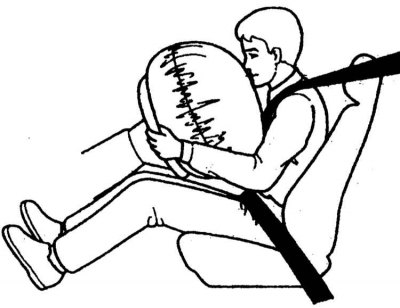
In the event of a frontal impact of sufficient force, the airbag installed in the steering wheel hub inflates almost instantly and protects the driver from hitting his head and chest on the steering wheel.
In order to effectively perform its protective function, the airbag must deploy from the folded state to the working state at a very high speed. Therefore, the airbag, while protecting you from serious injuries and in some cases even saving your life, can cause minor injuries. For example, you can get scratches, abrasions on your face, etc. In order to reduce the likelihood of injury to the face by the airbag, you should always sit in the driver's seat at the maximum possible distance from the steering wheel. At the same time, of course, you must ensure a good view and the ability to conveniently manipulate all the controls of the car.
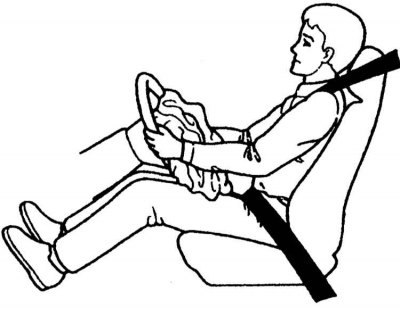
Immediately after filling with gas, the airbag quickly deflates, allowing the driver to visually assess the situation after a frontal impact and adjust the direction of the car using the steering wheel and other vehicle controls. The time from the moment the airbag is triggered until it deflates is a fraction of a second. You may not even realize that the airbag has deployed at first.
The driver's airbag is located under the steering wheel hub cover when folded. For your safety, do not attach any foreign objects to the steering wheel hub or rim. These objects may interfere with the normal operation of the airbag or be thrown by the inflating airbag shell and injure you or other passengers.
The passenger airbag is folded up on the top right side of the control panel under the cover marked SRS. Do not attach any objects to the cover. When the airbag deploys, these objects may be thrown by the inflating shell of the airbag and injure the occupants of the vehicle.
Seat backrest position for safety
In order for the seat belts to effectively perform their protective functions, the backs of the front seats must be in an upright position. If you increase the angle of the seat back, this will worsen the fixation of the body by the seat belt. The more the seat back is tilted back, the higher the likelihood of the body diving under the belt in a strong frontal impact of the car and the more severe the injuries may be.
Instructions for adjusting the seat back are provided in Seat adjustment.
Position of head restraints to ensure safety
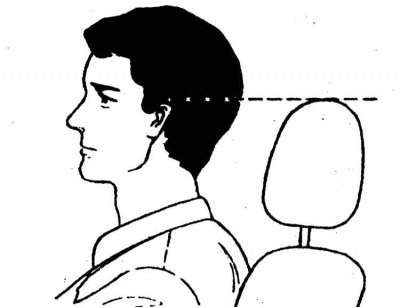
Head restraints help prevent neck and head injuries in the event of a rear-end collision. The height of the head restraint should be adjusted so that the top of the head restraint is level with the top of the ear. If this cannot be achieved, the head restraint should be set to the highest position. Instructions for adjusting the seat are provided in Seat adjustment.
Ensuring the safety of children
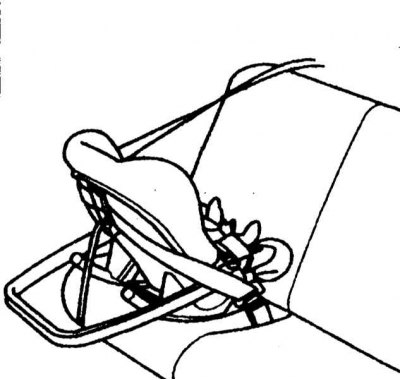
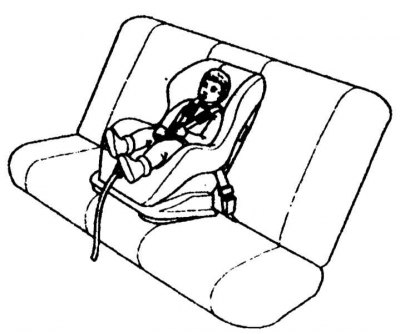
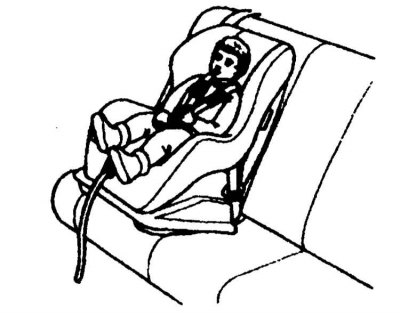
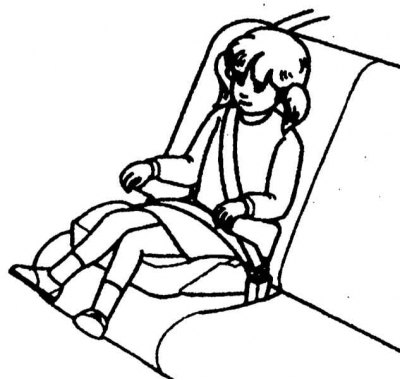
The child safety seats and cushions shown below are recommended for use in your vehicle.
 |
 |
 |
 |