
Contents: Front seat adjustment ⇊ Cars with 3-door hatchback body ⇊ Cars with 5-door hatchback body ⇊ Cars with 3-door hatchback body ⇊ Cars with 5-door hatchback body ⇊
Front seat adjustment
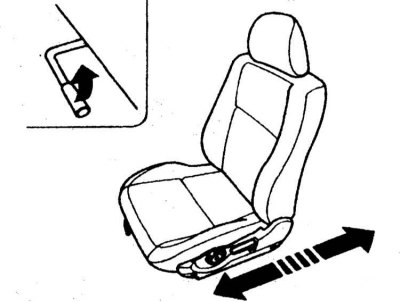
Before you start driving, adjust the seat position. To adjust the longitudinal position of the seat, lift the locking lever located at the front under the seat cushion. While holding the lever, move the seat forward or backward to a comfortable position. Then release the locking lever. To check that the seat is securely locked, try moving it forward and backward.
To change the angle of the seat back, lift the release lever located on the side of the seat cushion base (from the door side). While holding the lever, move the backrest to a comfortable position, then release the locking lever.
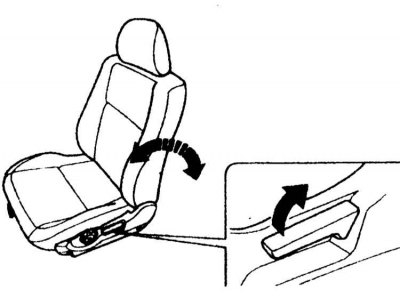
The backrest will be fixed in the new position.
Cars with 3-door hatchback body
To ensure the convenience of passengers getting into and out of the rear seat, the backrests of the front seats can be tilted forward. The release handles are located on the sides of the seatbacks (from the doorway side).
Cars with 5-door hatchback body
The backrest tilt of the front seat is adjusted using the rotating handle (rear), which is located on the side of the base of the seat cushion.
Warning! A large inclination of the seat back reduces the protective properties of the seat belt. In an accident, you can dive under the belt and be seriously injured. When driving, bring the seat back to an upright position. Sit so that your back is fully supported by the seat back.
Adjusting the height of the driver's seat cushion (individual models)
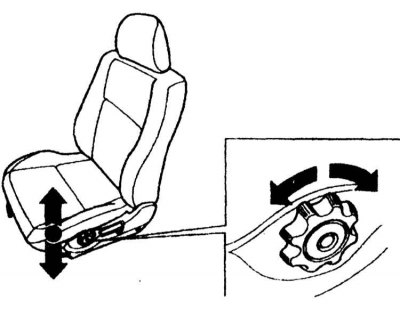
The driver's seat cushion can be adjusted in height. The adjustment is made by turning the regulator, which is located on the left side of the seat cushion base.
Electric adjustment of the driver's seat (individual models)
Your vehicle may be equipped with a driver's seat with electrically adjustable drives. Two electrically adjustable switches are located on the left side of the seat cushion base. The combination switch with a long horizontal handle is designed to adjust the longitudinal and vertical position of the seat, and the switch with a short vertical handle is designed to adjust the backrest tilt.
The seat can be adjusted with the key in any position in the ignition switch. Before driving, adjust the seat position.
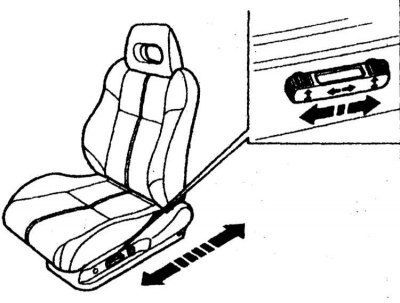
Press the combination switch handle forward or backward to move the seat closer to or further from the steering wheel and control pedals.
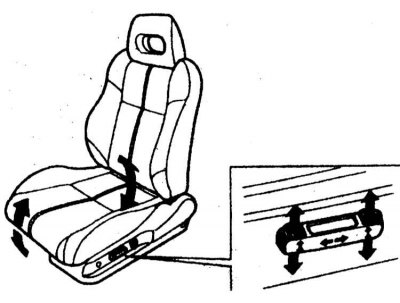
Press up or down on the front end of the combination switch handle to raise or lower the front edge of the seat cushion. Similarly, press up or down on the rear end of the combination switch handle to raise or lower the rear edge of the seat cushion.
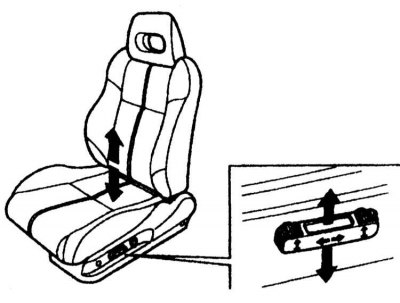
To raise or lower the entire seat cushion, press up or down on the center of the switch handle.
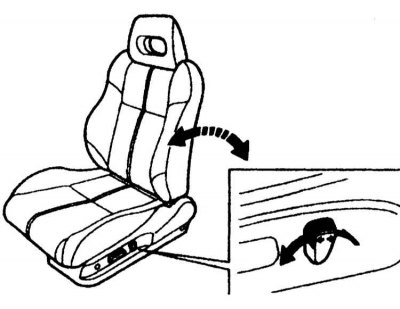
Adjust the seat back angle by moving the vertical switch handle, which is located behind the combination switch, to the appropriate side.
Warning! A large inclination of the seat back reduces the protective properties of the seat belt. In an accident, you can dive under the belt and be seriously injured. When driving, bring the seat back to an upright position. Sit so that your back is fully supported by the seat back.
Headrests
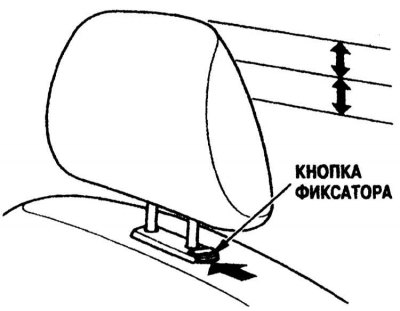
The front seats of your vehicle are equipped with head restraints. Some vehicle models also have head restraints installed in the rear seat. Head restraints help prevent neck and head injuries. In order for head restraints to perform their protective functions, they must be adjusted correctly. The top of the head restraint cushion should be level with the top edge of the ear.
Some vehicle modifications have the ability to adjust the height of the headrests. The headrest adjustment is done with both hands at the same time, so do not try to adjust the headrest while the car is moving. To raise the headrest, simply pull it up. In contrast, to lower the headrest, you must first press the locking button.
To remove the headrest for cleaning or replacement, do the following: Raise the headrest all the way. Then press the lock button and remove the headrest from the seat back.
Warning! Operating a vehicle without head restraints may result in serious injury to the driver and passengers in the event of an accident.
Check that the head restraints are in place and adjust them properly.
Folding the rear seat back (individual models)
The rear seat back is split and consists of two parts that can be folded forward, opening direct access to the trunk. The rear seat back locks, which lock it in the normal position, can be released from both the car interior and the trunk.
Each of the two sections of the rear backrest can be folded forward independently of the other.
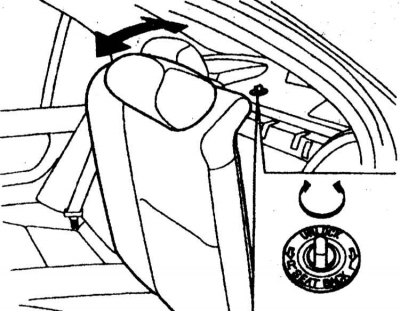
Turn the locking handle clockwise to fold the left section, or counterclockwise to fold the right section of the backrest.
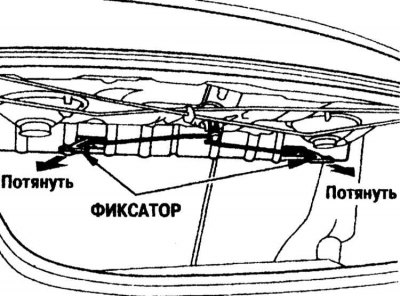
To fold the rear seat back from the trunk, pull the latches located under the rear shelf.
After returning the rear seat back sections to their normal position, press them firmly toward the rear shelf to lock them in place. Check that the rear seat back locks are engaged securely by pulling the top edge of the seat back toward you. After returning the rear seat back to its upright position, check that the straps of both diagonal lap belts are positioned over the seat back.
Make sure that all items in the trunk or protruding from the trunk into the car are securely tied down. Unsecured luggage can come loose and injure the driver and passengers in the event of emergency braking of the car.
Cars with 3-door hatchback body
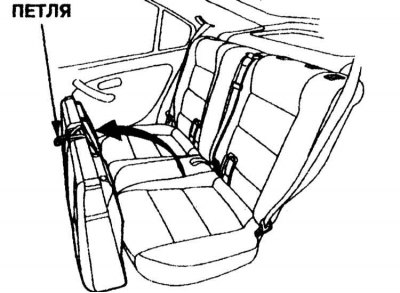
To fold the rear seat back sections (simultaneously or separately), lift the release button located at the top of each section.
Cars with 5-door hatchback body
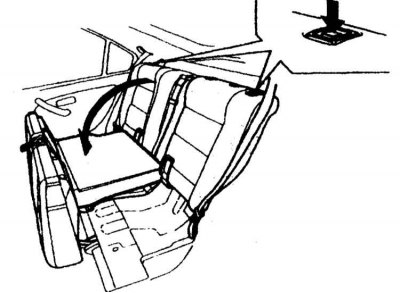
Before folding the backrest sections, rotate the rear seat cushion to a vertical position so that it is positioned behind the front seats. To do this, use the loop attached to the rear edge of the seat cushion. Remove the headrests from the backrest and insert their pins into the holes made in the base of the seat cushion. Then fold the rear seat back sections.
Do not drive with the trunk lid open and the rear seat back folded down, as this may result in carbon monoxide (CO) poisoning.
[Based on materials from the website HONDABOOK.ru]