
Contents: Removal and installation ⇊ Adjustment ⇊
Car doors are quite heavy, so it would be wise to enlist the help of an assistant.
Removal and installation
1. Roll down the window completely, then disconnect the negative battery cable.
2. Open the door all the way and support it with a jack or wooden blocks.
3. Remove the interior trim panel and water shield (see Removal and installation interior door trim).
4. Label and disconnect all electrical connectors, then release the wiring from the retainers on the door assembly.
5. On the door side, separate the rubber guide tube laid between it and the body. Remove the wiring harness threaded through the guide tube and remove it from the door.
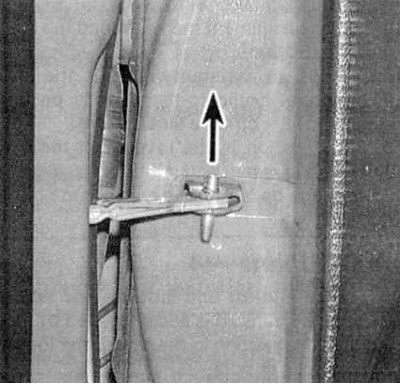
6. Knock out the center pin of the door stop (see accompanying illustration).
7. Trace around the hinge strips with a marker, marking their position on the door.
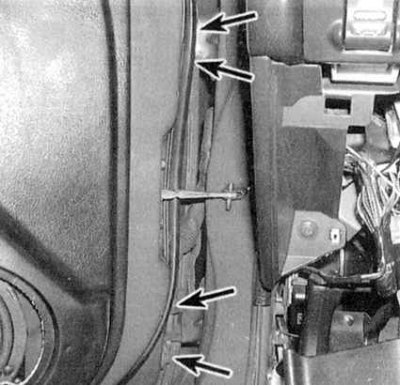
8. Ask an assistant to hold the door and give you the hinge plate mounting bolts (see accompanying illustration). Together, remove the door from the car.
9. Installation is carried out in reverse order.
Adjustment
1. The correct positioning of the door in the body opening is critical in terms of the proper functioning of the door assembly. First, assess the amount of play in the axial pins of the door hinges. Open the door completely and pull it up and down. If the door play exceeds 1.6 mm, the hinges should be replaced.
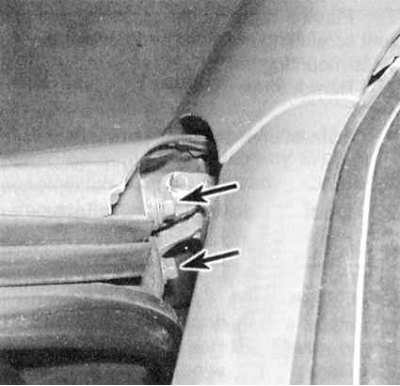
2. To adjust the door in the opening, loosen the hinge mounting bolts on the car body (see accompanying illustration). The door can be considered installed correctly when, in the closed position, its upper edge is parallel to the edge of the car roof; cutting edge (rear by the back door) the door should be flush with the wing surface, and the lower one should be flush with the threshold plane. If you cannot achieve the task by simply moving the door, you should select adjusting washers of the required thickness. The washers are placed under the hinge strips (both on the body and on the door) and can be purchased at automotive accessory stores.
3. Correct operation of the locking mechanism can be achieved by adjusting the position of the lock striker in the vertical direction (see illustration below). To estimate the amount of offset, circle the striker base plate with a marker. Loosen the fastener and make the necessary adjustments - the latch should engage with the central part of the striker.
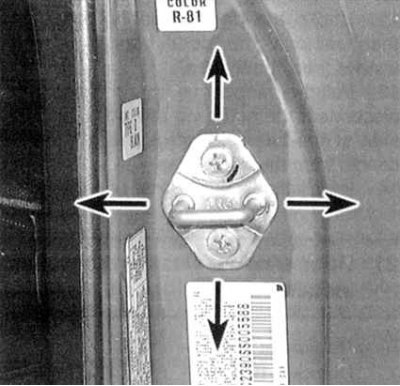
4. Finally, adjust the striker position horizontally – the closed door should be flush with the surface of the rear wing pillar/panel and lock properly (see accompanying illustration).