
Contents: Valve movement ⇊ Cylinder head non-flatness ⇊
Valve movement
Measure the valve guide-to-stem clearance with a dial indicator while rocking the stem in the direction of normal axial thrust (oscillation method).
Clearance between valve stem and valve guide of inlet valve:
- Standard value: 0.04 - 0.10 mm
- Limit value: 0.16 mm
Clearance between valve stem and valve guide of exhaust valve:
- Standard value: 0.10 - 0.16 mm
- Limit value: 0.22 mm
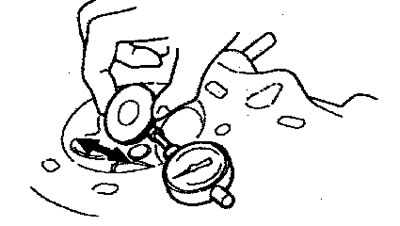
If the measurement still exceeds the limit, replace the valve and/or valve guide if necessary.
Note: An additional method for checking the guide is to subtract the measured outside diameter of the valve stem from the measured inside diameter of the valve guide. Measure at three locations along the length of the valve stem and three locations inside the valve guide. The difference between the largest guide measurement and the smallest stem measurement should not exceed the limit value.
Clearance between valve stem and valve guide of inlet valve:
- Standard value: 0.02 - 0.05 mm
- Limit value: 0.08 mm
Clearance between valve stem and valve guide of exhaust valve:
- Standard value: 0.05 - 0.08 mm
- Limit value: 0.11 mm
Cylinder head non-flatness
Caution: If the camshaft-to-retainer clearances are not within specification, the cylinder head cannot be reground.
If the camshaft-holder clearances are within the nominal value, check the cylinder head for flatness.
- If the flatness is less than 0.05 mm, regrinding of the cylinder head is not required.
- If the flatness is between 0.05 mm and 0.2 mm, regrind the cylinder head surface with a nougat grinder.
- The maximum value of non-flatness is 0.2 mm, with a height of 93 mm.
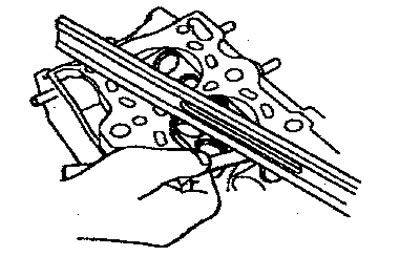
Take measurements in the directions shown in the figure.
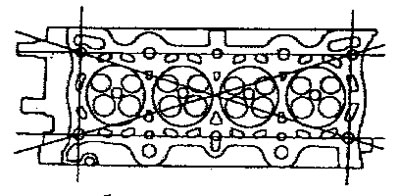
Cylinder head height:
- Nominal value: 92.95-93.05 mm
The original is located on the website: HondaBook