Attention:
- Do not rotate the camshaft during the check.
- Remove the rocker arms and rocker arm shafts.
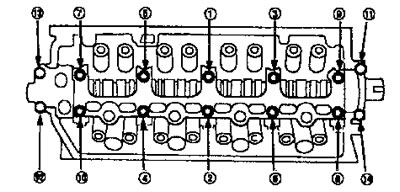
1. Place the camshaft and camshaft holders on the cylinder head, then tighten the bolts to the specification torque.
Tightening torque:
- Bolts 8 mm: 20 Nm
- Apply a coat of motor oil to the threads.
- Bolts 6 mm: 12 Nm
- Apply a coat of motor oil to the threads.
- Bolts 6 mm: No.11, No.12, No.13, No.14
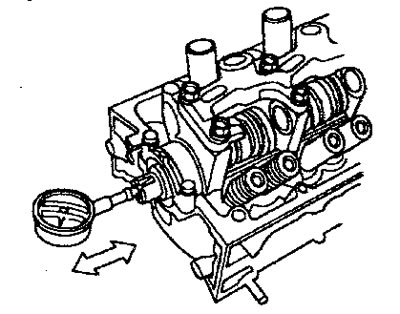
2. Position the camshaft, pressing it with force directed towards the rear of the cylinder head.
3. Set the dial indicator to zero against the end of the camshaft. Apply force to the camshaft in the axial direction (back and forth) and measure the axial clearance.
Axial clearance of the camshaft:
- Nominal value: 0.05 - 0.15 mm
- Limit value: 0.5 mm
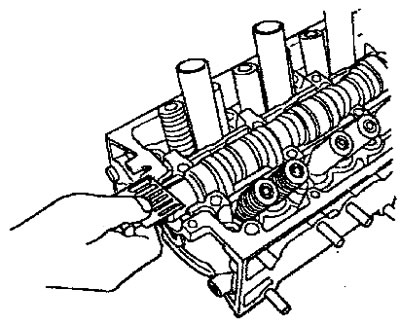
4. Remove the bolts, then remove the camshaft holders from the cylinder head,
- Remove the camshaft from the cylinder head. Wipe and clean the camshaft.
- Clean the camshaft bearing surfaces in the cylinder head and then hold the camshaft in place.
- Insert a strip of plastic gauge across each neck.
5. Install the camshaft holders and tighten (compress) the bolts to the specified torque.
6. Remove the camshaft holders, then measure the width of the plain bearing clearance tool on each journal at the widest part.
Clearance "camshaft - holder":
- Nominal value: 0.050 - 0.089 mm
- Limit value: 0.15 mm
7. If the gap "camshaft - holder" exceeds the limit value:
- And the camshaft has already been replaced, replace the cylinder head.
- If the camshaft has not been replaced, first check the camshaft runout on a test bench.
Camshaft runout:
- Standard value: 0.03 mm max
- Limit value: 0.04 mm
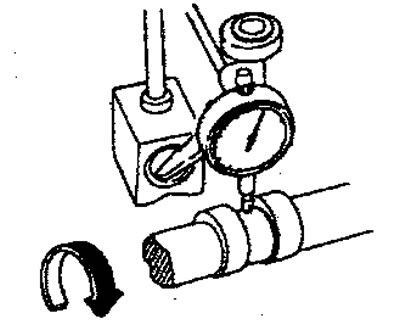
- If the camshaft runout is within the nominal value, replace the cylinder head.
- If the runout is out of the limit, replace the camshaft and recheck. If the bearing clearance is still out of the limit, replace the cylinder head.
8. Check the cam height.
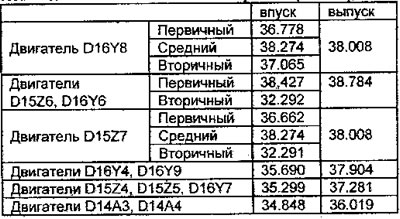
Nominal value of cam height (new), mm