
Contents: Rectifier Testing ⇊ Removal the rectifier (Mitsubishi) ⇊ Inspection of generator brushes ⇊ Checking the motor brush contacts ⇊ Stator check ⇊ Inspection and adjustment of the…⇊
Rectifier Testing
Nippon dense:
Note: The diodes are designed to pass current in one direction and block it in the other. Since the generator rectifier consists of eight diodes (four pairs), each diode must be tested for conductivity in both directions using an ohmmeter designed for testing a diode. A total of 16 measurements must be made.
1. Check the conductivity in each direction between:
- Contacts B and R.
- Contacts E (grounding) and R.
All diodes must conduct in one direction only.
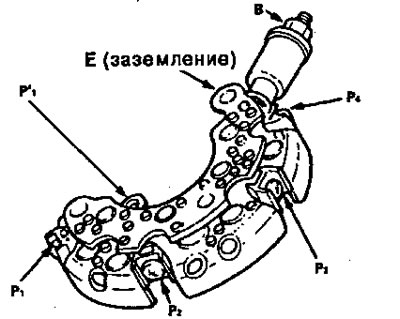
2. If any of the diodes are faulty, replace the rectifier assembly, (diodes are not available separately.)
Mitsubishi:
Note: Diodes are designed to pass current in one direction and block it in the other. Since the generator rectifier consists of nine (eleven) diodes, each diode must be tested for conductivity in both directions using an ohmmeter designed to test a diode. A total of 18 (22) measurements must be made, 1.
Check the conductivity in each direction between:
- Contacts B and R.
- Contacts B¹ and P (except P2)
- Contacts E (grounding) and R.
All diodes must conduct in one direction only.
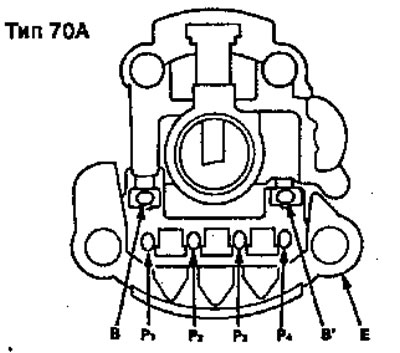
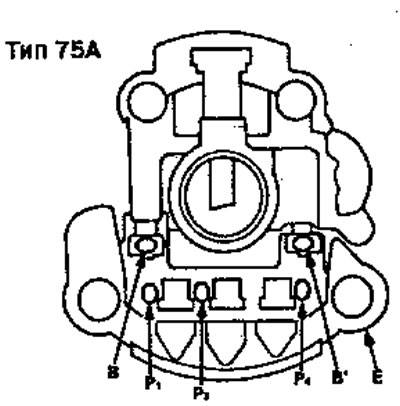
2. If any of the diodes are faulty, replace the rectifier assembly, (diodes are not available separately.)
Removal the rectifier (Mitsubishi)
1. Remove the four tie bolts.
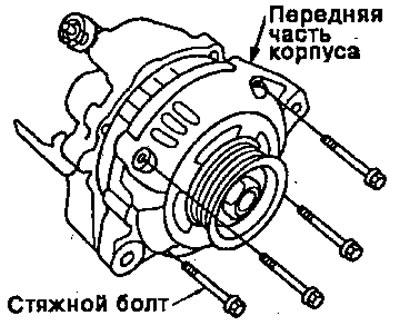
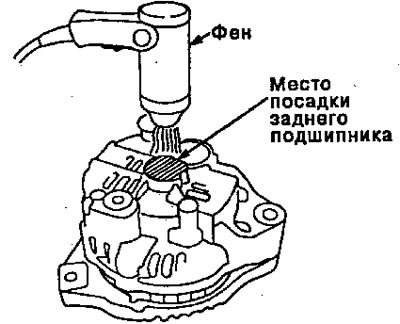
2. Heat the rear bearing seat with a hair dryer at 1000 W for 5 minutes (50-60°C).
3. Separate the back case from the front case by inserting flat-tip screwdrivers into the holes and pushing them apart.
Note: Be careful not to damage the stator with the tip of the screwdriver
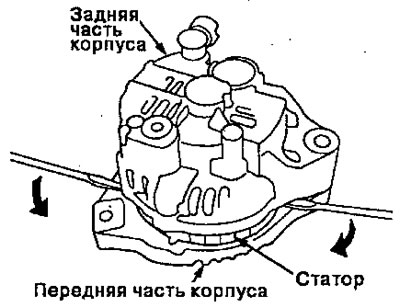
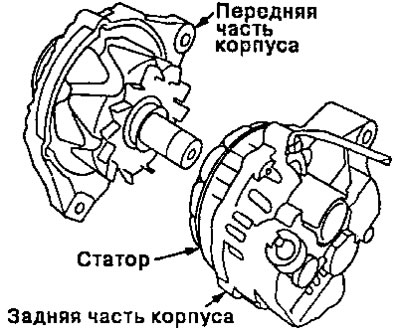
4. Separate the front and rear housings. NOTE: When separating the front and rear housings, the stator remains on the rear housing.
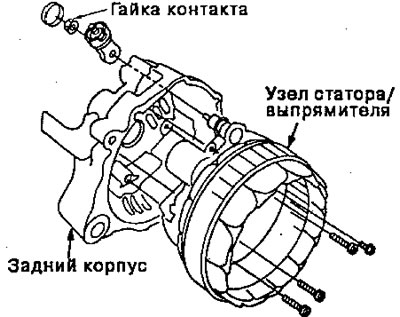
5. Separate the rear housing from the stator/rectifier assembly by removing the four screws and contact nut.
6. Unsolder the rectifier from the stator terminals.
- To avoid damaging the diodes due to high temperature, press the terminals with wire cutters to deflect (remove) the high temperature and use a soldering iron for as long as it takes to separate the terminals from the rectifier. (No longer).
- Use a 100W soldering iron.
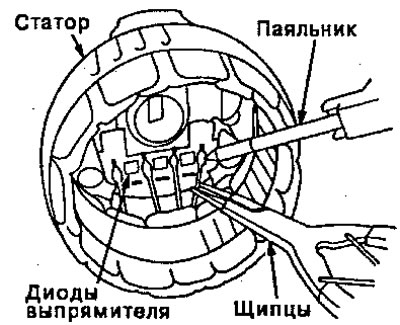
7. Install the new rectifier in the reverse order of removal.
- Use the soldering iron as long as necessary to ensure a good connection so that the high temperature does not damage the diodes.
- Use a flux such as rosin, otherwise the solder joints will corrode.
Inspection of generator brushes
Nippondenso:
1. Remove the cover, then pull out the brush retainer by removing its two screws.
2. Measure the length of the brushes using a caliper.
Generator brush length:

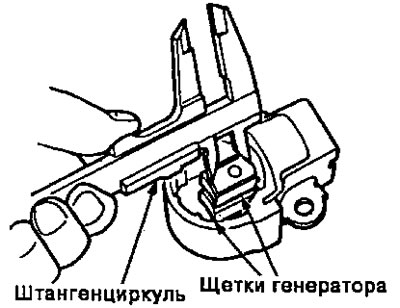
3. If the brush length is less than the specification, replace the generator brush assembly.
Mitsubishi:
1. Separate the front case from the back case.
2. Separate the rear housing from the rectifier/stator assembly by removing the four screws and contact nut from the rear housing.
3. Measure the length of the brushes with a caliper.
Generator brush length

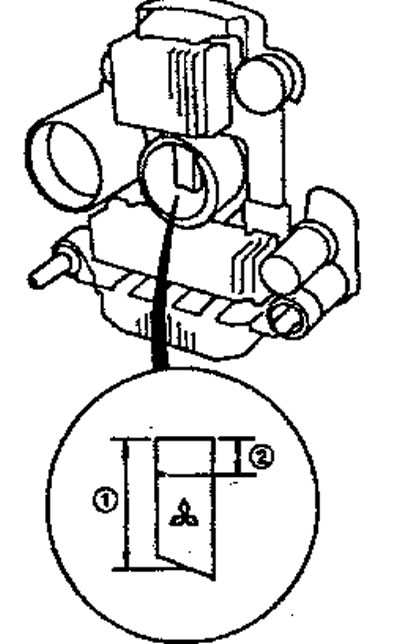
4. If the brush length is less than the specified operating values, replace them.
Checking the motor brush contacts
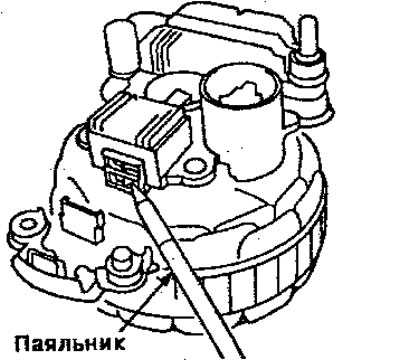
1. Check the resistance between the brush contacts.
The resistance should be 1.8-3.0 Ohm
- If the resistance is within specification, proceed to step 2.
- If the resistance is not within specification, replace the alternator.
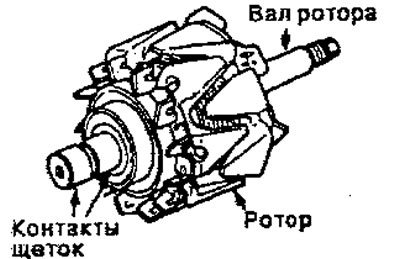
2. Check that there is no conductivity between the brush contacts and the rotor or rotor shaft.
3. If the rotor fails each of the continuity tests, replace the generator.
Stator check
1. Check that there is continuity between each pair of terminals.
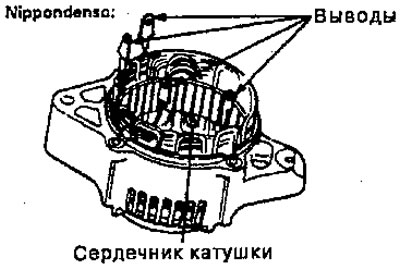
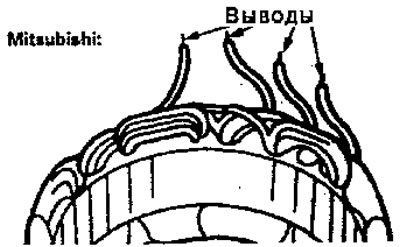
2. Check that there is no continuity between each terminal and the coil core.
3. If the coil fails each of the tests, replace the generator.
Inspection and adjustment of the alternator belt
Deviation measurement method:
Apply a force of 98 N (10 kgf) and measure the deviation between the generator and crankshaft pulleys.
Deviation: 7-10 mm
Note: The new belt (who worked for no more than five minutes), the deviation should be 5.0-8.0 mm when first measured. If the belt is worn or damaged, replace it.
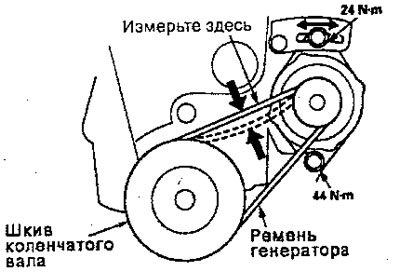
If adjustment is necessary:
1. Loosen the lower mounting nut and the upper mounting bolt.
2. Move the generator to obtain the required belt tension, then tighten the upper mounting bolt and lower mounting nut to the rated torque.
3. Check the belt tension again.