
HondaBook.ru
Auto companies Volkswagen Auto companies Ford Auto companies Lada Auto companies Skoda Auto companies BMW Auto companies Mazda Auto companies Peugeot
English Русский
Български
Беларускі
Український
Српски
Hrvatski
Română
Polski
Slovenský
Magyar
Bookmark Contacts Sitemap   


Accord Civic Fit / Jazz CR-V HR-V Others Articles
Civic 3 and 4 (1983-1991) Civic 5 and 6 (1991-2000) Civic 6 (1995-2000) Civic 7 (2000-2005) Civic 8 (2005-2011)

Piston/Connecting Rod — Installing and Checking the Clearance in the Connecting Rod Bearing (Honda Civic 3)

  • Main
  • Honda Civic
  • 3 (1983-1991)
  • Power unit
  • Engine overhaul
  • Piston/Connecting Rod — Installing and Checking the Clearance in the Connecting Rod Bearing
0
1. Before installing the piston group, thoroughly clean the cylinder walls, make sure there is a lead-in chamfer at the top of the cylinder. In engines with individual main bearing caps with an oil bridge, first install the pistons, and then the main bearing caps.

2. Remove the connecting rod cover, dismantle the old bearings and wipe the surfaces with a clean, lint-free cloth.

Checking the clearance in the connecting rod bearing


3. Wipe the back of the upper bearing shell and install the shell into the connecting rod. There is no need to lubricate the bearing at this stage.

4. Do the same with the connecting rod cap liner. Make sure that the liner retainers are installed in their sockets. When changing the clearance, it is extremely important that there is no oil in the bearing.

5. Spread the piston ring locks as shown in Fig. 24.5.
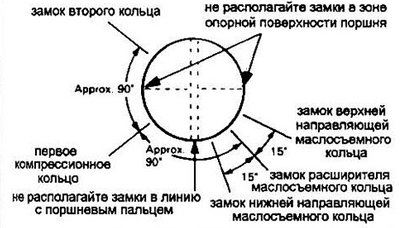
Fig. 24.5 Position of ring locks on the piston

Fig. 24.5 Position of ring locks on the piston


6. Place pieces of plastic or rubber tube on the connecting rod bolts to prevent mechanical damage to the surfaces.

7. Lubricate the piston and rings with clean oil and compress the rings with a mandrel until the rings are tightly seated in the grooves.


8. Set the crankshaft to the bottom dead center of the corresponding cylinder and lubricate its walls with oil.

9. Orient the piston relative to the front of the engine using the arrow or marks on the piston head, carefully insert the connecting rod and piston into the cylinder until they stop against the mandrel.
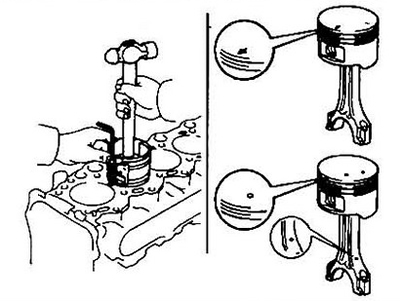
Fig. 24.9 Left. Installing the piston. Use a…

Fig. 24.9 Left. Installing the piston. Use a wooden or plastic hammer handle.
Right. The small holes on the piston and connecting rod should be on the intake manifold side. If there is an arrow on the piston, it should point to the front of the engine


10. Make sure the mandrel is in contact with the block surface all around.

11. Using light blows from the hammer handle, lower the piston into the cylinder until the connecting rod bearing seats on the shaft. When installing the piston, make sure that the rings do not jump out of the mandrel. In this case, stop assembly immediately to avoid breakage of the rings. And in any case, do not use force during installation.

12. The next step is to measure the bearing clearance.

13. Cut a suitable piece of plastic gauge and place it on the shaft journal, parallel to its axis.


14. Clean the bearing surface in the cap. Remove the protective tubes from the bolts and install the connecting rod cap. Pay attention to the orientation of the cap.

15. Tighten the cap in three steps to the torque specified in the specification. Note: Use a thin-walled socket to tighten to avoid jamming the tool. Do not rotate the shaft when measuring the clearance.

16. Remove the cover, being careful not to damage the gauge.

17. Measure the gap size using the scale on the gauge packaging and compare the result with the recommended specification.

18. If the measurement result is unsatisfactory, measure the journal size again and select the correct insert. If the gauge has different widths at the ends, the journal is tapered (see item 18). Final installation of the connecting rod.

19. Carefully remove any remaining gauge from the neck.

20. Wipe the bearing surfaces clean and lubricate them with engine oil. Remember to put the protective caps on the connecting rod bolts when lifting the piston to access the upper half of the bearing.

21. Lower the piston until the bearing rests against the shaft, remove the protective caps, install the connecting rod cover and tighten the nuts in three steps.

22. Repeat the entire procedure for the remaining pistons.

23. Remember:
  • a) The back surfaces of the liners and the corresponding surfaces must be absolutely clean.
  • b) Do not swap pistons.
  • c) the arrow on the piston should point to the front of the engine, the recesses should be on the side of the intake manifold.
  • d) lubricate the cylinder walls with clean oil.
  • d) Lubricate the bearings after completing the clearance measurement procedure.
  • e) correctly orient the connecting rod cap relative to its rod.

24. After completing the installation of the piston group, turn the engine by hand several times.


25. The final operation is to check the axial clearance of the connecting rod, see section 12.

26. Install the main bearing caps (see section 22).
This article is available at: russian, bulgarian, belarusian, ukrainian, serbian, croatian, romanian, polish, slovak, hungarian
This information has been verified: Yaroslav Shiryaev
Share with friends:
◀ Previous
Civic 3 and 4: Engine overhaul
Next ▶

Installing the rear oil seal
Crankshaft — installation and checking of bearing clearance
Piston rings — installation
Engine Repair — Assembly Sequence
Main and connecting rod bearings — inspection and rejection
First engine start after repair
See also other articles from Honda manuals:
Installing connecting rod and piston assemblies and checking working… Honda Accord 6 (1997-2002)
Checking the axial clearance of the connecting rod and crankshaft Honda Fit 1 (2001-2008)
Checking the connecting rod bolts Honda CR-V 2 (2002-2006, petrol)
Piston and connecting rod — design description Honda HR-V 1 (1998-2006, petrol)
Checking wheels/hubs — bearing axial play Honda Avancier 1 (1999-2003, petrol)
Link in different formats to this article
Comments and feedback from visitors
No comments yet


How much will 30 + 17 ?


Civic 8 (2005-2011) 
  • General information
  • Technical data
  • Governing bodies
  • Driving and maintenance
  • Power unit
  • Gasoline engines (L13A)
  • Gasoline engines (R18A)
  • Diesel engines (N22A)
  • Cooling and lubrication (L13A)
  • Cooling and lubrication (R18A)
  • Cooling and lubrication (N22A)
  • Injection system (gasoline)
  • Injection system (diesel)
  • Toxicity reduction system
  • Troubleshooting
  • Transmission
  • Clutch and drive shafts
  • Mechanical gearbox
  • Chassis and running gear
  • Suspension and wheels
  • Steering
  • Brake system
  • Body and interior
  • Exterior (external elements)
  • Doors, locks and windows
  • Electrical equipment
  • Equipment and devices
  • Headlights and lighting
  • Power devices
  • Electrical circuits
Civic 7 (2000-2005) 
  • General information
  • User manual
  • Maintenance
  • Power unit
  • Engines D15B and D17A
  • K20A Engines
  • Overhaul engine
  • Cooling system
  • Lubrication system
  • Fuel injection system
  • Toxicity reduction system
  • Engine electrical equipment
  • Transmission
  • Clutch
  • Manual gearbox
  • Automatic gearbox
  • Variator (CVT)
  • Drive shafts
  • Chassis and running gear
  • Car suspension
  • Steering
  • Brake system
  • Body and interior
  • Exterior (external elements)
  • Interior (internal elements)
  • Doors, locks and windows
  • Heater and air conditioner
  • Manual air conditioner
  • Automatic air conditioner
  • Security system
  • Electrical equipment
  • Equipment and devices
  • Headlights and lighting
  • Windscreen wipers
  • Audio system
  • Electrical diagrams
Civic 6 (1995-2000) 
  • General information
  • Introduction to guide
  • User manual
  • Maintenance
  • Power unit
  • Engine in car (Civic)
  • Engine in car (Integra)
  • Engine overhaul
  • Cooling and heating
  • Power and exhaust systems
  • Engine electrical equipment
  • Engine management systems
  • Transmission
  • Manual gearbox
  • Automatic transmission (AT/CVT)
  • Clutch and drive shafts
  • Chassis and running gear
  • Brake system
  • Car suspension
  • Steering
  • Body and interior
  • Exterior (external elements)
  • Interior (internal elements)
  • Doors, locks and windows
  • Electrical equipment
  • Equipment and devices
  • Electrical circuits
Civic 5 and 6 (1991-2000) 
  • Power unit
  • SOHC engines
  • DOHC engines
  • Engine overhaul
  • Cooling and lubrication system
  • Intake and exhaust system
  • Fuel injection system (SOHC)
  • Fuel injection system (DOHC)
  • Carburetor
  • Transmission
  • Clutch
  • Manual gearbox S4C
  • Manual gearbox S40
  • Automatic gearbox
  • Drive shafts
  • Chassis and running gear
  • Car suspension
  • Steering
  • Brake system
  • Body and interior
  • Body elements
  • Heater and air conditioner
  • Electrical equipment
  • Power devices
  • Equipment and instruments
  • Electrical circuits
Civic 3 and 4 (1983-1991) 
  • General information
  • Maintenance
  • Power unit
  • Engine in a car
  • Engine overhaul
  • Cooling system
  • Power and exhaust system
  • Engine electrical equipment
  • Emission control system
  • Transmission
  • Mechanical gearbox
  • Automatic gearbox
  • Clutch and drive shafts
  • Four-wheel drive
  • Chassis and running gear
  • Brake system
  • Car suspension
  • Steering
  • Body and interior
  • Body elements
  • Electrical equipment
  • Equipment and devices
  • Electrical circuits
HondaBook.ru © 2018–2026 • Mobile version • Sitemap: EN BG BY UA RS HR RO PL SK HU • Feedback • Driver Information • Search system • Bookmark
Accord 3 (1985-1989) • Accord 6 (1997-2002) • Civic 3 and 4 (1983-1991) • Civic 5 and 6 (1991-2000) • Civic 6 (1995-2000) • Civic 7 (2000-2005) • Civic 8 (2005-2011) • Fit 1 (2001-2008) • CR-V 1 (1995-2001) • CR-V 2 (2002-2006) • HR-V 1 (1998-2006) • Avancier 1 (1999-2003) •
 
This website uses cookies to ensure proper functioning. By clicking "OK," you agree.