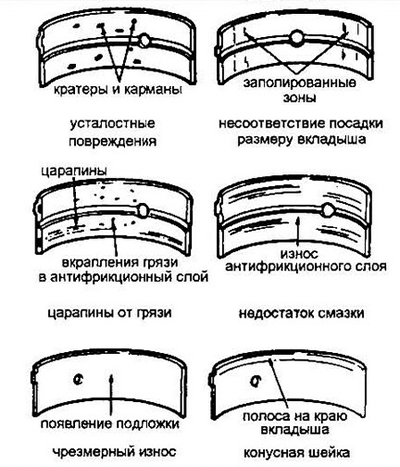
Fig. 19.1 Typical pictures of bearing damage
2. Bearing failures occur due to lack of lubricating oil, dirt and other foreign particles, engine overload and corrosion. Regardless of the cause of bearing failure, it must be identified and eliminated before engine assembly.
3. To inspect the bearings, place them on a flat and clean surface in the same order as they are on the engine. This is necessary in order to correctly identify the main or connecting rod journals that have defects.
4. Dirt and other foreign particles can enter the engine in a variety of ways: during assembly, through filters or the crankcase ventilation system. Solid particles damage the bearing surface. Large foreign particles cannot be removed by oil and make grooves in the bearing and shaft journal. The best protection against such damage is clean assembly and frequent filter changes.
5. Insufficient lubrication flow through bearings can be caused by a number of interrelated factors, such as engine overheating (reduction of oil viscosity), overload (squeezing oil out of the gap), excessive leaks through the bearing with a large clearance in it, wear of the oil pump and frequent operation at high speeds. Rarely, but mechanical blocking of oil channels occurs due to misalignment of holes in the block and in the bearing.
Lack of lubrication leads to abrasion or displacement of the antifriction coating of the bearings, and local heating can lead to the appearance of tempering colors on the steel substrate of the bearing.
6. The durability of bearings is also affected by the riding style. Driving at low speed with the throttle fully open (i.e. untimely switching to a higher gear) leads to bearing overload and a tendency to thinning of the bearing oil layer is observed. Such loads strongly bend the bearing, leading to the appearance of a network of fatigue cracks. At the same time, the antifriction layer can crumble. Frequent short-distance travel leads to bearing corrosion (condensation of moisture and corrosive gases on unheated massive parts) Condensation products accumulate in the mass, forming a fairly significant amount of acids.
7. Dirty assembly, excessive force during bearing assembly, incorrect orientation of the liners lead to quick and certain failure.
Rejection
8. If the bearings you removed are worn or damaged or the bearing clearance is outside the acceptable range (see paragraphs 22 and 23) we offer below the following procedure for selecting new bearings. This procedure does not apply to the case of regrinding the shaft to a repair size - here the installation of repair liners is simply mandatory.
Main bearings
9. When setting the nominal size of the bearing, make sure that the color code of the old and new bearing match. The color code is marked on the rib of the bearing shell.
10. If the bearing color code is lost, it can be restored using the marks stamped on the block on the side where the clutch housing is connected or on the mating surface of the oil pan.
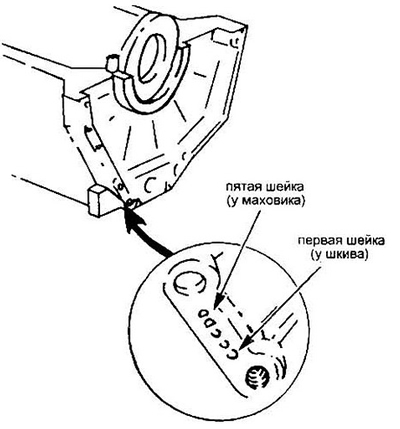
Fig. 19.10 Codes for the dimensions of the crankshaft bed diameters (letters)
11. The location of the main bearing diameter codes is shown in Figure 19.11.
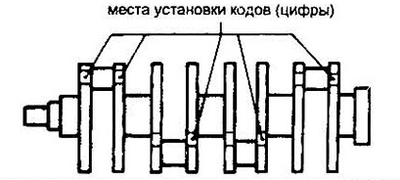
Fig. 19.11 Crankshaft main journal size codes
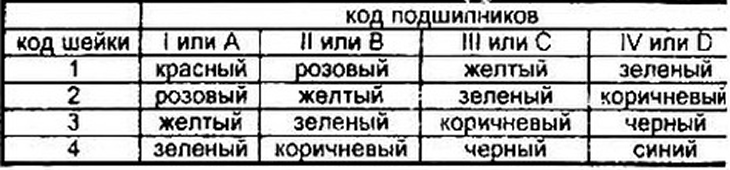
12. Select bearings according to the table in Fig. 19.12.
Fig. 19.12 Selecting the bearing color code using the buoy or Roman numerals on the block and Arabic numerals on the crankshaft. For example: the combination C3 gives brown.
Horizontal arrow: decrease in liner thickness, increase in shaft bed diameter.
Vertical arrow: neck reduction, liner thickness reduction.
Connecting rod bearings
13. When installing the nominal size insert, pay attention to the color code.
14. If the color code of the old bearing is lost, refer to the side surface of the connecting rod bearing cap for information.
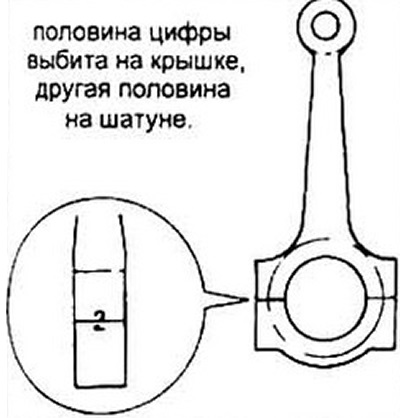
Fig. 19.14 Connecting rod bearing bore size code. Not a connecting rod serial number
15. In Fig. 19.15 you will find the places where the diameter code of the corresponding crank pin is entered (keep in mind that these are not neck numbers).
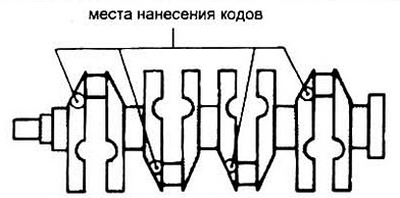
Fig. 19.15 Crankpin size codes (letters)
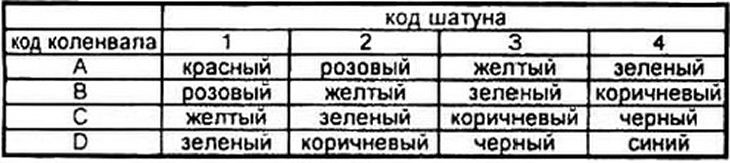
16. Using the table in Fig. 19.16, determine the color code of the bearing for each connecting rod journal.
Fig. 19.16 Search for the required connecting rod bearing code using the numbers on the connecting rod and the letters on the shaft. Example D4 - blue.
Horizontal arrow: increase in connecting rod diameter, thinner bearing.
Vertical arrow: reduction in neck diameter, thinning of the liner.
All bearings
17. Remember that the final bearing size selection is determined by the bearing clearance.
18. Note: After assembling the engine with new bearings, the engine should be warmed up at idle speed to operating temperature and run in this mode for 15 minutes.