
HondaBook.ru
Auto companies Volkswagen Auto companies Ford Auto companies Lada Auto companies Skoda Auto companies BMW Auto companies Mazda Auto companies Peugeot
English Русский
Български
Беларускі
Український
Српски
Hrvatski
Română
Polski
Slovenský
Magyar
Bookmark Contacts Sitemap   


Accord Civic Fit / Jazz CR-V HR-V Others Articles
Civic 3 and 4 (1983-1991) Civic 5 and 6 (1991-2000) Civic 6 (1995-2000) Civic 7 (2000-2005) Civic 8 (2005-2011)

Checking the condition and replacing fuel lines and their fittings (Honda Civic 6)

  • Main
  • Honda Civic
  • 6 (1995-2000)
  • Power unit
  • Power and exhaust systems
  • Checking the condition and replacing fuel lines and their fittings
0
Contents: Steel tubes ⇊ Flexible hoses ⇊
Warning! See warnings at the beginning Relieving pressure in the fuel system.


1. Before servicing the fuel lines or their fittings, it is necessary to relieve the pressure in the fuel system (see Relieving pressure in the fuel system).

2. The fuel lines of the fuel system are laid between the gas tank and the engine compartment. Steel tubes and flexible fuel hoses are attached to the bottom of the car with clamps and screw fasteners. Every time the car is raised above the ground for any purpose (for example, to inspect or replace components of the exhaust system), try to take advantage of the opportunity and check the condition of the fuel lines and their fittings. Carefully inspect all hoses and tubes of the fuel system for cracks, twists, deformations and other damage.

3. If signs of internal contamination or obstruction are detected, the corresponding section of the fuel line must be removed and blown out with compressed air. It is also necessary to check the condition of the mesh filter of the fuel flow sensor (see Removal and installation the fuel pump).

Steel tubes


1. Use only high-strength steel tubes from well-known manufacturers as replacement sections.

2. Remember that copper and aluminum tubes are not able to withstand vibration loads that occur during vehicle operation.

3. Remember that fuel lines on models equipped with injection systems must withstand high internal pressure.

4. Often, sections of metal tubes equipped with threaded nipples can be purchased in branded car accessory stores. When loosening and tightening nipple connections, use two wrenches to avoid turning the mating part of the connector. Be sure to check the condition of the sealing rings used to seal the nipple connections. Replace worn or mechanically damaged rings immediately. Try to use only branded parts as replacement components.


Flexible hoses


Caution: When replacing fuel hoses, use only original components designed for high internal pressure.
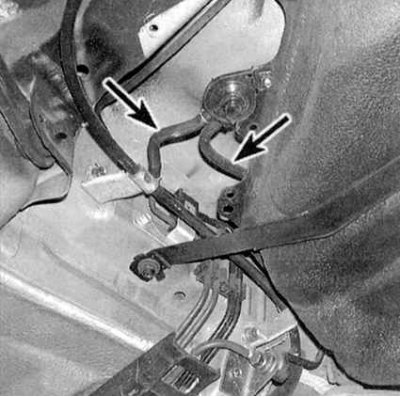

Caution: When replacing fuel hoses, use only…


1. Flexible fuel hoses must be installed no closer than 10 cm from the exhaust system components and no closer than 25 cm from the catalytic converter. Make sure that the fuel lines do not come into contact with the bodywork and suspension components (see accompanying illustration). The minimum allowable gap is 6.3 mm.

Removal and installation


1. Relieve the pressure in the fuel system (see Relieving pressure in the fuel system).

2. Release the section of the fuel line to be removed from the intermediate fasteners securing it to the bottom of the vehicle.

3. Loosen the clamps securing the rubber hoses to the steel pipes of the fuel system. To disconnect the hose, rotate it on the pipe.
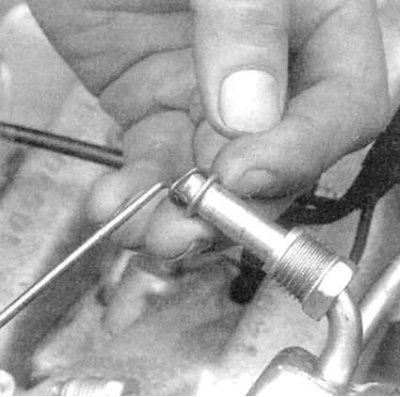
3. Loosen the clamps securing the rubber hoses to…


4a. Installation is carried out in the reverse order. Do not forget to replace the sealing rings of the threaded nipple connections.
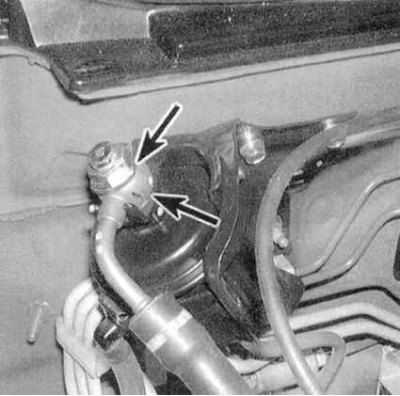


4a. Installation is carried out in the reverse…


4b. The sealing washers of the hollow bolt of the union nut on the fuel filter must also be replaced without fail (see accompanying illustrations).

Repair


Damaged sections of fuel lines (tubes or hoses) must be removed and replaced with new ones, of brand production.

[Material obtained from the website «HONDABOOK.ru»]
This article is available at: russian, bulgarian, belarusian, ukrainian, serbian, croatian, romanian, polish, slovak, hungarian
This information has been verified: Timofey Goryachev
Share with friends:
◀ Previous
Civic 6: Power and exhaust systems
Next ▶

Checking the proper functioning of the fuel pump / fuel pressure
Relieving pressure in the fuel system
Power and exhaust system specifications
Location of fuel system components in the engine compartment
Fuel and exhaust systems — general information
Removal and installation the fuel pump
Checking the condition and replacing the fuel flow sensor
Removal and installation the fuel tank
Fuel Tank Cleaning and Repair — General Information
Removal and installation the air cleaner assembly
See also other articles from Honda manuals:
Checking the condition and replacing fuel lines Honda Accord 6 (1997-2002)
Checking tire pressure and condition Honda Fit 1 (2001-2008)
Checking fuel lines Honda CR-V 2 (2002-2006, petrol)
Fuel lines of the power supply system Honda HR-V 1 (1998-2006, petrol)
Checking fuel lines Honda Avancier 1 (1999-2003, petrol)
Link in different formats to this article
Comments and feedback from visitors
No comments yet


How much will 46 + 15 ?


Civic 8 (2005-2011) 
  • General information
  • Technical data
  • Governing bodies
  • Driving and maintenance
  • Power unit
  • Gasoline engines (L13A)
  • Gasoline engines (R18A)
  • Diesel engines (N22A)
  • Cooling and lubrication (L13A)
  • Cooling and lubrication (R18A)
  • Cooling and lubrication (N22A)
  • Injection system (gasoline)
  • Injection system (diesel)
  • Toxicity reduction system
  • Troubleshooting
  • Transmission
  • Clutch and drive shafts
  • Mechanical gearbox
  • Chassis and running gear
  • Suspension and wheels
  • Steering
  • Brake system
  • Body and interior
  • Exterior (external elements)
  • Doors, locks and windows
  • Electrical equipment
  • Equipment and devices
  • Headlights and lighting
  • Power devices
  • Electrical circuits
Civic 7 (2000-2005) 
  • General information
  • User manual
  • Maintenance
  • Power unit
  • Engines D15B and D17A
  • K20A Engines
  • Overhaul engine
  • Cooling system
  • Lubrication system
  • Fuel injection system
  • Toxicity reduction system
  • Engine electrical equipment
  • Transmission
  • Clutch
  • Manual gearbox
  • Automatic gearbox
  • Variator (CVT)
  • Drive shafts
  • Chassis and running gear
  • Car suspension
  • Steering
  • Brake system
  • Body and interior
  • Exterior (external elements)
  • Interior (internal elements)
  • Doors, locks and windows
  • Heater and air conditioner
  • Manual air conditioner
  • Automatic air conditioner
  • Security system
  • Electrical equipment
  • Equipment and devices
  • Headlights and lighting
  • Windscreen wipers
  • Audio system
  • Electrical diagrams
Civic 6 (1995-2000) 
  • General information
  • Introduction to guide
  • User manual
  • Maintenance
  • Power unit
  • Engine in car (Civic)
  • Engine in car (Integra)
  • Engine overhaul
  • Cooling and heating
  • Power and exhaust systems
  • Engine electrical equipment
  • Engine management systems
  • Transmission
  • Manual gearbox
  • Automatic transmission (AT/CVT)
  • Clutch and drive shafts
  • Chassis and running gear
  • Brake system
  • Car suspension
  • Steering
  • Body and interior
  • Exterior (external elements)
  • Interior (internal elements)
  • Doors, locks and windows
  • Electrical equipment
  • Equipment and devices
  • Electrical circuits
Civic 5 and 6 (1991-2000) 
  • Power unit
  • SOHC engines
  • DOHC engines
  • Engine overhaul
  • Cooling and lubrication system
  • Intake and exhaust system
  • Fuel injection system (SOHC)
  • Fuel injection system (DOHC)
  • Carburetor
  • Transmission
  • Clutch
  • Manual gearbox S4C
  • Manual gearbox S40
  • Automatic gearbox
  • Drive shafts
  • Chassis and running gear
  • Car suspension
  • Steering
  • Brake system
  • Body and interior
  • Body elements
  • Heater and air conditioner
  • Electrical equipment
  • Power devices
  • Equipment and instruments
  • Electrical circuits
Civic 3 and 4 (1983-1991) 
  • General information
  • Maintenance
  • Power unit
  • Engine in a car
  • Engine overhaul
  • Cooling system
  • Power and exhaust system
  • Engine electrical equipment
  • Emission control system
  • Transmission
  • Mechanical gearbox
  • Automatic gearbox
  • Clutch and drive shafts
  • Four-wheel drive
  • Chassis and running gear
  • Brake system
  • Car suspension
  • Steering
  • Body and interior
  • Body elements
  • Electrical equipment
  • Equipment and devices
  • Electrical circuits
HondaBook.ru © 2018–2026 • Mobile version • Sitemap: EN BG BY UA RS HR RO PL SK HU • Feedback • Driver Information • Search system • Bookmark
Accord 3 (1985-1989) • Accord 6 (1997-2002) • Civic 3 and 4 (1983-1991) • Civic 5 and 6 (1991-2000) • Civic 6 (1995-2000) • Civic 7 (2000-2005) • Civic 8 (2005-2011) • Fit 1 (2001-2008) • CR-V 1 (1995-2001) • CR-V 2 (2002-2006) • HR-V 1 (1998-2006) • Avancier 1 (1999-2003) •
 
This website uses cookies to ensure proper functioning. By clicking "OK," you agree.