
Contents: General checks ⇊ Checking the pressure characteristic…⇊ Checking the fuel pump electrical…⇊
Warning! See warnings at the beginning Relieving pressure in the fuel system.
Note: To check the fuel pressure, you will need a special pressure gauge with a wide scale range and an adapter to connect the pressure gauge to the injection system.
General checks
1. Make sure there is enough fuel in the gas tank.
2. Make sure the fuel pump is actually working. Ask an assistant to turn the ignition on by turning the key to the ON position – the characteristic sound of a working pump should be heard in the gas tank for two seconds.
Note: The pump can be heard running through the open fuel tank neck. If the pump does not turn on, proceed directly to checking its electrical circuit(see paragraph 9).
Checking the pressure characteristic of the fuel pump
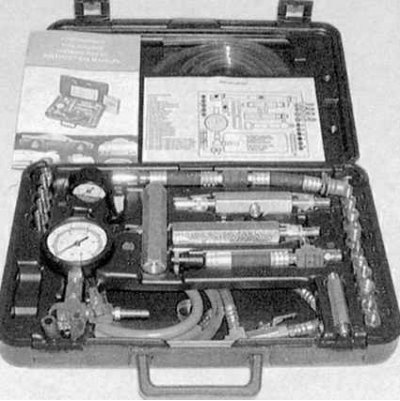
1a. Connect a special pressure gauge to the test nipple on the fuel filter (see accompanying illustrations).
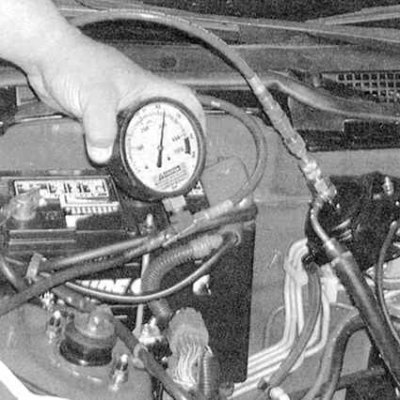
1b. The adapter is screwed into the hole for installing the service bolt (models up to 1996.), or instead of a hollow bolt of a nipple connection (models since 1997.) (cm. Relieving pressure in the fuel system).
2. Turn the ignition key to the ON position (without starting the engine), make sure the K/V is off. The fuel pump will turn on for a couple of seconds – the pressure in the fuel system should rise (check the pressure gauge reading) and stabilize.
3. Start the engine and warm it up at idle speed to normal operating temperature. Compare the pressure gauge reading with the requirements Specifications. Now disconnect the vacuum hose from the fuel pressure regulator - the pressure should immediately rise, again to the specified value Specifications values.
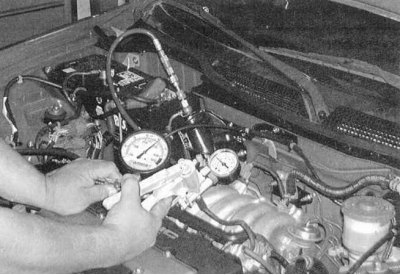
4. If the pressure exceeds the norm when the vacuum hose is connected, use a hand vacuum pump (see accompanying illustration) create a vacuum of 305÷355 mm Hg in the regulator. If the pressure drops, check the proper functioning of the vacuum source, otherwise replace the regulator.
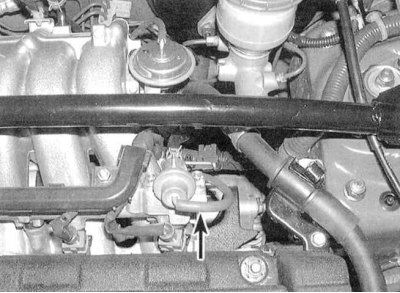
5. If the pressure measurement results are outside the acceptable range, perform the following checks:
- a) If the pressure is excessively high, check that the supply to the vacuum regulator is working properly (see accompanying illustration). The vacuum depth should fluctuate with engine speed. If vacuum is present, check the condition and patency of the fuel return hose/tube. If the return line is OK, replace the regulator.
- b) If the pressure is too low, replace the fuel filter, eliminating the possibility of its blockage. If replacing the filter does not help to correct the situation, install a shut-off valve in the section between the regulator and the return fuel line (instead of a valve, you can install a piece of flexible hose, which can easily be clamped with pliers or a clamp). Start the engine and begin to slowly close the valve/pinch the hose. If the pressure rises above 3.2 kgf/cm², replace the regulator (see Removal and installation the throttle body).
Caution! Do not allow the pressure to rise above 4.2 kgf/cm². Do not pinch the return fuel line itself to avoid the risk of damaging it.
- c) If the pressure remains excessively low even with the return line closed, check the injection injector for leaks (see Removal and installation of fuel line and fuel injectors fuel injectors). Also check the serviceability of the fuel pump.
6. After completing the check, release the pressure (see Relieving pressure in the fuel system) and disconnect the pressure gauge.
Checking the fuel pump electrical circuit
Note: For more detailed information on the fuel pump electrical circuit diagram, refer to Chapter On-board electrical equipment.
1. If the fuel pump does not function when the ignition is turned on (no characteristic sounds are heard from the gas tank), check the condition of the fuse of the main (PGM-FI) relay of the injection system (see Chapter On-board electrical equipment). Replace the blown fuse and retest. If the pump starts working after replacing the fuse, check the wiring of its circuit for signs of a short circuit between the PGM-FI relay and the pump.
2. If replacing the fuse does not restore the pump to operation, check for proper power supply to the pump. Remove the rear seat and check for battery voltage at the pump connector in the service cover of the pump/fuel flow sensor assembly. If power is present, replace the pump.
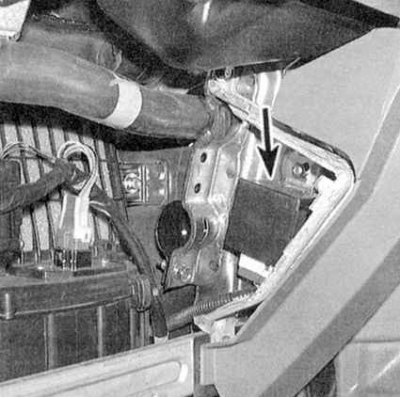
3a. If the pump is not powered, check the PGM-FI relay circuit. Have an assistant cycle the ignition switch from OFF to ON and back several times (without starting the engine). Watch for battery voltage to appear on the relay connector. Civic models - the relay is located on the right under the fairing.
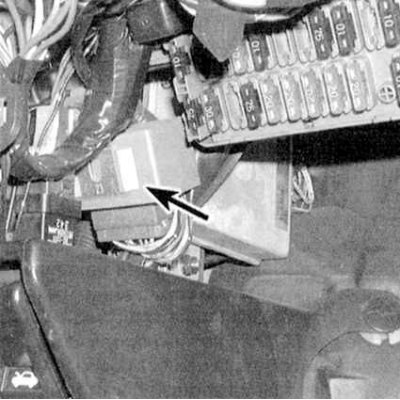
3b. Integra models - the relay is located on the left under the fairing.
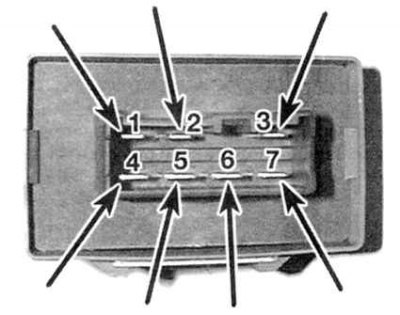
3s. When the ignition is on, voltage should be supplied to terminals 5 and 7 (see accompanying illustrations). If power is not supplied, check the circuit for opens or shorts (see the electrical connection diagrams in Chapter On-board electrical equipment of this Guide).
Note: On some models, if the oil pressure drops below a certain set value, the oil pressure switch will act as a shut-off valve, shutting off the fuel supply - check the switch and its wiring (see the electrical connection diagrams in Chapter On-board electrical equipment).
Note: The anti-theft alarm system is designed to immobilize the fuel supply. If the system fails, the engine will not start. Also check the anti-theft alarm circuit.
4. If the power supply is correct, remove the relay for testing. Using a jumper wire, connect the positive battery terminal to terminal 2 of the relay socket. Ground terminal 1. Then use an ohmmeter to check for continuity between terminals 4 and 5. If there is no continuity, replace the relay.
5. If there is continuity, connect the positive battery terminal to terminal 5 of the relay, ground terminal 3. Now there should be continuity between terminals 6 and 7, otherwise replace the relay.
6. If continuity is present, apply power to terminal 6, ground terminal 1, and check for continuity between terminals 4 and 5. If there is no continuity, replace the relay.
The original can be found on the resource: hondabook