
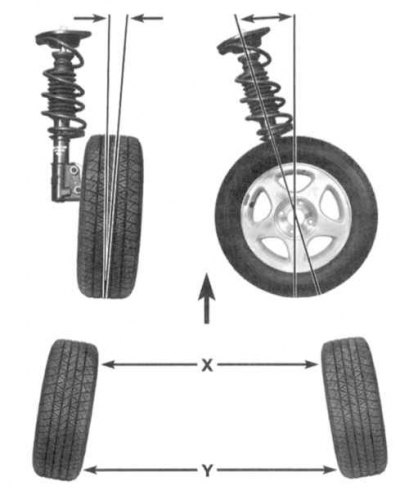
Only one of the parameters is subject to adjustment – toe-in, both for the front and rear wheels of the car. The values of camber and run-out of the front wheels should be checked on a regular basis to assess the degree of wear of the suspension and steering components.
Wheel alignment is one of those procedures that require particularly precise measurements, and for high-quality performance it is necessary to have special, rather bulky and expensive equipment. It is best to entrust this work to professional mechanics at a car service center. Below, for general understanding, are definitions of each of the controlled wheel alignment angles of a car, knowledge of which will facilitate communication between the car owner and the car service personnel.
Convergence is the amount of convergence of the front edges of the car wheels. Such a violation of the parallelism of the wheel installation helps to minimize tread wear due to skidding when turning. With zero toe-in, the distance between the front edges of the wheels is equal to the distance between their rear edges. Normal toe-in (X - Y) - see illustration - usually does not exceed fractions of an inch (1 inch = 2.54 cm). Adjustment of the front wheel toe-in is carried out by adjusting the length of the steering rods. To adjust the rear wheel toe-in, you should adjust the position of the suspension compensating arms in their brackets on the bottom of the car. Violation of the toe-in adjustment leads to accelerated wear of the tire treads due to their slipping on the road surface.
Collapse is the angle of the plane of the wheels relative to the vertical. If the wheels are tilted with their upper edges outward, the camber is called positive, and vice versa. The camber value is measured in degrees. Correct camber adjustment determines the size and position of the contact patch of the treads with the road and allows for compensation for changes in the suspension geometry when turning and when the car is moving on uneven road surfaces.
Run-out is called the angle of deviation from the vertical of the axis of rotation of the wheel in the plane of the latter. If the axis of rotation is tilted backwards, the runout is called positive, vice versa.
| Characteristic | Meaning |
Front wheels | |
Convergence, deg (mm) | |
Honda Civic | –0.08÷0.24 (-1.0÷3.0) |
Acura Integra | –0.16÷0.16 (-2.0÷2.0) |
Collapse, hail | |
Honda Civic | 0±1 |
Acura Integra R | –1.5÷1.0 |
| Acura Integra (except R) | –1.17÷0.83 |
| Longitudinal tilt of the wheel steering axis, deg | |
Honda Civic | 0.67 – 2.67 |
Acura Integra | 0.17 – 2.17 |
| Angle of rotation of the inner wheel to the rotation, degrees | |
Honda Civic | 39.50 |
Acura Integra | 36.0 |
| Angle of rotation of the outer wheel to the rotation of the wheel, degrees | |
Honda Civic | 33.10 |
Acura Integra | 30.5 |
| Rear wheels | |
| Convergence, mm | 0.08÷0.32 (1.0÷4.0) |
Collapse, hail | –1±1 |