
HondaBook.ru
Auto companies Volkswagen Auto companies Ford Auto companies Lada Auto companies Skoda Auto companies BMW Auto companies Mazda Auto companies Peugeot
English Русский
Български
Беларускі
Український
Српски
Hrvatski
Română
Polski
Slovenský
Magyar
Bookmark Contacts Sitemap   


Accord Civic Fit / Jazz CR-V HR-V Others Articles
Accord 3 (1985-1989) Accord 6 (1997-2002)

Wheel alignment angles (Honda Accord 6)

  • Main
  • Honda Accord
  • 6 (1997-2002)
  • Chassis and running gear
  • Car suspension
  • Wheel alignment angles
0
Wheel alignment angles


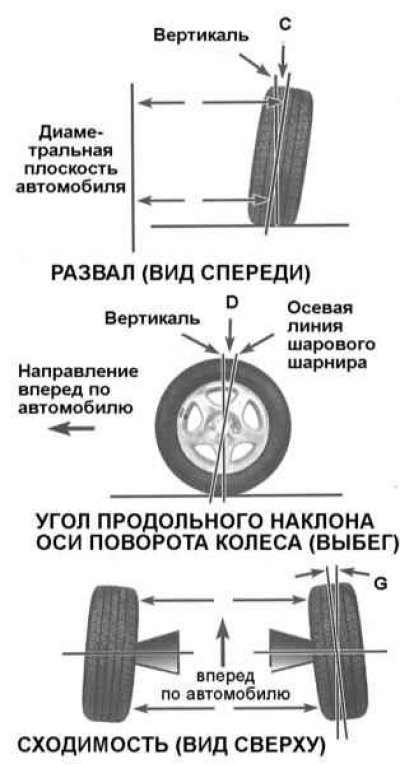
The front wheel alignment angles determine the geometry of the position of the latter relative to the vehicle suspension and the road surface. Violation of this geometry adjustment leads to decreased vehicle controllability and increased tire wear. The front wheel alignment angles subject to control include camber, run-out (the longitudinal tilt angle of the wheel turning axis) and toe-in. Only one of the parameters is subject to adjustment - toe-in, both for the front and rear wheels of the vehicle. The camber and run-out values of the front wheels should be checked on a regular basis to assess the degree of wear of the suspension and steering components.

Wheel alignment is one of those procedures that require particularly precise measurements, and for high-quality performance it is necessary to have special, rather bulky and expensive equipment. It is best to entrust this work to professional mechanics at a car service center. Below, for general understanding, are definitions of each of the controlled wheel alignment angles of a car, knowledge of which will facilitate communication between the car owner and the car service personnel.


Toe-in is the amount of convergence of the front edges of the vehicle wheels. This violation of the parallelism of the wheel installation helps to minimize tread wear due to skidding when turning. With zero toe-in, the distance between the front edges of the wheels is equal to the distance between their rear edges. Normal toe-in usually does not exceed fractions of an inch (1 inch = 2.54 cm). Adjustment of the front wheel toe-in is carried out by adjusting the length of the steering rods by changing the position of their tips. A special adjusting cam bolt screwed into the inner end of the rear suspension control arm is provided to adjust the rear wheel toe-in. Violation of the toe-in adjustment leads to accelerated wear of the tire treads due to their slippage on the road surface.

Camber is the angle of the plane of the wheels relative to the vertical. If the wheels are tilted with their upper edges outward, the camber is called positive, and vice versa. The camber value is measured in degrees. Correct camber adjustment determines the size and position of the contact patch of the treads with the road and allows for compensation for changes in the suspension geometry when turning and when the car is moving on uneven road surfaces. The models of cars in question do not have the ability to adjust the camber.

The runout is the angle of deviation from the vertical of the wheel's turning axis in the plane of the latter. If the turning axis is tilted backwards, the runout is called positive, and vice versa. The adjustment of the front wheel runout is carried out by selecting spacers placed under the suspension push rods.
This article is available at: russian, bulgarian, belarusian, ukrainian, serbian, croatian, romanian, polish, slovak, hungarian
This information has been verified: Timofey Goryachev
Share with friends:
◀ Previous
Accord 6: Car suspension
Next ▶

Wheels and tires — general information
Removal and installation rear suspension arms
Removal and installation the rear anti-roll bar
Removal and installation the rear hub assembly with wheel bearing
Removal and installation the rear wheel hub assembly
 
See also other articles from Honda manuals:
Wheel alignment angles (L13A/R18A) Honda Civic 8 (2005-2011)
Checking and adjusting the front wheel alignment angles Honda Fit 1 (2001-2008)
Wheel alignment angles Honda CR-V 2 (2002-2006, petrol)
Wheel alignment angles Honda HR-V 1 (1998-2006, petrol)
Wheel alignment angles — preliminary remarks Honda Avancier 1 (1999-2003, petrol)
Link in different formats to this article
Comments and feedback from visitors
No comments yet


How much will 33 + 49 ?


Accord 6 (1997-2002) 
  • General information
  • Introduction to the guide
  • User manual
  • Maintenance
  • Power unit
  • Four-cylinder engines
  • Six-cylinder engines
  • Engine overhaul
  • Cooling system
  • Heater and air conditioner
  • Power and exhaust systems
  • Engine electrical equipment
  • Engine management
  • Transmission
  • Mechanical gearbox
  • Automatic gearbox
  • Clutch and drive shafts
  • Chassis and running gear
  • Brake system
  • Car suspension
  • Steering
  • Body and interior
  • Exterior (external elements)
  • Interior (internal elements)
  • Electrical equipment
  • Equipment and devices
  • Electrical circuits
Accord 3 (1985-1989) 
  • General information
  • Maintenance
  • Power unit
  • Engine adjustment
  • Engine repair
  • Engine electrics
  • Emission management
  • Engine management (carburetor)
  • Electronic injection
  • Programmable injection
  • Schematic of emission system
  • Fuel system
  • Feedback management
  • Transmission
  • Manual gearbox
  • Automatic gearbox
  • Clutch
  • Chassis and running gear
  • Front suspension
  • Rear suspension
  • Steering
  • Brake system
  • Electrical equipment
  • Ventilation and heating
  • Air conditioner
  • Cruise control system
  • Equipment and devices
HondaBook.ru © 2018–2026 • Mobile version • Sitemap: EN BG BY UA RS HR RO PL SK HU • Feedback • Driver Information • Search system • Bookmark
Accord 3 (1985-1989) • Accord 6 (1997-2002) • Civic 3 and 4 (1983-1991) • Civic 5 and 6 (1991-2000) • Civic 6 (1995-2000) • Civic 7 (2000-2005) • Civic 8 (2005-2011) • Fit 1 (2001-2008) • CR-V 1 (1995-2001) • CR-V 2 (2002-2006) • HR-V 1 (1998-2006) • Avancier 1 (1999-2003) •
 
This website uses cookies to ensure proper functioning. By clicking "OK," you agree.