
Note: Check the clutch pedal position sensor.
Before adjusting the clutch pedal, remove the mat from the driver's side.
To compensate for wear, the clutch is self-adjusting.
If there is no clearance between the master cylinder piston and the pushrod, the release bearing will be in close contact with the diaphragm spring, which can cause clutch slippage and other problems in the clutch system.
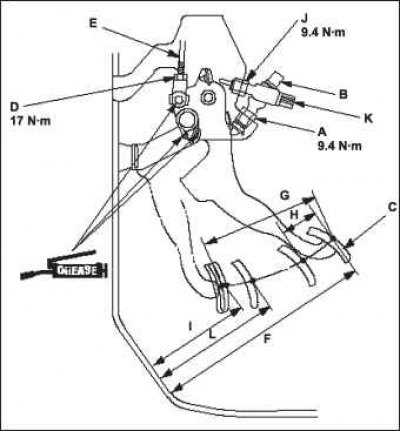
1. Loosen the lock nut A of the clutch pedal position switch, and turn the clutch pedal position switch B so that it does not touch the clutch pedal C.
2. Loosen the lock nut D of the clutch pusher and, by turning the pusher E inward or outward, set the required pedal height F, full pedal travel G, free pedal travel H, and clutch pedal position with the clutch disengaged I.
- Full travel of the clutch pedal: 135-145 mm.
- Clutch pedal free travel: 11-19 mm.
- Clutch pedal height: 162 mm.
- Pedal height with clutch fully disengaged: 67 mm.
3. Tighten the clutch pusher lock nut.
4. With the clutch pedal released, install the clutch pedal position sensor so that it touches the clutch pedal.
5. Turn the clutch pedal position sensor another 3/4 of one turn.
6. Tighten the clutch pedal position sensor lock nut.
7. Press the clutch pedal to the floor.
8. Adjust the clutch lock sensor K so that it closes/opens when the clutch is engaged/disengaged using the L pedal.
Height for closing/opening the clutch pedal position sensor: 79 mm.
9. Tighten the clutch pedal position switch locknut J.
The original can be found on the resource hondabook