
2. Measure the pedal height (the distance from the pedal pad to the floor).
- Pedal height - 163 mm
3. Press the clutch pedal and measure the clutch pedal travel.
- Pedal travel: 130-140 mm
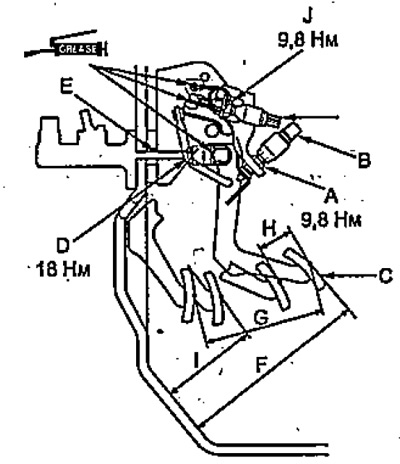
A - lock nut,
B - switch on the clutch pedal,
C - clutch pedal,
D - lock nut,
E - rod,
F - pedal height,
G - pedal stroke,
H - free pedal travel,
I - height of the pedal when disengaging the clutch,
J - lock nut,
K - starter lock switch.
4. Measure the height of the pedal when disengaging the clutch and the free travel of the clutch pedal.
- Pedal height when disengaging the clutch - 72 mm
- Free travel - 6-20 mm
4. Make adjustments if necessary.
a) Loosen the lock nut (A) and turn the clutch pedal switch (B) or adjusting bolt (models without cruise control) so that it does not touch the clutch pedal (C).
b) Loosen the lock nut (D) and, by turning the rod (E), adjust the height of the position (F), the height of the pedal when disengaging the clutch (I), the stroke (G) and the free play (H) of the clutch pedal.
c) Tighten the lock nut (D).
- Tightening torque - 18 Nm
d) With the clutch pedal not depressed, turn the switch on the clutch pedal (B) so that it touches the clutch pedal.
d) Turn the switch on the clutch pedal by 0.75 turns.
e) Tighten the lock nut (A).
- Tightening torque - 10 Nm
g) Loosen the lock nut (J) and turn out the starter interlock switch (K).
c) Press the clutch pedal all the way down.
i) Release the clutch pedal so that the distance from the floor to the clutch pedal pad is 67-72 mm, and hold the pedal in this position.
k) Adjust the position of the starter interlock switch so that the engine starts at the given position of the clutch pedal.
l) Tighten the lock nut (J).
- Tightening torque - 10 Nm