
Contents: Car interior ventilation ⇊ Heating the car interior ⇊ Removal condensed moisture and frost…⇊ Removal frost and ice from the outer…⇊ Turning off heating and ventilation…⇊ Voice control system ⇊ System operation in automatic mode ⇊ Turning off the climate control…⇊ Operation of the microclimate…⇊ A/C button for turning on the air…⇊ Temperature control ⇊ Air recirculation mode activation…⇊ Buttons for switching on the…⇊ Fan speed control switch ⇊ Button for switching on the…⇊ Air flow distribution mode switching…⇊ Windshield defroster mode button ⇊ Rear window defroster switch ⇊
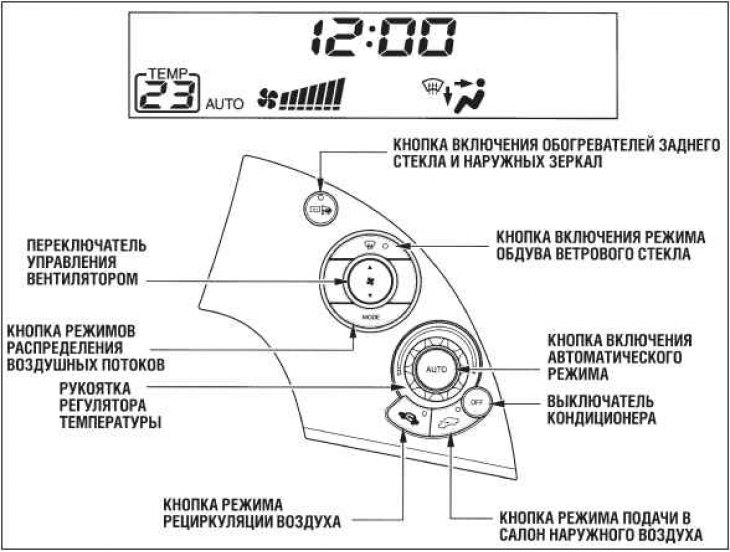
Temperature control knob
To increase the temperature of the air entering the passenger compartment, turn the knob clockwise.
Fan control switch
The fan speed is changed by pressing the top or bottom part (
 or
or  ) switch. The speed value is displayed on the display as a bar indicator.
Buttons for supplying outside air and air recirculation modes
The choice of air intake source is performed using two buttons. When the mode is on
 outside air enters the cabin. In recirculation mode
  the car's interior is isolated from the atmosphere, and the air circulates in a closed circuit.
Outside air enters the heating and air conditioning systems through the air intake grille located in front of the windshield. Periodically clean the air intake grille openings from leaves and other debris that obstruct the passage of air.
In the absolute majority of cases, the best results of the systems providing a comfortable microclimate are achieved in the mode of outside air intake into the passenger compartment. Long-term activation of the air recirculation mode, especially when the air conditioner is not working, leads to condensation of moisture on the glass.
Therefore, it is recommended to turn on the air recirculation mode only when necessary, for example, when driving in a smoky or polluted area. As soon as there is no longer a need to isolate the car interior from the atmosphere, turn off the air recirculation mode.
Air flow distribution mode switching button
The "MODE" button is used to select the air flow distribution mode in the passenger compartment. In all modes, a small air flow enters the passenger compartment through the side ventilation grilles located in the control panel.
 Each time you press the "MODE" button, the set air distribution mode is displayed on the display.
 Outside air enters the passenger compartment through the central and side ventilation grilles located in the control panel.
 Outside air enters the passenger compartment simultaneously through the central and side ventilation grilles in the control panel and through the lower ventilation openings, which provide air supply to the footwell area of the driver and passengers.
 Outside air enters the cabin only through the lower air vents, which provide air to the driver and passenger area.
 Outside air enters the cabin through the lower vents, side vents and windshield defroster vents.
Windshield defroster mode button

Pressing this button directs the main air flow to the windshield. At the same time, the previously active air supply mode is cancelled.
Pressing the button automatically activates the mode of supplying outside air into the cabin. To speed up the blowing of the windshield, you can manually set the maximum fan speed. It is also recommended to temporarily close the side ventilation grilles located on the front panel.
When you press the button again, the system returns to the mode that was set before the windshield defroster began.
To improve traffic safety, it is necessary to ensure full visibility through all vehicle windows.
Rear window defroster switch
The button is designed to turn the rear window heater on and off.
This button also switches the electric heaters of the outside rear-view mirrors on and off.
Car interior ventilation
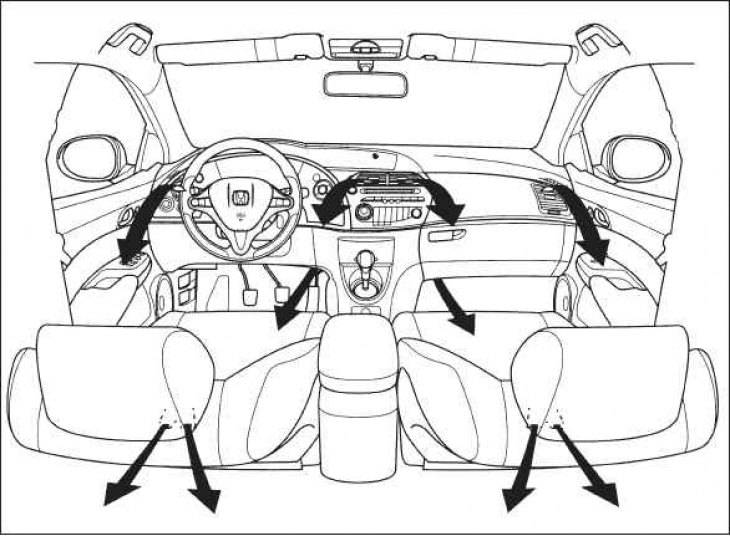
The supply and exhaust ventilation system ensures a constant exchange of air in the car's interior. Fresh outside air, entering through the air intake grille, circulates through the interior and is then removed through the outlet openings located near the rear window.
1. Turn the air temperature control knob to the minimum heat position.
2. Press the button
 switching between air flow distribution modes and the mode of supplying outside air to the cabin.
3. Use the fan control knob to set the desired level of air supply to the passenger compartment.
Heating the car interior
The heater uses the heat of the hot engine coolant to heat the interior. If the engine is not warmed up, it will take some time before the interior starts to heat up.
1. Press the "AUTO" button, which is located in the center of the temperature controller.
2. Turn the air temperature control knob in one direction or another to set the desired degree of heating of the air entering the passenger compartment. The information display will show the inscription "AUTO" and the set temperature value.
The system will automatically select the optimal combination of supply air temperature, fan speed and air flow direction to ensure that the cabin maintains a constant set temperature.
Removal condensed moisture and frost from glass
You can clean the inner surfaces of the glass from condensed moisture and frost as follows:
1. Turn on the fan. Select a comfortable fan speed or maximum speed if you want to clean the glass faster.
2. Set the mode
 air flow distribution. The system automatically sets the mode of supplying outside air into the cabin and turns on the air conditioner.
3. Turn the air temperature control knob to a position where warm air flows to the windows.
4. By pressing the button
 , turn on the rear window heater to quickly remove condensed moisture from its surface.
5. To increase the air flow directed to the windshield, close the side vent louvers.
Removal frost and ice from the outer surface of glass
1. Using the button
 set the air supply mode to the windshield. The outside air supply mode must be turned on. The system automatically turns on the outside air supply mode.
2. Turn on the recirculation mode
 .
.
3. Turn the temperature control knob to the maximum heat position and turn on the fan to maximum air flow.
To quickly remove condensation, frost or ice from the windshield, you can close the side ventilation grilles by turning the adjusting knobs located under the grilles to the extreme position. In this case, all the heated air will only go to blowing the windshield. After cleaning the windshield, select the mode for supplying outside air to the cabin to avoid fogging of the glass.
For safety reasons, do not drive until all vehicle windows are clear of condensation, frost or ice and there is a clear view from the vehicle.
Turning off heating and ventilation systems
To turn off the heating and ventilation systems, press the "OFF" button.
Do not turn off the system for an extended period of time.
It is recommended that the cabin fan remains on at all times to avoid stagnant air in the cabin and the formation of an unpleasant odor.
Only for vehicles equipped with automatic heating, ventilation and air conditioning systems
The climate control system installed in the Honda car performs the functions of ventilation, heating and air conditioning in the cabin. In addition, the climate control system automatically regulates the fan mode and sets the optimal air distribution mode depending on the set air temperature.
For vehicles with separate microclimate control in two interior zones, the air temperature in the driver and front passenger zones can be independently adjusted.
In "AUTO" mode, the interior temperature will be automatically adjusted separately for the driver and front passenger areas.
The climate control system only functions when the engine is running.
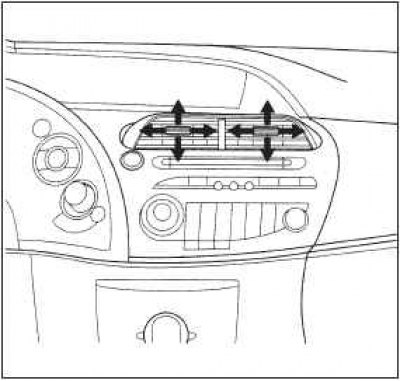
The direction of air flow from the central and side ventilation grilles can be adjusted manually.
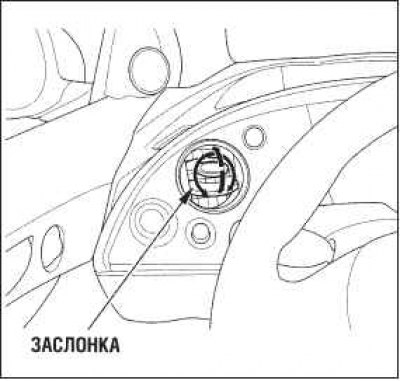
The driver's side air vent can be opened or closed using a flap. To open the air vent, press the flap. To close the air vent, pull the flap toward you. To adjust the air flow from the side grill, first press the flap to open the air vent, and then move the flap vertically and horizontally.
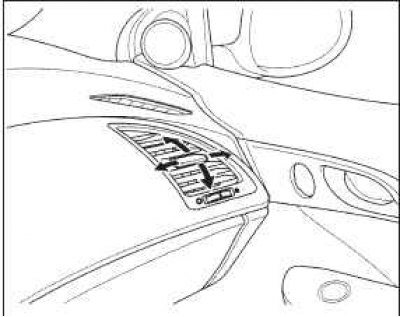
The air flows coming out of the central ventilation grille and out of the front passenger side ventilation grille can be adjusted by using a lever that can be shifted vertically and horizontally. The air flow coming out of the ventilation grille on the front passenger side can be blocked or opened by means of a rotary regulator located under the grille.
For vehicles with a navigation system, you can control the climate control system using voice commands. For more information, see the separate navigation manual
Voice control system
For vehicles equipped with a navigation system, you can use the voice control system in addition to the traditional climate control system. For more information, please refer to the separate navigation system manual.
System operation in automatic mode
To enable fully automatic operation of the climate control system, follow the steps described below.
1. Press the "AUTO" button.
2. Turn the air temperature control knob to set the desired temperature. The air conditioner display will show "AUTO" ("Automatic mode"). For vehicles equipped with a dual-zone climate control system, you can set the temperature for the front passenger area independently.
The system automatically selects the optimal mixture of heated and air cooled by the air conditioner, which allows you to set the desired temperature in the cabin as quickly as possible.
If you set the minimum ("LO") or maximum ("HI") temperature value, the system will, accordingly, supply the entire air flow only from the air conditioner or from the heater. In this case, automatic regulation of the air temperature in the cabin is not performed.
In cold weather, the fan does not turn on until the heater is ready to supply warm air to the passenger compartment.
For vehicles equipped with a dual-zone climate control system If the display shows the dual-zone climate control system indicator, the temperature in the driver's and front passenger's areas can be adjusted independently.
Turning off the climate control system
The climate control system is completely switched off by pressing the "OFF" button.
Do not turn off the climate control system for an extended period of time.
It is recommended that the cabin fan remains on at all times to avoid stagnant air in the cabin and the formation of an unpleasant odor.
Operation of the microclimate control system in semi-automatic mode
During fully automatic operation of the system, you can manually set the desired mode for any function of the system: fan speed, temperature, etc. The system will continue to control all other functions automatically. However, the word "AUTO" will disappear from the climate control system display.
A/C button for turning on the air conditioner
The air conditioner is turned on and off by pressing the A/C button. The display shows the message A/C "ON" ("Air conditioner is on") or A/C "OFF" ("Air conditioner is off"), respectively.
If you manually turn off the air conditioner, the climate control system will not be able to maintain the set temperature of the air entering the cabin if it is lower than the ambient air temperature.
Temperature control
For vehicles equipped with a dual-zone climate control system To increase the temperature of the air entering the passenger compartment, turn the knob clockwise.
For vehicles equipped with a dual-zone climate control system For vehicles equipped with a dual-zone climate control system, you can set the temperature for the driver's and front passenger's zones independently. When the indicator light in the button lights up, you can adjust the temperature in the driver's zone by turning the control knob.
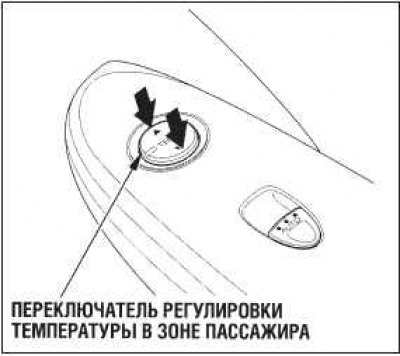
To adjust the temperature in the front passenger area, press the sides
 and
and  switch located on the front passenger door armrest. If the indicator built into the button does not light, the same temperature is set in both areas of the cabin.
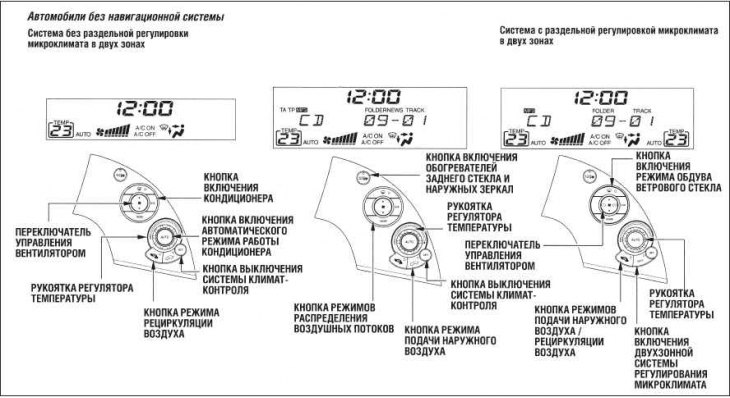
Air recirculation mode activation button
For vehicles equipped with a dual-zone climate control system If the recirculation mode indicator is on, the air circulates in the vehicle interior in a closed loop. If the recirculation mode indicator is off, the air enters the vehicle interior from outside.
Buttons for switching on the recirculation mode and supplying outside air into the cabin
These two buttons are used to control the source of air entering the passenger compartment. In the mode
 outside air enters the cabin. In the mode
  air circulates within the cabin without the intake of outside air.
Outside air enters the climate control system through the air intake grille located in front of the windshield. Periodically clean the air intake grille openings from leaves and other debris that obstruct the passage of air.
In the absolute majority of cases, the best results of the systems providing a comfortable microclimate are achieved in the mode of outside air intake into the passenger compartment. Long-term activation of the air recirculation mode, especially when the air conditioner is not working, leads to condensation of moisture on the glass.
Therefore, it is recommended to turn on the air recirculation mode only when necessary, for example, when driving in a smoky or polluted area. As soon as there is no longer a need to isolate the car interior from the atmosphere, turn off the air recirculation mode.
Fan speed control switch
The switch allows you to manually adjust the fan speed. The fan speed value is set by pressing the sides
 and
and  switch and is displayed on the display as a bar indicator.
Button for switching on the dual-zone climate control system
For vehicles equipped with a dual-zone climate control system To turn on the dual-zone climate control mode, press the "DUAL" button.
If the indicator built into the button lights up, you can adjust the temperature in the driver's area by turning the knob. If the indicator built into the button does not light up, the rotary knob sets the same temperature in both areas of the cabin.
Air flow distribution mode switching button
The "MODE" button is used to select the air flow distribution mode in the passenger compartment. In all modes, a small air flow enters the passenger compartment through the side ventilation grilles located in the control panel.
Each time you press the "MODE" button, the set air distribution mode is displayed on the display.
 Outside air enters the passenger compartment through the central and side ventilation grilles located in the control panel.
 Outside air enters the passenger compartment simultaneously through the central and side ventilation grilles in the control panel and through the lower ventilation openings, which provide air supply to the footwell area of the driver and passengers.
 Outside air enters the cabin only through the lower air vents, which provide air to the driver and passenger area.
 Outside air enters the cabin through the lower vents, side vents and windshield defroster vents.
Windshield defroster mode button

Pressing this button directs the main air flow to the windshield. At the same time, the previously active air supply mode is cancelled.
Pressing the button automatically activates the mode of supplying outside air into the cabin. To speed up the blowing of the windshield, you can manually set the maximum fan speed. It is also recommended to temporarily close the side ventilation grilles located on the front panel.
When you press the button again, the system returns to the mode that was set before the windshield defroster began.
To improve traffic safety, it is necessary to ensure full visibility through all vehicle windows.
Rear window defroster switch
The button is designed to turn the rear window heater on and off.
When the rear window heater is switched on, the heating of the outside rear-view mirrors is also switched on.