
HondaBook.ru
Auto companies Volkswagen Auto companies Ford Auto companies Lada Auto companies Skoda Auto companies BMW Auto companies Mazda Auto companies Peugeot
English Русский
Български
Беларускі
Український
Српски
Hrvatski
Română
Polski
Slovenský
Magyar
Bookmark Contacts Sitemap   


Accord Civic Fit / Jazz CR-V HR-V Others Articles
Civic 3 and 4 (1983-1991) Civic 5 and 6 (1991-2000) Civic 6 (1995-2000) Civic 7 (2000-2005) Civic 8 (2005-2011)

Starting the engine (Honda Civic 7)

  • Main
  • Honda Civic
  • 7 (2000-2005)
  • General information
  • User manual
  • Starting the engine
0
Contents: Ignition switch ⇊ Starting the engine ⇊ If the engine does not start ⇊ Starting the engine (if the spark…⇊ Jump starting with an additional…⇊

Ignition switch


There are four fixed positions of the key in the ignition switch:
  • 0: In this position, the key can be inserted or removed from the ignition switch. When the key is removed, the steering wheel is locked.
  • I: In this position you can use the following electrical devices: radio, cigarette lighter and control the side mirrors.
  • II: The engine operates in this position. When the engine starts, the indicators of various vehicle systems light up.
  • III: In this position the engine is started.
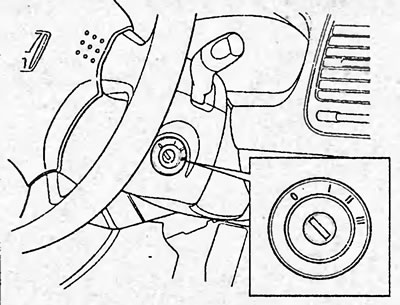
III: In this position the engine is started.


Starting the engine


Caution: Do not allow the engine to run at high speed for a long time or accelerate sharply when not warmed up.


1. Apply the parking brake.

2. Turn off unnecessary lights and auxiliary equipment.

3. For models with manual transmission:
  • a) Press the clutch pedal all the way down and move the gearshift lever to neutral position.
  • b) Keep the clutch pedal depressed until the engine starts.

4. For models with automatic transmission:


  • a) Set the selector to position "P". When restarting (the engine stalled) set the selector to the "N" position.
  • b) Press the brake pedal and hold it until you start moving.

5. Starting the engine.

Turn the ignition key to position "II". Without pressing the accelerator pedal, turn the engine crankshaft by turning the ignition key to position "III". Release the ignition key when the engine starts.

Caution: Do not crank the engine for more than 15 seconds at a time. This may cause the starter and electrical connections to overheat. If the engine does not start within 15 seconds, wait about one minute before trying again.


6. After the engine speed has been automatically reduced, the vehicle is ready to move.

If the engine does not start


1. Before performing checks, make sure that the startup procedure has been performed correctly (see the relevant section) and the presence of sufficient fuel in the tank.

2. If the engine crankshaft does not turn or turns too slowly:
  • a) Make sure the battery terminals are tight and clean.
  • b) If the battery terminals are OK, turn on the interior lighting. If there is no lighting, it is dim, or it goes out when the engine is cranked by the starter, then the battery is discharged.
  • c) If the lighting is normal, but the engine does not start, then it is faulty.

3. If the engine crankshaft turns normally, but the engine does not start:
  • a) Check the tightness of the connectors (for example, spark plug connections, ignition coils).
  • b) If the connectors are OK, the spark plugs may be "flooded" due to repeated cranking of the engine crankshaft.


Starting the engine (if the spark plugs are "flooded")


1. While pressing the accelerator pedal, crank the engine with the ignition key in position "III" for approximately 15 seconds. Do not pump the pedal, just hold it down.

2. Release the ignition key and the accelerator pedal. Then try to start the engine without pressing the accelerator pedal.

3. If the engine does not start within 15 seconds of cranking the crankshaft, release the ignition key and wait a few minutes.

4. Try starting the engine without pressing the accelerator pedal.

If the engine still does not start, it is faulty and requires adjustment or repair.

Caution: Do not crank the engine for more than 15 seconds at a time. This may cause overheating of the starter and electrical circuit connections.


Warning: Pushing is prohibited for vehicles with automatic transmission (towing).


Jump starting with an additional battery


Caution: The booster battery voltage must be 12 V. Do not jump start the engine using a booster battery unless you are sure that it meets the required parameters.


1. Turn off all unnecessary lights and accessories and ensure that the vehicles do not touch.

2. If necessary, remove all vent plugs from the booster and discharged batteries.

Place a cloth over the open vents on the batteries (this helps reduce the risk of explosion).

3. If the engine of the vehicle with the booster battery does not work, start it and let it run for a few minutes. When starting with the booster battery, the engine should run at approximately 2000 rpm.


4. Connecting cables.

a) Make the cable connections in the sequence shown in the figure.
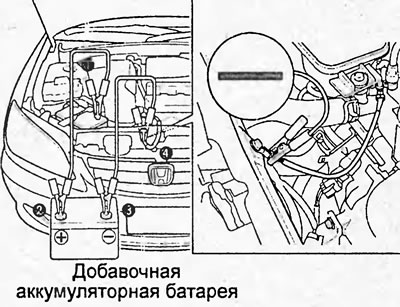
Sedan, hatchback (five-door models).
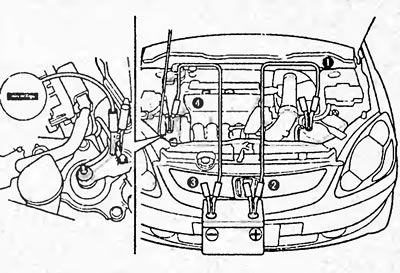
Sedan, hatchback (five-door models).


Hatchback (three-door models).

Hatchback (three-door models).


Note: To avoid serious injury when making connections, do not lean over the battery or allow cables or clamps to accidentally touch anything other than the appropriate battery terminals or vehicle ground.


b) Connect the clamp from the other end of the negative cable of the booster battery to a rigid, stationary, unpainted metal part of the engine of the vehicle with the discharged battery.

Caution: Do not connect the cable near any part that may move when the engine cranks.


5. Start the engine in the normal way. Once started, it should run at 2000 rpm for several minutes.


6. Carefully disconnect the cables: first the negative, then the positive.

7. Carefully remove any cloths covering the batteries as they may contain sulfuric acid.

8. If the ventilation plugs were removed, install them in their places.
This article is available at: russian, bulgarian, belarusian, ukrainian, serbian, croatian, romanian, polish, slovak, hungarian
This information has been verified: Yaroslav Shiryaev
Share with friends:
◀ Previous
Civic 7: User manual
Next ▶

Towing a car
Tips for driving in different conditions
Features of the transmission of 4WD models
Driving a car with a manual transmission
Driving a car with a CVT
Engine malfunctions while driving
Spare tire, jack and tools
Jacking up a car
Wheel replacement
Recommendations for choosing tires
See also other articles from Honda manuals:
4-cylinder engine starting system Honda Accord 6 (1997-2002)
Starting the engine Honda Fit 1 (2001-2008)
Starting and running in the repaired engine Honda CR-V 1 (1995-2001, petrol)
Engine Starting Procedure Honda HR-V 1 (1998-2006, petrol)
Starting the engine Honda Avancier 1 (1999-2003, petrol)
Link in different formats to this article
Comments and feedback from visitors
No comments yet


How much will 20 + 35 ?


Civic 8 (2005-2011) 
  • General information
  • Technical data
  • Governing bodies
  • Driving and maintenance
  • Power unit
  • Gasoline engines (L13A)
  • Gasoline engines (R18A)
  • Diesel engines (N22A)
  • Cooling and lubrication (L13A)
  • Cooling and lubrication (R18A)
  • Cooling and lubrication (N22A)
  • Injection system (gasoline)
  • Injection system (diesel)
  • Toxicity reduction system
  • Troubleshooting
  • Transmission
  • Clutch and drive shafts
  • Mechanical gearbox
  • Chassis and running gear
  • Suspension and wheels
  • Steering
  • Brake system
  • Body and interior
  • Exterior (external elements)
  • Doors, locks and windows
  • Electrical equipment
  • Equipment and devices
  • Headlights and lighting
  • Power devices
  • Electrical circuits
Civic 7 (2000-2005) 
  • General information
  • User manual
  • Maintenance
  • Power unit
  • Engines D15B and D17A
  • K20A Engines
  • Overhaul engine
  • Cooling system
  • Lubrication system
  • Fuel injection system
  • Toxicity reduction system
  • Engine electrical equipment
  • Transmission
  • Clutch
  • Manual gearbox
  • Automatic gearbox
  • Variator (CVT)
  • Drive shafts
  • Chassis and running gear
  • Car suspension
  • Steering
  • Brake system
  • Body and interior
  • Exterior (external elements)
  • Interior (internal elements)
  • Doors, locks and windows
  • Heater and air conditioner
  • Manual air conditioner
  • Automatic air conditioner
  • Security system
  • Electrical equipment
  • Equipment and devices
  • Headlights and lighting
  • Windscreen wipers
  • Audio system
  • Electrical diagrams
Civic 6 (1995-2000) 
  • General information
  • Introduction to guide
  • User manual
  • Maintenance
  • Power unit
  • Engine in car (Civic)
  • Engine in car (Integra)
  • Engine overhaul
  • Cooling and heating
  • Power and exhaust systems
  • Engine electrical equipment
  • Engine management systems
  • Transmission
  • Manual gearbox
  • Automatic transmission (AT/CVT)
  • Clutch and drive shafts
  • Chassis and running gear
  • Brake system
  • Car suspension
  • Steering
  • Body and interior
  • Exterior (external elements)
  • Interior (internal elements)
  • Doors, locks and windows
  • Electrical equipment
  • Equipment and devices
  • Electrical circuits
Civic 5 and 6 (1991-2000) 
  • Power unit
  • SOHC engines
  • DOHC engines
  • Engine overhaul
  • Cooling and lubrication system
  • Intake and exhaust system
  • Fuel injection system (SOHC)
  • Fuel injection system (DOHC)
  • Carburetor
  • Transmission
  • Clutch
  • Manual gearbox S4C
  • Manual gearbox S40
  • Automatic gearbox
  • Drive shafts
  • Chassis and running gear
  • Car suspension
  • Steering
  • Brake system
  • Body and interior
  • Body elements
  • Heater and air conditioner
  • Electrical equipment
  • Power devices
  • Equipment and instruments
  • Electrical circuits
Civic 3 and 4 (1983-1991) 
  • General information
  • Maintenance
  • Power unit
  • Engine in a car
  • Engine overhaul
  • Cooling system
  • Power and exhaust system
  • Engine electrical equipment
  • Emission control system
  • Transmission
  • Mechanical gearbox
  • Automatic gearbox
  • Clutch and drive shafts
  • Four-wheel drive
  • Chassis and running gear
  • Brake system
  • Car suspension
  • Steering
  • Body and interior
  • Body elements
  • Electrical equipment
  • Equipment and devices
  • Electrical circuits
HondaBook.ru © 2018–2026 • Mobile version • Sitemap: EN BG BY UA RS HR RO PL SK HU • Feedback • Driver Information • Search system • Bookmark
Accord 3 (1985-1989) • Accord 6 (1997-2002) • Civic 3 and 4 (1983-1991) • Civic 5 and 6 (1991-2000) • Civic 6 (1995-2000) • Civic 7 (2000-2005) • Civic 8 (2005-2011) • Fit 1 (2001-2008) • CR-V 1 (1995-2001) • CR-V 2 (2002-2006) • HR-V 1 (1998-2006) • Avancier 1 (1999-2003) •
 
This website uses cookies to ensure proper functioning. By clicking "OK," you agree.