
Contents: Examination ⇊ Replacement ⇊
The VSS is mounted on the transmission housing and is a sensor with variable magnetic resistance that begins to generate voltage pulses as soon as the vehicle speed exceeds 4.8 km/h (3 miles per hour). The pulses from the sensor are sent to the ECM/PCM and are used by the module to control the duration of the fuel injector opening time and transmission shifting.
Examination
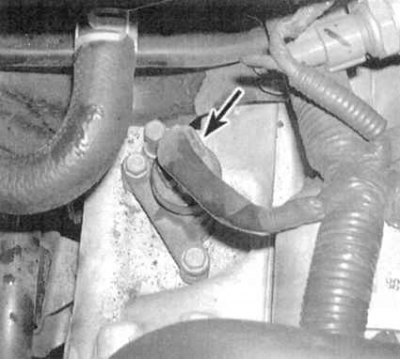
1. Disconnect the sensor wiring harness connector. Use a voltmeter to measure the voltage at the connector (see accompanying illustration). The power supply wire terminal can be identified using the electrical connection diagrams (see Chapter On-board electrical equipment). There should be battery voltage at the connector. If there is no power, check the condition of the VSS wiring between the sensor and the fuse box. Use an ohmmeter to check for continuity between the connector's black wire terminal and ground. If there is no continuity, check the condition of the black wire and the quality of its terminal connections.
2. Jack up the front of the vehicle and place it on stands. Chock the rear wheels and shift the transmission into neutral. Connect the wiring to the VSS, turn on the ignition and test the signal wire terminal on the back of the connector with a voltmeter (connect the negative probe to the body ground). While holding one wheel stationary, manually rotate the opposite one - the voltage should fluctuate between zero and 5 V, otherwise replace the VSS.
Replacement
1. Disconnect the electrical wiring from the VSS.
2. Remove the mounting bolt and remove the sensor from the transmission.
3. Installation is carried out in reverse order.
(The original is located on the website: www.HondaBook.ru)