
Contents: Examination ⇊ Replacement ⇊
The λ-probe located in the engine exhaust manifold monitors the oxygen content in the exhaust gas flow. When O2 molecules come into contact with the sensitive element of the probe, the sensor generates an amplitude signal in the range from 0.1 to 0.9 V, depending on the oxygen concentration. Moreover, a value of 0.1 V corresponds to a high O2 content (lean mixture), and the value of 0.9 V is low (enriched mixture). The ECM/PCM continuously monitors the signal coming from the oxygen sensor, if necessary issuing commands to adjust the air-fuel mixture composition by changing the duration of the injection injectors opening. The optimal ratio of the components of the combustible mixture, which guarantees minimum fuel consumption with the most efficient operation of the catalytic converter, is 14.7 parts air to 1 part fuel - this is what the control module tries to constantly maintain, focusing on the information coming from the λ-probe.
It should be noted that the oxygen sensor is only capable of producing a signal voltage when it is warmed up to normal operating temperature (approximately 320°C). While the sensor is cold, the ECM/PCM operates in OPEN LOOP mode.
If, when the engine is warmed up to normal operating temperature and/or has been running for at least two minutes, the oxygen sensor produces a stable signal with an amplitude of 0.45 V (at a speed of not less than 1500 rpm), the self-diagnosis system stores the corresponding fault code in the ECM/PCM memory (see Checking the condition and replacing the TDC/crankshaft position/piston position sensor in the engine cylinders (TDC/CKR/CYP)). The code is also entered if a malfunction is detected in the sensor heater circuit.
In the event of a malfunction of the λ-probe or its circuit, the ECM/PCM switches to open-loop mode, ignoring the information coming from the sensor and maintaining the composition of the air-fuel mixture at a certain specified level that ensures sufficient engine efficiency.
The proper functioning of the oxygen sensor depends on the fulfillment of a set of certain conditions:
- a) Electrical parameters: The stability of the low-voltage amplitude signal generated by the sensor largely depends on the quality of the contact connections of the λ-probe circuit, which should be checked first in case of problems;
- b) Outside air supply: The design of the λ-probe provides for free circulation of outside air inside the sensor. When installing the probe, always check the patency of the air ducts;
- c) Operating temperature: The ECM/PCM only starts to respond to the information coming from the λ-probe after the sensor has warmed up to normal operating temperature (approximately 320°C). This fact should not be overlooked when checking the correct functioning of the probe;
- d) Fuel quality: Correct functioning of the λ-probe is possible only if UNLEADED fuel is used to refuel the vehicle!
In addition to the conditions listed in the previous paragraph, some special precautions should be observed when servicing the λ probe:
- a) The oxygen sensor is equipped with a section of electrical wiring permanently mounted into it and equipped with a contact plug, attempts to disconnect which may lead to irreversible failure of the sensor;
- b) Avoid allowing dirt and grease to enter the sensor louvers or its electrical connector;
- c) Do not use any solvents to clean the oxygen sensor;
- d) Handle the λ-probe with extreme care, do not drop it and try not to shake it;
- e) The silicone protective cover must be placed on the sensor in a strictly defined manner so as not to melt and impair the proper functioning of the probe.
Examination
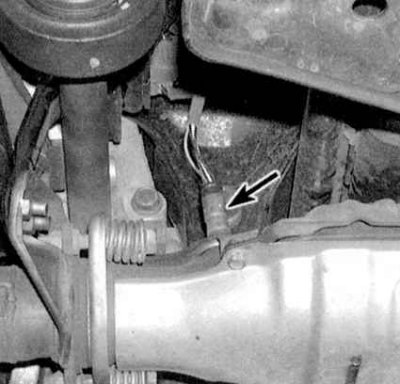
1. Locate the sensor's electrical connector. From the back of the connector, insert an unbent paper clip into the signal wire contact socket (white or white and red) (see accompanying illustration).
Note: Identification of the connector terminals can be made using the electrical connection diagrams (see Chapter On-board electrical equipment). Connect the positive probe of the voltmeter to the paper clip, ground the negative terminal.
Note: The insulation colors of the λ-probe wiring are also given in the electrical connection diagrams (see Chapter On-board electrical equipment).
2. Monitor the meter readings (mV) as the engine warms up.
3. At the initial stage, the cold sensor should generate a constant signal with an amplitude of 0.1÷0.2 V (open loop mode). After about two minutes, the engine will reach normal operating temperature and the sensor readings will begin to fluctuate between 0.1 and 0.9 V (closed loop mode). If the system does not enter closed loop mode, or enters with an unacceptably long delay (lazy sensor), replace the λ probe.
4. Also check the proper functioning of the oxygen sensor heater. Disconnect the probe wiring connector and connect an ohmmeter between the heater terminals (see the electrical connection diagrams in Chapter On-board electrical equipment of this Manual). The nominal resistance is 10÷40 Ohm.
5. Check the power supply to the heater. Disconnect the electrical connector and measure the voltage on the harness side (refer to the electrical connection diagrams again). With the ignition on (do not start the engine) the voltmeter should register battery voltage. If there is no power, check the wiring condition in the circuit between the main relay, ECM/PCM and the oxygen sensor.
6. If the above checks are negative, replace the λ-probe.
Replacement
Note: Removing the λ-probe on a cold engine can be extremely difficult due to thermal contraction of the metal of the exhaust manifold/pipe. To avoid the risk of damaging components, warm up the engine for a couple of minutes before removing the sensor - try not to burn yourself on hot surfaces during the procedure.
1. Disconnect the negative battery cable. Jack up the car and support it on stands.
Warning! If the car stereo system is equipped with a security code, make sure you have the correct combination to activate the audio system before disconnecting the battery!
2. Disconnect the oxygen sensor wiring connector.
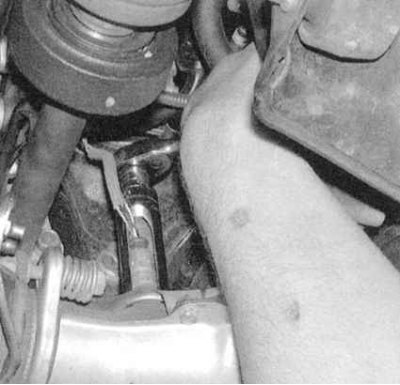
3. Carefully unscrew the probe from the exhaust manifold (see accompanying illustration).
4. Before screwing the sensor into place, lubricate its threaded part with anti-seize sealant (new sensors are usually already coated with the appropriate compound).
5. Screw the sensor into its original place and tighten it securely.
6. Connect the electrical wiring.
7. Lower the vehicle to the ground and test drive it. Check the control module memory for fault codes.