
Contents: Examination ⇊ Replacement ⇊
The ELD system detects signs of overload of the electrical circuits of the external lighting and signaling devices, fuel injection, charging, etc. The first symptom of such overloads is a disruption in the stability of the power supply at idle speed. The ELD is attached to the bottom of the fuse box located in the engine compartment of the car.
Examination
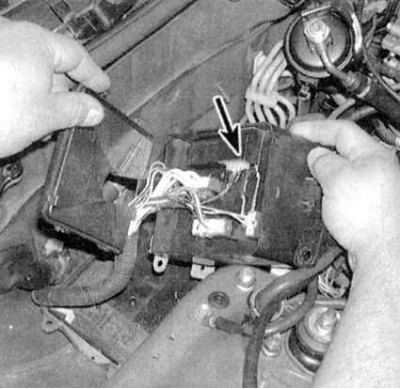
1. Disconnect the ELD system electrical connector (see accompanying illustration).
2. Measure the voltage between the terminals of the power wires (black and white [Civic] or black and yellow [Integra]) with the ignition on (do not start the engine) and ground (black). The nominal value is equal to the battery voltage. If there is no voltage, check the condition of the wiring in the area between the mounting block located under the instrument panel and the main mounting block in the engine compartment.
3. Measure the voltage between the green/red () and black (-) wire terminals. The nominal range is 4.0 to 4.5 V. If there is no reading, check the wiring between the fuse box and the ECM/PCM.
4. With the engine off, disconnect the 3-pin ELD harness connector. Now run the engine at idle speed and measure the voltage at the green/red wire terminal.
5. Now turn on the low beam headlights and read the new voltmeter reading - it should be less than the value measured in paragraph 4, otherwise replace the ELD.
Replacement
New ELDs are not supplied individually. Therefore, the detector is replaced together with the mounting block.