
HondaBook.ru
Auto companies Volkswagen Auto companies Ford Auto companies Lada Auto companies Skoda Auto companies BMW Auto companies Mazda Auto companies Peugeot
English Русский
Български
Беларускі
Український
Српски
Hrvatski
Română
Polski
Slovenský
Magyar
Bookmark Contacts Sitemap   


Accord Civic Fit / Jazz CR-V HR-V Others Articles
Civic 3 and 4 (1983-1991) Civic 5 and 6 (1991-2000) Civic 6 (1995-2000) Civic 7 (2000-2005) Civic 8 (2005-2011)

Hydraulic control (Honda Civic 5)

  • Main
  • Honda Civic
  • 5 (1991-2000)
  • Transmission
  • Automatic gearbox
  • Hydraulic control
0
Contents: ATF Pump (S4NA) ⇊ Control valve ⇊ Regulator valve ⇊ Reactor hydraulic pressure control ⇊
In the hydraulic control unit, the regulator valve, manual control valve and ATF pump connected with the torque converter are integrated and located inside the valve body. The valve body consists of the main level body, the regulator valve body, the secondary level body, the servo body, the lock-up system valve body, and the modulator valve body.

The ATF pump is driven through splines on the right end of the torque converter, which is connected to the engine. Fluid passes through the regulator valve to maintain rated pressure through the main level housing to the manual control valve, which directs pressure to each clutch.
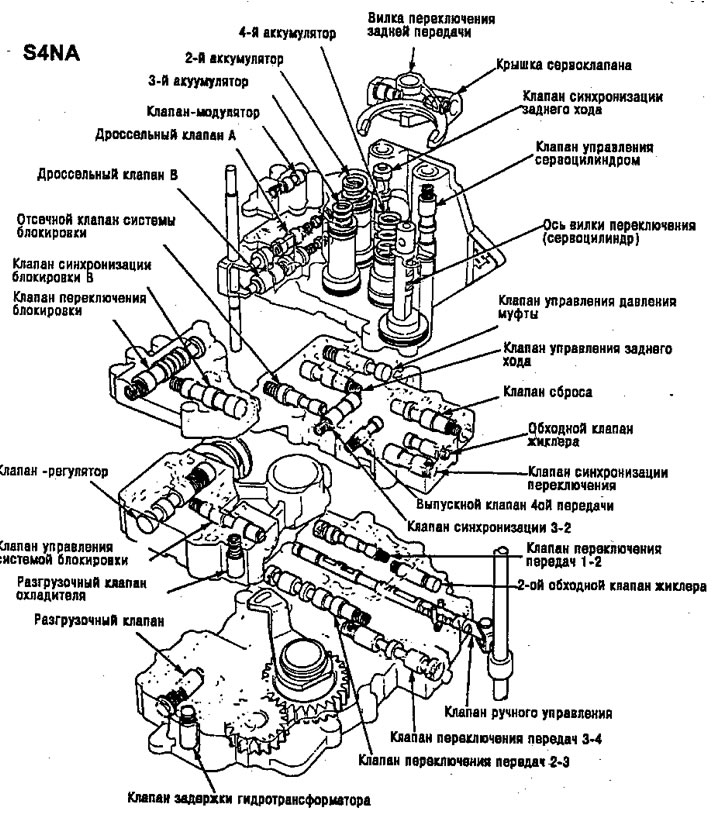
Hydraulic control

S4NA


ATF Pump (S4NA)


The ATF gear pump of external engagement consists of a housing, combined with the main level housing, a driving gear, a driven gear and a pump shaft. The ATF pump is installed on the torque converter housing, the pump is driven by the torque converter pump (directly connected to the engine) through the drive gear, which is connected to the shaft by splines. The gears are located in the housing, the input and output lines, and the torque converter line are also located in the housing.
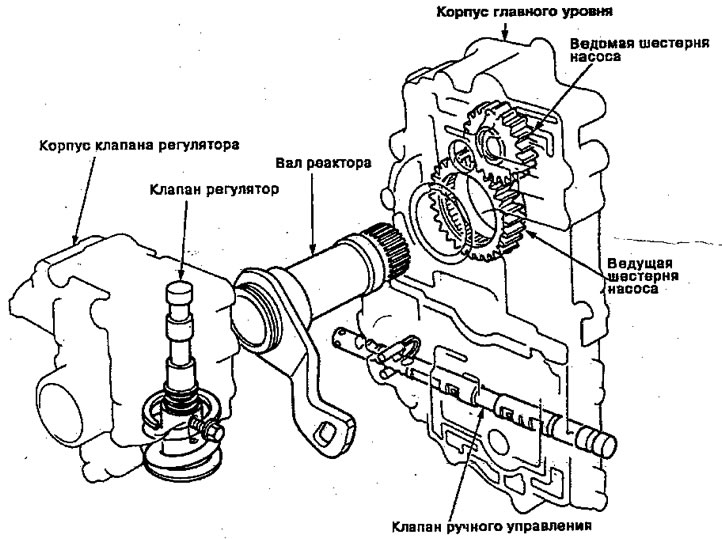


The ATF gear pump of external engagement consists…


Control valve


The control valve regulates the hydraulic pressure depending on the vehicle speed. The control valve maintains high pressure at high vehicle speed and low pressure at low vehicle speed, the pressure generated by the control valve acts on the gear shift valve and is one of the two causes of automatic speed change. The control valve gear, being in engagement with the driven gear of the main gear, rotates the valve shaft, regulating it with the help of centrifugal force. The control valve receives the line pressure. The generation of control pressure, regulates the line pressure. This pressure is regulated by the balance of centrifugal forces using the first, second and third weights centered around the axis of rotation. The force arises as a result of the difference in the diameters of the control valve and the number of revolutions, depending on the vehicle speed. The control pressure increases with increasing vehicle speed.
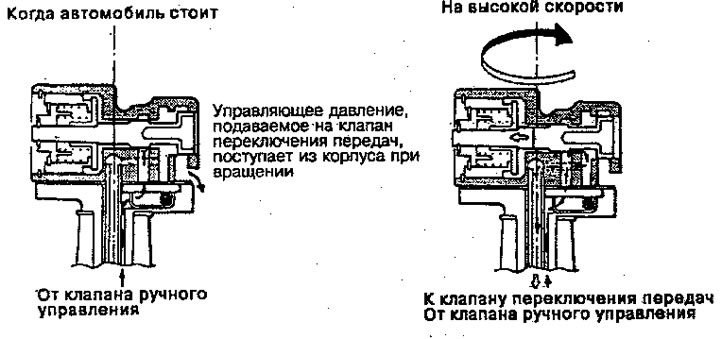
The control valve regulates the hydraulic…


Regulator valve


The regulator valve maintains constant hydraulic pressure sent from the ATF pump to the hydraulic control system, while at the same time transferring fluid to the lubrication system and torque converter.

The fluid passes through lines B and B*. The fluid entering line B then passes through the opening of valve A, pushing the regulator valve to the right. In accordance with the amount of hydraulic pressure in line B, the position of the valve changes, and thus the amount of fluid passing through lines B* and D changes. This process continues, maintaining the pressure of the line.

Note: When the term "right" or "left" is used, it refers to the direction as shown in the figure below.

(With the engine off.)
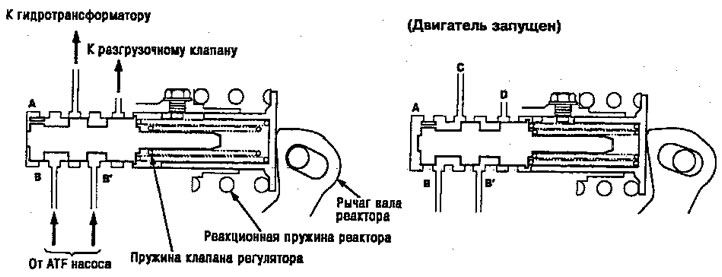
(With the engine off.)


Reactor hydraulic pressure control


The increase of hydraulic pressure in accordance with the moment is carried out by means of the regulator valve, using the reaction moment of the reactor. The shaft of the reactor enters the splines of the reactor and its end contacts the tip of the regulator spring. When the car accelerates or moves uphill(torque converter range), the reaction torque acts on the reactor shaft, and the lever pushes the tip of the regulator spring toward the arrow, proportional to the reaction. The spring is compressed, and the valve moves, increasing the regulated control pressure or line pressure. Line pressure is at its maximum when the reactor reaction is at its maximum.
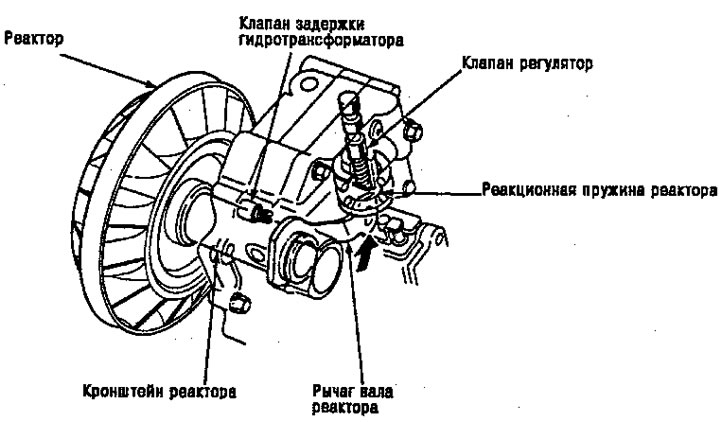


The increase of hydraulic pressure in accordance…


(Refer to the original source on the website: «HondaBook.ru»)
This article is available at: russian, bulgarian, belarusian, ukrainian, serbian, croatian, romanian, polish, slovak, hungarian
This information has been verified: Mikhail Kopasov
Share with friends:
◀ Previous
Civic 5 and 6: Automatic gearbox
Next ▶

Description of automatic transmission
Electronic control system (S4XA)
Logical selection system of control modes
Troubleshooting (S4XA)
Solenoid valve assembly for control of the locking system (S4XA)
Primary and secondary shaft speed sensor
See also other articles from Honda manuals:
Idle speed control Honda Accord 3 (1985-1989)
Windscreen wiper and washer control Honda Fit 1 (2001-2008)
Hydraulic drive control Honda CR-V 2 (2002-2006, petrol)
Instruments, control and signal lamps Honda HR-V 1 (1998-2006, petrol)
Remote control Honda Avancier 1 (1999-2003, petrol)
Link in different formats to this article
Comments and feedback from visitors
No comments yet


How much will 45 + 32 ?


Civic 8 (2005-2011) 
  • General information
  • Technical data
  • Governing bodies
  • Driving and maintenance
  • Power unit
  • Gasoline engines (L13A)
  • Gasoline engines (R18A)
  • Diesel engines (N22A)
  • Cooling and lubrication (L13A)
  • Cooling and lubrication (R18A)
  • Cooling and lubrication (N22A)
  • Injection system (gasoline)
  • Injection system (diesel)
  • Toxicity reduction system
  • Troubleshooting
  • Transmission
  • Clutch and drive shafts
  • Mechanical gearbox
  • Chassis and running gear
  • Suspension and wheels
  • Steering
  • Brake system
  • Body and interior
  • Exterior (external elements)
  • Doors, locks and windows
  • Electrical equipment
  • Equipment and devices
  • Headlights and lighting
  • Power devices
  • Electrical circuits
Civic 7 (2000-2005) 
  • General information
  • User manual
  • Maintenance
  • Power unit
  • Engines D15B and D17A
  • K20A Engines
  • Overhaul engine
  • Cooling system
  • Lubrication system
  • Fuel injection system
  • Toxicity reduction system
  • Engine electrical equipment
  • Transmission
  • Clutch
  • Manual gearbox
  • Automatic gearbox
  • Variator (CVT)
  • Drive shafts
  • Chassis and running gear
  • Car suspension
  • Steering
  • Brake system
  • Body and interior
  • Exterior (external elements)
  • Interior (internal elements)
  • Doors, locks and windows
  • Heater and air conditioner
  • Manual air conditioner
  • Automatic air conditioner
  • Security system
  • Electrical equipment
  • Equipment and devices
  • Headlights and lighting
  • Windscreen wipers
  • Audio system
  • Electrical diagrams
Civic 6 (1995-2000) 
  • General information
  • Introduction to guide
  • User manual
  • Maintenance
  • Power unit
  • Engine in car (Civic)
  • Engine in car (Integra)
  • Engine overhaul
  • Cooling and heating
  • Power and exhaust systems
  • Engine electrical equipment
  • Engine management systems
  • Transmission
  • Manual gearbox
  • Automatic transmission (AT/CVT)
  • Clutch and drive shafts
  • Chassis and running gear
  • Brake system
  • Car suspension
  • Steering
  • Body and interior
  • Exterior (external elements)
  • Interior (internal elements)
  • Doors, locks and windows
  • Electrical equipment
  • Equipment and devices
  • Electrical circuits
Civic 5 and 6 (1991-2000) 
  • Power unit
  • SOHC engines
  • DOHC engines
  • Engine overhaul
  • Cooling and lubrication system
  • Intake and exhaust system
  • Fuel injection system (SOHC)
  • Fuel injection system (DOHC)
  • Carburetor
  • Transmission
  • Clutch
  • Manual gearbox S4C
  • Manual gearbox S40
  • Automatic gearbox
  • Drive shafts
  • Chassis and running gear
  • Car suspension
  • Steering
  • Brake system
  • Body and interior
  • Body elements
  • Heater and air conditioner
  • Electrical equipment
  • Power devices
  • Equipment and instruments
  • Electrical circuits
Civic 3 and 4 (1983-1991) 
  • General information
  • Maintenance
  • Power unit
  • Engine in a car
  • Engine overhaul
  • Cooling system
  • Power and exhaust system
  • Engine electrical equipment
  • Emission control system
  • Transmission
  • Mechanical gearbox
  • Automatic gearbox
  • Clutch and drive shafts
  • Four-wheel drive
  • Chassis and running gear
  • Brake system
  • Car suspension
  • Steering
  • Body and interior
  • Body elements
  • Electrical equipment
  • Equipment and devices
  • Electrical circuits
HondaBook.ru © 2018–2026 • Mobile version • Sitemap: EN BG BY UA RS HR RO PL SK HU • Feedback • Driver Information • Search system • Bookmark
Accord 3 (1985-1989) • Accord 6 (1997-2002) • Civic 3 and 4 (1983-1991) • Civic 5 and 6 (1991-2000) • Civic 6 (1995-2000) • Civic 7 (2000-2005) • Civic 8 (2005-2011) • Fit 1 (2001-2008) • CR-V 1 (1995-2001) • CR-V 2 (2002-2006) • HR-V 1 (1998-2006) • Avancier 1 (1999-2003) •
 
This website uses cookies to ensure proper functioning. By clicking "OK," you agree.