
Note: If your distributor looks like the one shown in Fig. 8.7a, it is a TOYO DENSO distributor. Otherwise, it is a HITACHI distributor.
1. Remove the distributor cap (see Chapter 1).
2. Remove the breaker wires (see fig. 8.2).
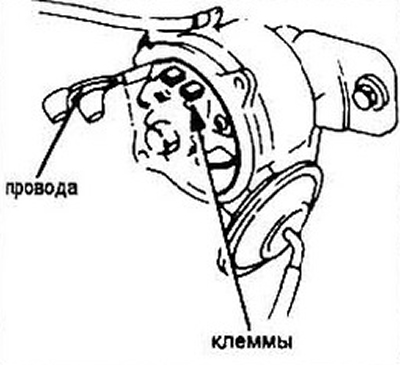
3. Turn the ignition key to the second position. Measure the voltage between the ground and the blue wire, then between the black and yellow wire and the ground. The voltage should be equal to the battery voltage. If the voltages are not equal, there is damage somewhere in the system.
4. Without connecting the wires, check for continuity in both directions at the two terminals of the breaker using an ohmmeter. There should be continuity in one direction only. If there is no continuity or continuity in both directions, replace the breaker, see below.
5. Unscrew the two screws securing the breaker to the distributor and remove it.
6. Install in the reverse order of crushing.
Models from 1984 to 1987 - TOYO DENSO distributor
7. Remove the breaker cover and remove the breaker assembly from the distributor.
8. Turn the ignition key to the second position. Check the voltage between the "ground" and the terminals blue 1 and black-yellow. In both cases there should be battery voltage.
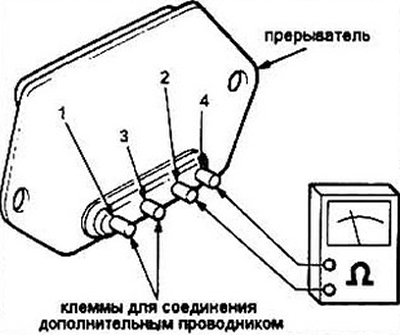
9. Short-circuit the blue 2 and green terminals with an additional conductor (see fig. 8.8). Using an ohmmeter, check between the black/yellow and blue (1) terminals. There should be continuity in one direction only.
10. Replace the faulty breaker.
Models since 1988
11. Using self-diagnosis (see Chapter 6) check for faults in the ignition system. On 1988-1989 models, the breaker is checked by diagnostic wires of the electronic control module (ECM), so diagnostics can only be performed at a service station. Since 1990, diagnostics are performed directly at the distributor.
12. Check the presence and serviceability of the 50-amp fuse in socket 32 of the fuse box.
13. Label and disconnect the connectors from the breaker.
14. Turn the ignition key to the second position and measure the voltage between the black-yellow wire and the "ground". It should be equal to the battery voltage. If there is no voltage equality, then there is a break somewhere between the ignition switch and the black-yellow wire.
15. With the ignition on, check the voltage between the white-blue wire and the ground. If this voltage is not equal to the battery voltage, check the circuit from the breaker to the lock and the ignition coil.
16. Using an ohmmeter, check the continuity of the current between the white wire and the "ground". If there is no continuity, there is a break between the interrupter and the ECU.
17. Check the continuity of the current between the blue and the "ground". If there is no continuity, there is a break between the interrupter, tachometer and the automatic transmission control unit.
18. If all the above tests are positive, but the engine does not start, replace the breaker.