
Engine cooling system
All vehicles covered in this manual use a closed, pressurized cooling system with thermostatically controlled circulation (see fig. 1.1).
The centrifugal type water pump is mounted from the front of the unit. The coolant (coolant) moves from front to back, washing each cylinder. Channels in the cooling jacket direct the coolant to the intake and exhaust channels in the spark plug zones and in close proximity to the exhaust valve guides.
The thermostat is located in the housing on the front of the engine. During warm-up, the thermostat is closed, preventing the coolant from circulating through the radiator. When warm, the coolant circulates in a large circle.
The cooling system is under pressure, which increases the boiling point of the coolant and the efficiency of the radiator. The pressure level in the system is regulated by a valve in the radiator cap (see fig. 1.3). The expansion tank serves both as a place to fill the coolant system and as a container that accumulates excess coolant when the engine heats up. Heating system.
The heating system consists of an air duct and a heater radiator placed in a common housing and connected to the cooling system by hoses. The heating level is controlled from the dashboard. Heated engine coolant circulates through the heater radiator. When the regulator is turned on to the heating position, warm air is directed into the car interior by means of flaps, which are forced to turn on from the dashboard.
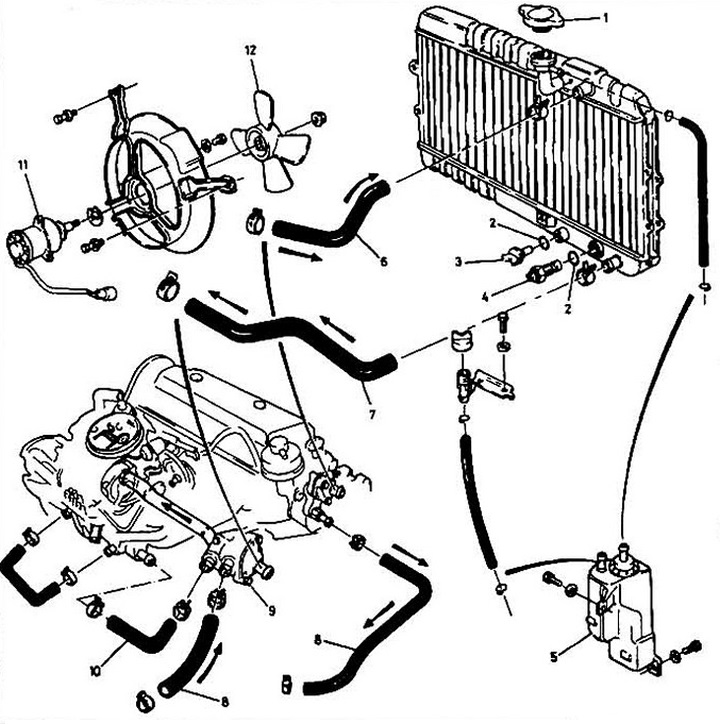
Fig. 1.1 Main components of the cooling system (the carburetor engine variant is shown)
1 - radiator cap; 2 - rubber ring; 3 - drain cock; 4 - thermal switch; 5 - expansion tank; 6 - upper hose; 7 - lower step; 8 - heater hoses; 9 - thermostat housing; 10 - bypass; 11 - Fan motor; 12 - fan.
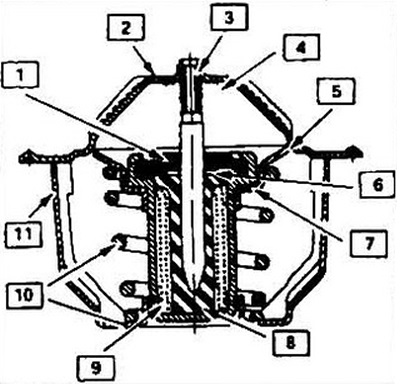
Fig. 1.2 Thermostat
1 - seal; 2 - flange; 3 - piston; 4 - nut; 5 - valve seat; 6 - Teflon gasket; 7 - valve; 8 - diaphragm; 9 - wax filler; 10 - spring; 11 - body.
Air conditioning system
The air conditioning system consists of a condenser mounted in front of the cooling system radiator, an evaporator mounted on the heater radiator, a compressor mounted on the engine, a filter-dryer (receiver) with a high-pressure check valve and the corresponding pipelines.
The fan takes air from the passenger compartment; feeds it to the evaporator, where heat is removed and the cooled air is fed into the cabin.
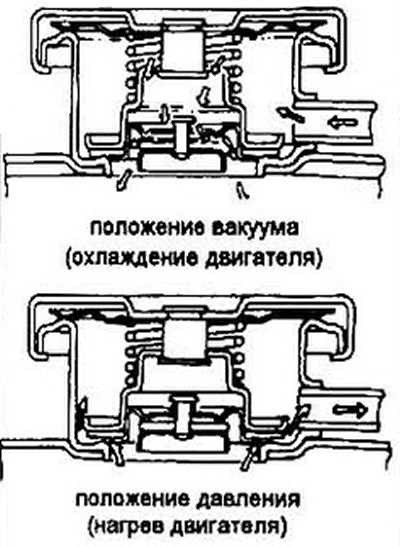
Fig. 1.3 Radiator cap
The article was taken from the website: www.hondabook.ru