
Warning! Failure to properly adjust the direction of the optical axes of the headlights may result in blinding drivers of parallel vehicles and may cause an emergency situation on the road. The headlights should be checked for correct adjustment regularly once every 12 months, as well as every time after replacing the headlights and repairing the supporting elements of the front of the vehicle. Readers should pay attention to the fact that the procedure described below can only be considered a preventive adjustment. The final adjustment of the optical axes should be performed in a specialized car service workshop!
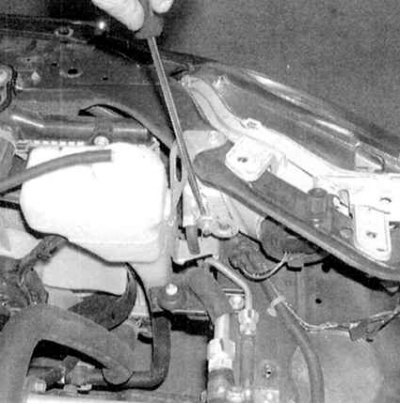
1a. Each of the headlight units is equipped with two spring-loaded adjusting screws: one on the inside – for adjusting the position of the headlight in the vertical plane...
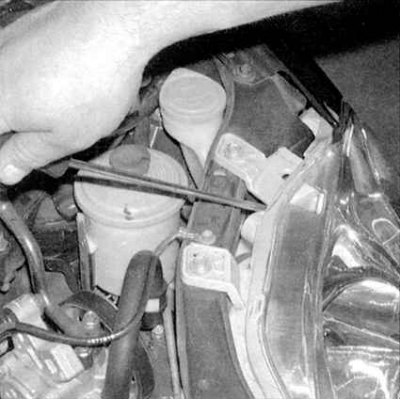
1b....and one outside (next to the parking light assembly) – to adjust the headlight in the horizontal plane) (see accompanying illustrations).
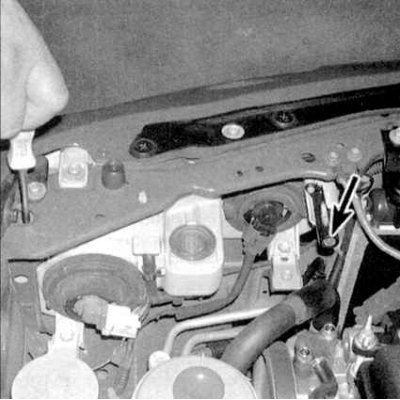
1c. Headlamp alignment points on Integra models.
2. There are several methods for adjusting the direction of the optical axes of the headlights. The simplest of them is the method using scotch tape and a section of a blank wall with a flat horizontal area in front of it.
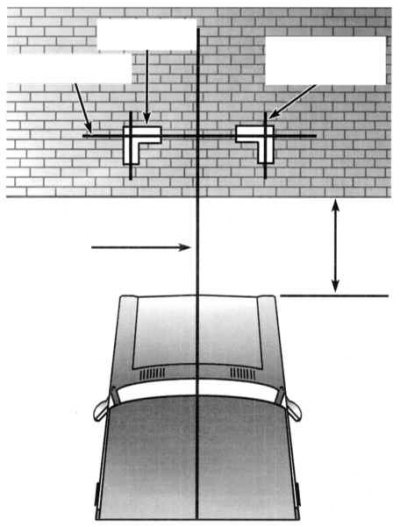
3. Roll the front of the car to the wall. Stick a strip of tape on the wall along a vertical line running in the plane of the car's symmetry axis. Also stick vertical strips of tape along the lines running through the centers of the headlight lenses' projections on the wall (see accompanying illustration).
4. Stick a horizontal strip of tape onto the wall along a line drawn through the centers of the projections of the headlight lenses onto the wall surface.
Note: This procedure is easier to perform if you drive the car close to the wall.
5. To adjust the direction of the optical axes of the headlights, roll the car away from the wall to a distance of approximately 7.6 m.
Note: The area on which the vehicle is placed must have a flat horizontal surface, preferably with a hard surface. The vehicle's fuel tank must be half full, and all heavy objects that could disrupt the vehicle's alignment must be removed from the passenger compartment and luggage compartment.
6. Start by adjusting the direction of the low beam optical axis. Try to achieve such a position of the light spots by turning the adjusting screws of the headlights that the zones with maximum illumination intensity are approximately 50 mm below the horizontal line and the same amount to the right of the vertical ones.
7. After completing the first adjustment, turn on the high beam: the zones of maximum illumination intensity should shift in the direction of the intersection of the vertical lines with the horizontal, ending up slightly below the latter.
Note. It is not possible in practice to achieve the same complete centering of both low and high beams. You should try to achieve some compromise solution taking into account the specifics of vehicle operation, keeping the desire to ensure maximum traffic safety at the forefront.
8. At the earliest opportunity, take the vehicle to a service station to have the optical axes of the headlights adjusted using special equipment.