
Warning! Frequent inhalation of dust from brake pad surfaces, regardless of the material composition, may pose a health hazard.
- Do not inhale dust.
- Do not clean brake surfaces with compressed air or a brush. Use a vacuum cleaner.
1. Slightly loosen the front wheel nuts, then raise the vehicle and secure it on safety stands. Remove the front wheels.
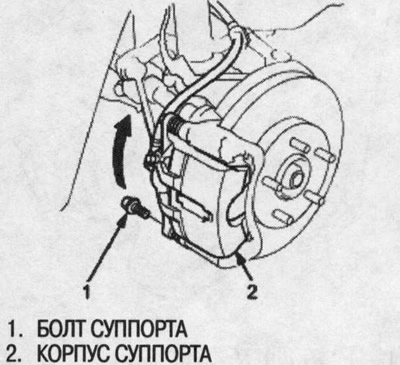
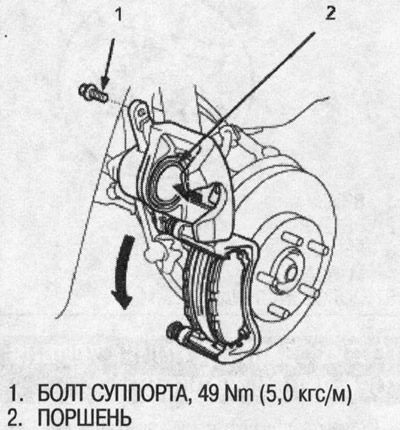
2. Remove the bolt from the caliper and swing it up and to the side. Check the hoses and finger boots for damage or wear.
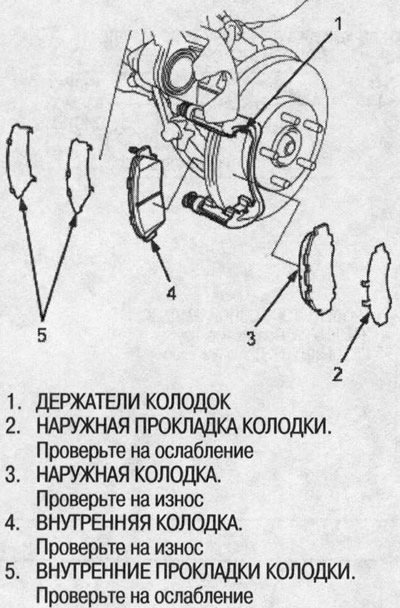
3. Remove the brake pad linings, pad retainers and pads.
4. Using a caliper, measure the thickness of the brake pad friction material. This does not include the thickness of the metal backing.
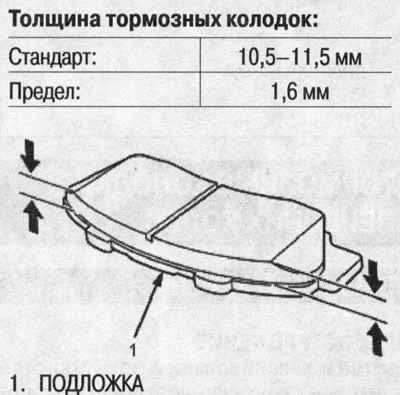
5. If the thickness of the brake pads is less than the limit value, replace the pads and linings at the same time.
6. Clean the caliper thoroughly; remove rust and check for grooves or cracks.
7. Check the brake disc for damage and cracks.
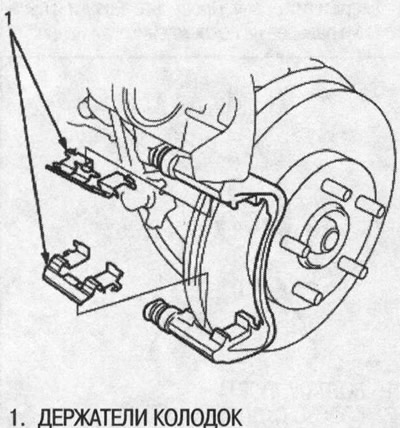
8. Install the brake shoe holders.
9. Apply Molykote M77 or Daikal-ub 528D grease to the pad side of the gaskets and to the back side of the brake pads. Wipe off excess grease from the gaskets.
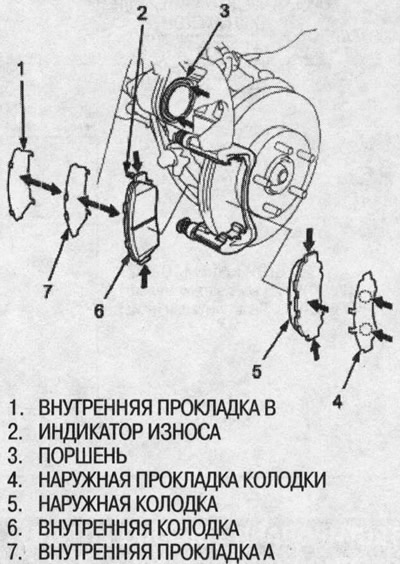
10. Install the brake pads and linings correctly. Install the pad with the wear indicator facing inward.
Warning!
- When reusing brake pads, always install them in their original position to avoid loss of braking efficiency.
- Contaminated brake discs or pads increase the braking distance. Do not allow grease to come into contact with the discs and pads.
11. Press the piston in so that the caliper fits over the pads. Make sure the piston dust boot is in place to avoid damage when the caliper is swung down.
12. Fold the caliper down without damaging the pin boot. Insert the bolt into the caliper and tighten it.
13. Press the brake pedal several times to make sure the brakes work, then road test.
Note: Immediately after replacing the brake pad assembly, a greater pedal travel may be required to engage the brake. After a few presses of the brake pedal, normal pedal travel will be restored.
14. After installation, check for leaks at the joints of the hoses and tubes or at the fittings and tighten if necessary.
[Information obtained from this source «HondaBook»]