
Basic control
The ABS control unit detects the wheel speed from the received wheel sensor signal, then calculates the vehicle speed based on the detected wheel speeds. The control unit determines the vehicle speed during deceleration by subtracting the corresponding values from the vehicle speed before deceleration.
The ABS control unit calculates the relative slip for each wheel and transmits a control signal to the electromagnetic modulator unit when the relative slip is too high. The pressure reduction circuit is a three-channel system of each front wheel and both rear wheels. The pressure reduction control is a three-mode system such as pressure reduction, pressure retention and pressure strengthening. The wheel sensor signal is a four-channel system from each wheel.
Self-diagnosis function
The ABS control unit is equipped with a control chronometer.
The ABS control unit is equipped with a main CPU (processor unit) and an auxiliary CPU, both CPUs control each other.
Both CPUs monitor the electrical circuit of the system. When at least one of the CPUs detects a fault, both switch the system to the system failure mode or the slowdown control mode,

Self-diagnosis can be classified into four categories as below.
1. Initial diagnosis
2. Out of ABS control
3. During ABS control
4. During the warning
On-board diagnostic functions
The ABS control unit is equipped with a data transfer connector.
The ABS system can be diagnosed with the HONDA PGM-H tester.
ABS modulator
ABS modulator consists of inlet solenoid valve, outlet solenoid valve, filler tank, pump, pump motor and vibration damping chamber. The ABS unit with direct pressure reduction control, which directly reduces the brake fluid pressure, is completely included in the modulator, it is also known as recirculation type because the brake fluid circulates through the brake1 filler tank and the master cylinder.
The hydraulic control has three modes: pressure reduction, pressure holding and pressure increase.
The hydraulic circuit consists of four independent channels for each wheel
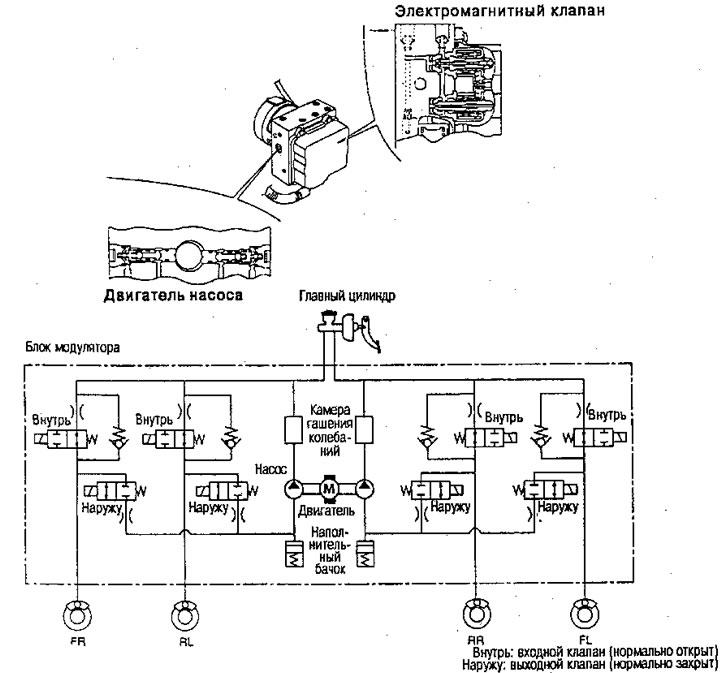
Pressure boost mode:
- The inlet valve is open, the outlet valve is closed. The master cylinder fluid is pumped out of the brake cylinders.
Pressure Hold Mode:
- Inlet valve closed, outlet valve closed.
- The brake cylinder fluid is blocked by an inlet and outlet valve.
Pressure reduction mode:
- The inlet valve is closed, the outlet valve is open.
- Brake fluid flows through the outlet valve to the filler tank.
Engine operating mode:
- When the pressure reduction mode is activated, the pump motor is turned on.
- When ABS operation stops, the pump motor turns off.
- The fluid from the filling tank is pumped out by the pump and flows through the vibration damping chamber to the master brake cylinder.