
HondaBook.ru
Auto companies Volkswagen Auto companies Ford Auto companies Lada Auto companies Skoda Auto companies BMW Auto companies Mazda Auto companies Peugeot
English Русский
Български
Беларускі
Український
Српски
Hrvatski
Română
Polski
Slovenský
Magyar
Bookmark Contacts Sitemap   


Accord Civic Fit / Jazz CR-V HR-V Others Articles
Civic 3 and 4 (1983-1991) Civic 5 and 6 (1991-2000) Civic 6 (1995-2000) Civic 7 (2000-2005) Civic 8 (2005-2011)

Electric windows (Honda Civic 8)

  • Main
  • Honda Civic
  • 8 (2005-2011)
  • General information
  • Governing bodies
  • Electric windows
0
Contents: "AUTO" mode ⇊ Main window switch ⇊ Autoreverse (automatic glass return…⇊
The car is equipped with electric windows that…


The car is equipped with electric windows that can only be operated when the ignition is on (ignition key turned to the "ON" (II) position). To open the window, press the switch button down and hold it down while the window is lowered. You can stop the window in the desired position by releasing the button. The window is raised by pressing and holding the switch button in the upper position.

The windows remain operational for 10 minutes after the ignition is switched off. During this period, the automatic window lifter function operates only for the driver's door window. Once any front door is opened, this function no longer operates.

Warning! The power window can severely pinch and injure a hand or fingers caught in the window opening.


Before turning on the power window to close the windows, make sure that passengers have removed their hands and heads from the window openings.

If you exit a vehicle with passengers remaining, be sure to remove the key from the ignition and take it with you.


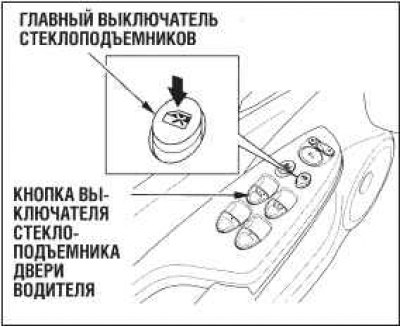
The driver's door armrest contains the central control panel for all the car's electric windows. To open a window on any passenger door, press the corresponding switch button down and hold it down while lowering the window to the desired position. To raise the window, slide the corresponding button up and hold it in this position. When the window reaches the desired position, release the switch button.

"AUTO" mode


The driver's door window, as well as the front passenger door window, can be completely lowered by pressing the switch button once. To lower the window automatically, press the window lifter switch button firmly. This will open the window completely. You can stop the window at any time by pushing the button up while the window is lowering.

To raise the window automatically, press the window lift switch button firmly until it rises. This will close the window completely. You can stop the window at any time by pressing down on the button while the window is rising.

To partially lower or raise the driver's door window or the front passenger door window, lightly press the window switch button down or up, respectively, and hold it down while the window moves. The window will stop as soon as you release the switch button.

Main window switch


The master switch allows the driver to cut off power to the passenger door power windows, preventing the passenger door windows from being raised or lowered using the switches located on them. The master switch has no effect on the driver's door window. To restore control of the windows from the passenger door remote controls, press the recessed button on the master switch. Disable the passenger door remote controls using the master switch if children are riding in the vehicle. This will help prevent children from being accidentally injured by the windows moving up.


Visual indicators built into the power window control buttons illuminate when the ignition key is turned to the "ON" (II) position.

Autoreverse (automatic glass return mode)


If the driver's door window, as well as the front passenger door, is raised in automatic mode and there is an obstacle in its path, the window will automatically stop raising and will start to lower down to its original position. To close the window after the window lift has stopped, remove the obstacle from the window opening and press the window lift button again.

Even with this feature, you should always check the safe position of all passengers in the car before closing the windows. The window lifter does not function in this mode if the window is already almost completely raised.

As a result of the battery being discharged, disconnected or the fuse being removed, the operation of the driver's door window lifter and the front passenger door window lifter in automatic mode is impossible. In this case, after the battery is restored, (or installing a fuse) it is necessary to initialize the electric windows as follows:

1. Start the engine. Press and hold the driver's door window switch until the window is completely lowered.

2. Slide the driver's door window switch up and hold it until the window is fully raised and for two seconds after that.

3. Repeat steps 1 and 2 for the front passenger door window.

If the correct operation of the window lifts is not restored after initialization, contact your dealer or service station to determine and eliminate the causes of the system malfunction.
This article is available at: russian, bulgarian, belarusian, ukrainian, serbian, croatian, romanian, polish, slovak, hungarian
This information has been verified: Yaroslav Shiryaev
Share with friends:
◀ Previous
Civic 8: Governing bodies
Next ▶

Opening and closing the hood
Fuel tank filler hatch
Luggage securing
Rear door lock
Replacing the battery built into the remote control
Overhead hatches (for some vehicle versions)
Instrument cluster indicator lights
Instrument cluster gauges and instruments
Windscreen wiper and washer switch
Interior rear view mirror
See also other articles from Honda manuals:
Radiator and electric fans — removal and installation Honda Accord 3 (1985-1989)
Electric fan of the cooling system Honda Fit 1 (2001-2008)
Restoration of electric motors in a car Honda CR-V 1 (1995-2001, petrol)
Electric windows — general description Honda HR-V 1 (1998-2006, petrol)
Electric valves B and C of gear shifting — replacement Honda Avancier 1 (1999-2003, petrol)
Link in different formats to this article
Comments and feedback from visitors
No comments yet


How much will 31 + 14 ?


Civic 8 (2005-2011) 
  • General information
  • Technical data
  • Governing bodies
  • Driving and maintenance
  • Power unit
  • Gasoline engines (L13A)
  • Gasoline engines (R18A)
  • Diesel engines (N22A)
  • Cooling and lubrication (L13A)
  • Cooling and lubrication (R18A)
  • Cooling and lubrication (N22A)
  • Injection system (gasoline)
  • Injection system (diesel)
  • Toxicity reduction system
  • Troubleshooting
  • Transmission
  • Clutch and drive shafts
  • Mechanical gearbox
  • Chassis and running gear
  • Suspension and wheels
  • Steering
  • Brake system
  • Body and interior
  • Exterior (external elements)
  • Doors, locks and windows
  • Electrical equipment
  • Equipment and devices
  • Headlights and lighting
  • Power devices
  • Electrical circuits
Civic 7 (2000-2005) 
  • General information
  • User manual
  • Maintenance
  • Power unit
  • Engines D15B and D17A
  • K20A Engines
  • Overhaul engine
  • Cooling system
  • Lubrication system
  • Fuel injection system
  • Toxicity reduction system
  • Engine electrical equipment
  • Transmission
  • Clutch
  • Manual gearbox
  • Automatic gearbox
  • Variator (CVT)
  • Drive shafts
  • Chassis and running gear
  • Car suspension
  • Steering
  • Brake system
  • Body and interior
  • Exterior (external elements)
  • Interior (internal elements)
  • Doors, locks and windows
  • Heater and air conditioner
  • Manual air conditioner
  • Automatic air conditioner
  • Security system
  • Electrical equipment
  • Equipment and devices
  • Headlights and lighting
  • Windscreen wipers
  • Audio system
  • Electrical diagrams
Civic 6 (1995-2000) 
  • General information
  • Introduction to guide
  • User manual
  • Maintenance
  • Power unit
  • Engine in car (Civic)
  • Engine in car (Integra)
  • Engine overhaul
  • Cooling and heating
  • Power and exhaust systems
  • Engine electrical equipment
  • Engine management systems
  • Transmission
  • Manual gearbox
  • Automatic transmission (AT/CVT)
  • Clutch and drive shafts
  • Chassis and running gear
  • Brake system
  • Car suspension
  • Steering
  • Body and interior
  • Exterior (external elements)
  • Interior (internal elements)
  • Doors, locks and windows
  • Electrical equipment
  • Equipment and devices
  • Electrical circuits
Civic 5 and 6 (1991-2000) 
  • Power unit
  • SOHC engines
  • DOHC engines
  • Engine overhaul
  • Cooling and lubrication system
  • Intake and exhaust system
  • Fuel injection system (SOHC)
  • Fuel injection system (DOHC)
  • Carburetor
  • Transmission
  • Clutch
  • Manual gearbox S4C
  • Manual gearbox S40
  • Automatic gearbox
  • Drive shafts
  • Chassis and running gear
  • Car suspension
  • Steering
  • Brake system
  • Body and interior
  • Body elements
  • Heater and air conditioner
  • Electrical equipment
  • Power devices
  • Equipment and instruments
  • Electrical circuits
Civic 3 and 4 (1983-1991) 
  • General information
  • Maintenance
  • Power unit
  • Engine in a car
  • Engine overhaul
  • Cooling system
  • Power and exhaust system
  • Engine electrical equipment
  • Emission control system
  • Transmission
  • Mechanical gearbox
  • Automatic gearbox
  • Clutch and drive shafts
  • Four-wheel drive
  • Chassis and running gear
  • Brake system
  • Car suspension
  • Steering
  • Body and interior
  • Body elements
  • Electrical equipment
  • Equipment and devices
  • Electrical circuits
HondaBook.ru © 2018–2026 • Mobile version • Sitemap: EN BG BY UA RS HR RO PL SK HU • Feedback • Driver Information • Search system • Bookmark
Accord 3 (1985-1989) • Accord 6 (1997-2002) • Civic 3 and 4 (1983-1991) • Civic 5 and 6 (1991-2000) • Civic 6 (1995-2000) • Civic 7 (2000-2005) • Civic 8 (2005-2011) • Fit 1 (2001-2008) • CR-V 1 (1995-2001) • CR-V 2 (2002-2006) • HR-V 1 (1998-2006) • Avancier 1 (1999-2003) •
 
This website uses cookies to ensure proper functioning. By clicking "OK," you agree.