
HondaBook.ru
Auto companies Volkswagen Auto companies Ford Auto companies Lada Auto companies Skoda Auto companies BMW Auto companies Mazda Auto companies Peugeot
English Русский
Български
Беларускі
Український
Српски
Hrvatski
Română
Polski
Slovenský
Magyar
Bookmark Contacts Sitemap   


Accord Civic Fit / Jazz CR-V HR-V Others Articles
Civic 3 and 4 (1983-1991) Civic 5 and 6 (1991-2000) Civic 6 (1995-2000) Civic 7 (2000-2005) Civic 8 (2005-2011)

Bleeding the brake system (Honda Civic 7)

  • Main
  • Honda Civic
  • 7 (2000-2005)
  • Chassis and running gear
  • Brake system
  • Bleeding the brake system
0
Contents: Checking the brake fluid level ⇊ Bleeding the brake system ⇊

Checking the brake fluid level


The procedures for checking the brake fluid level are described in the chapter "Maintenance and general check and adjustment procedures".

Bleeding the brake system


Note:
  • During bleeding, the brake fluid level in the reservoir should not fall below 3/4 of the set level.
  • Whenever the brake pipes are disconnected, the entire system must be bled. If the brake pipe was disconnected from the master cylinder, start bleeding from the wheel cylinder farthest from the master, then move to the next farthest wheel cylinder, and so bleed all four wheel cylinders. If the brake pipe was disconnected in another place, start bleeding from the wheel cylinder closest to the place where the pipe was disconnected, move to the next closest wheel cylinder, and so bleed all four wheel cylinders.


1. Make sure that the brake fluid level in the reservoir is near the "MAX" mark. Add brake fluid if necessary.
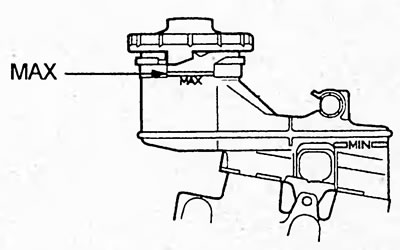
Sedan.
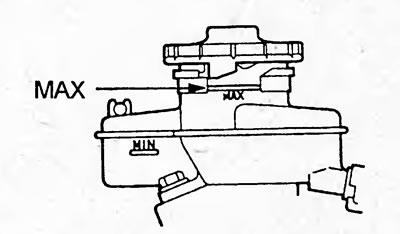
Sedan.


Hatchback.

Hatchback.


2. Jack up the car and place it on stands.

3. Remove the cap from the bleed nipple and place a clear vinyl hose on the nipple (the location of the fittings is shown in the figure).
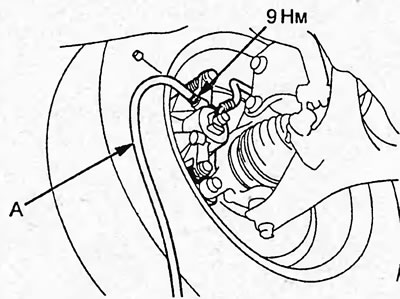
Front wheels.
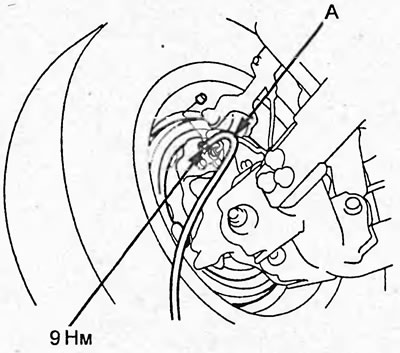
Front wheels.


Rear wheels (models with rear drum brakes).
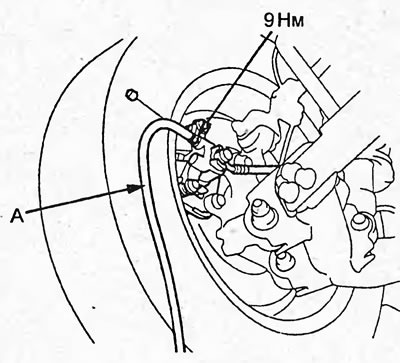
Rear wheels (models with rear drum brakes).


Rear wheels (models with rear disc brakes).

Rear wheels (models with rear disc brakes).


3. Place the other end of the hose into a clear container to collect the brake fluid.


4. One worker must press the brake pedal several times and hold the pedal down.

5. Another worker uses a special tool to loosen the bleed nipple and, after the fluid has passed into the brake fluid drain tank, tightens the nipple.

6. Repeat steps 4 and 5 until no more air bubbles appear in the escaping brake fluid.

7. Check that the brakes are working properly.

8. Check for brake fluid leaks.

Caution: If brake fluid leaks, remove it immediately.


9. After bleeding the brake system, bring the brake fluid level to the maximum.

Brake fluid - DOT-3 or DOT-4
Location of brake system components. 1 - master…

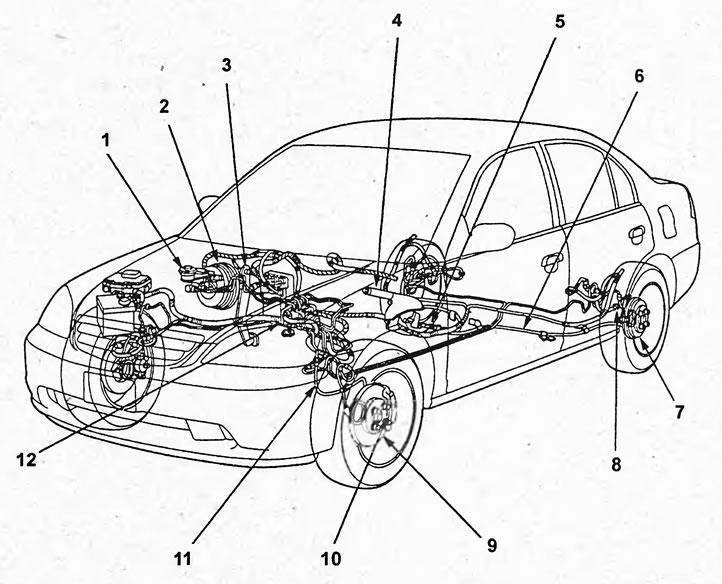
Location of brake system components. 1 - master brake cylinder, 2 - brake booster, 3 - brake pedal, 4 - parking brake lever / parking brake pedal (5-door hatchback), 5 - equalizer, 6 - parking brake cable, 7 - rear wheel brake mechanisms, 8 - brake hose, 9 - brake disc, 10 - brake caliper, 11 - brake hose, 12 - pressure modulator.


(Original material on the website HondaBook.ru)
This article is available at: russian, bulgarian, belarusian, ukrainian, serbian, croatian, romanian, polish, slovak, hungarian
This information has been verified: Yaroslav Shiryaev
Share with friends:
◀ Previous
Civic 7: Brake system
Next ▶

 
Checking the vacuum hose
Brake pedal
Master Brake Cylinder (Sedan)
Brake Master Cylinder (Hatchback)
Vacuum brake booster
See also other articles from Honda manuals:
Bleeding the brake system Honda Accord 3 (1985-1989)
Bleeding the brake system Honda Fit 1 (2001-2008)
Bleeding the brake system Honda CR-V 1 (1995-2001, petrol)
Bleeding the brake system Honda HR-V 1 (1998-2006, petrol)
Brake system — bleeding Honda Avancier 1 (1999-2003, petrol)
Link in different formats to this article
Comments and feedback from visitors
No comments yet


How much will 30 + 12 ?


Civic 8 (2005-2011) 
  • General information
  • Technical data
  • Governing bodies
  • Driving and maintenance
  • Power unit
  • Gasoline engines (L13A)
  • Gasoline engines (R18A)
  • Diesel engines (N22A)
  • Cooling and lubrication (L13A)
  • Cooling and lubrication (R18A)
  • Cooling and lubrication (N22A)
  • Injection system (gasoline)
  • Injection system (diesel)
  • Toxicity reduction system
  • Troubleshooting
  • Transmission
  • Clutch and drive shafts
  • Mechanical gearbox
  • Chassis and running gear
  • Suspension and wheels
  • Steering
  • Brake system
  • Body and interior
  • Exterior (external elements)
  • Doors, locks and windows
  • Electrical equipment
  • Equipment and devices
  • Headlights and lighting
  • Power devices
  • Electrical circuits
Civic 7 (2000-2005) 
  • General information
  • User manual
  • Maintenance
  • Power unit
  • Engines D15B and D17A
  • K20A Engines
  • Overhaul engine
  • Cooling system
  • Lubrication system
  • Fuel injection system
  • Toxicity reduction system
  • Engine electrical equipment
  • Transmission
  • Clutch
  • Manual gearbox
  • Automatic gearbox
  • Variator (CVT)
  • Drive shafts
  • Chassis and running gear
  • Car suspension
  • Steering
  • Brake system
  • Body and interior
  • Exterior (external elements)
  • Interior (internal elements)
  • Doors, locks and windows
  • Heater and air conditioner
  • Manual air conditioner
  • Automatic air conditioner
  • Security system
  • Electrical equipment
  • Equipment and devices
  • Headlights and lighting
  • Windscreen wipers
  • Audio system
  • Electrical diagrams
Civic 6 (1995-2000) 
  • General information
  • Introduction to guide
  • User manual
  • Maintenance
  • Power unit
  • Engine in car (Civic)
  • Engine in car (Integra)
  • Engine overhaul
  • Cooling and heating
  • Power and exhaust systems
  • Engine electrical equipment
  • Engine management systems
  • Transmission
  • Manual gearbox
  • Automatic transmission (AT/CVT)
  • Clutch and drive shafts
  • Chassis and running gear
  • Brake system
  • Car suspension
  • Steering
  • Body and interior
  • Exterior (external elements)
  • Interior (internal elements)
  • Doors, locks and windows
  • Electrical equipment
  • Equipment and devices
  • Electrical circuits
Civic 5 and 6 (1991-2000) 
  • Power unit
  • SOHC engines
  • DOHC engines
  • Engine overhaul
  • Cooling and lubrication system
  • Intake and exhaust system
  • Fuel injection system (SOHC)
  • Fuel injection system (DOHC)
  • Carburetor
  • Transmission
  • Clutch
  • Manual gearbox S4C
  • Manual gearbox S40
  • Automatic gearbox
  • Drive shafts
  • Chassis and running gear
  • Car suspension
  • Steering
  • Brake system
  • Body and interior
  • Body elements
  • Heater and air conditioner
  • Electrical equipment
  • Power devices
  • Equipment and instruments
  • Electrical circuits
Civic 3 and 4 (1983-1991) 
  • General information
  • Maintenance
  • Power unit
  • Engine in a car
  • Engine overhaul
  • Cooling system
  • Power and exhaust system
  • Engine electrical equipment
  • Emission control system
  • Transmission
  • Mechanical gearbox
  • Automatic gearbox
  • Clutch and drive shafts
  • Four-wheel drive
  • Chassis and running gear
  • Brake system
  • Car suspension
  • Steering
  • Body and interior
  • Body elements
  • Electrical equipment
  • Equipment and devices
  • Electrical circuits
HondaBook.ru © 2018–2026 • Mobile version • Sitemap: EN BG BY UA RS HR RO PL SK HU • Feedback • Driver Information • Search system • Bookmark
Accord 3 (1985-1989) • Accord 6 (1997-2002) • Civic 3 and 4 (1983-1991) • Civic 5 and 6 (1991-2000) • Civic 6 (1995-2000) • Civic 7 (2000-2005) • Civic 8 (2005-2011) • Fit 1 (2001-2008) • CR-V 1 (1995-2001) • CR-V 2 (2002-2006) • HR-V 1 (1998-2006) • Avancier 1 (1999-2003) •
 
This website uses cookies to ensure proper functioning. By clicking "OK," you agree.