
Clutch Pedal Adjustment Details
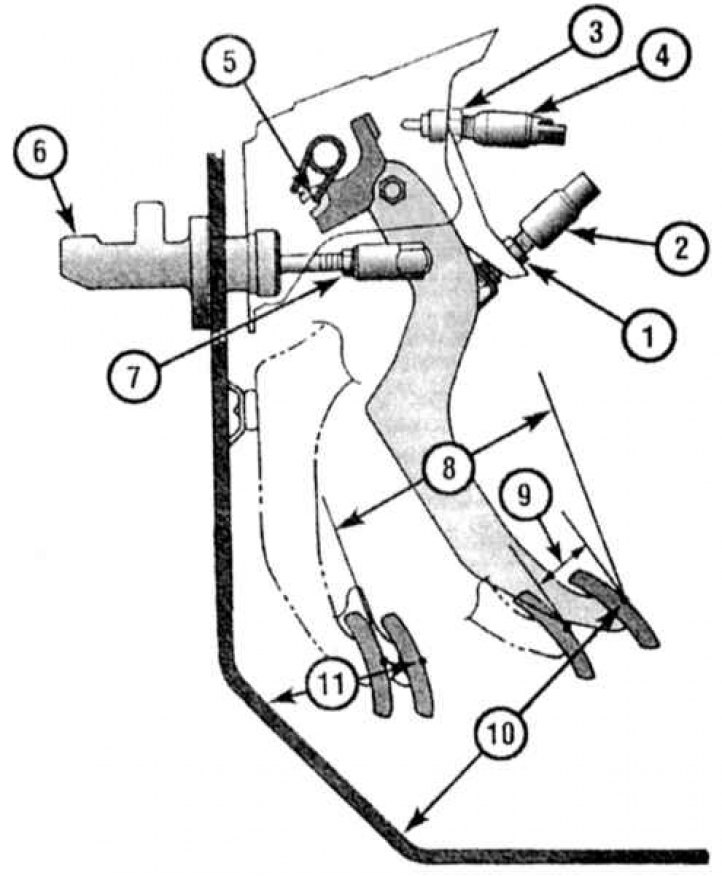
1 - Lock nut of sensor-switch A; 2 - Sensor-switch A; 3 - Lock nut of the sensor-switch B; 4 - Sensor-switch B for opening the starter circuit; 5 - Auxiliary spring; 6 - Clutch master cylinder; 7 - Master cylinder pusher lock nut; 8 - Full travel of the clutch pedal; 9 - Free travel of the clutch pedal; 10 - Clutch pedal height; 11 - Height of the depressed clutch pedal
Pedal height
The height of the pedal position is the distance from its pad to the floor panel (see accompanying illustration). If the measurement result of this distance is outside the permissible range, appropriate adjustment must be made.
1. To adjust the pedal position, loosen the clutch switch lock nut (A) or adjusting bolt and turn the switch so that it no longer contacts the pedal. Now loosen the push rod lock nut (see illustration above) and, rotating the latter, adjust the height of the pedal position as required. Tighten the lock nut.
2. Rotate the switch/bolt clockwise until it contacts the pedal arm, then turn it another 3/4 turn/turn. Tighten the lock nut.
3. Adjust the starter circuit breaker switch (see Checking the condition, replacing and adjusting the starter circuit breaker switch sensor).
Free pedal travel
Free play is the distance the pedal can move without encountering resistance and without causing the clutch to engage (see illustration above). If the pedal free travel value goes beyond the permissible range, it is necessary to make the appropriate adjustment.
1. To adjust the free play, loosen the lock nut on the pedal pusher, then rotate the pusher until the desired result is achieved. Tighten the lock nut.
2. Make sure that the starter circuit breaker switch is adjusted correctly (see Checking the condition, replacing and adjusting the starter circuit breaker switch sensor)