
Note: Before performing any starter function tests, make sure that the hard starting condition is not caused by a low battery level.
1. If the starter does not turn at all when the ignition key is turned to the START position, first of all, perform the following simple checks:
- a) Check the battery charge level and the reliability of the wires on the battery terminals and the starter solenoid relay;
- b) Check the condition of the battery cables (see Checking the condition and replacing battery wires). Replace defective components;
- c) Check the battery status (see Checking the battery status and replacing it). If necessary, replace it with a new one;
- d) Check the condition of the wiring and terminal connections of the starter (see the electrical connection diagrams in Chapter On-board electrical equipment);
- e) Check that the starter mounting bolts are securely tightened;
- f) If equipped, check the condition of the fuse links in the fuse box in the engine compartment of the vehicle (see Chapter On-board electrical equipment). If any of the inserts fail, investigate and eliminate the causes of the overload. Also check the proper functioning of the ignition switch circuit (see Chapter On-board electrical equipment);
- g) Check the proper functioning of the start enable switch sensor (models with AT)/starter circuit shutdown (models with manual transmission). The engine can only be started when the gear selector lever is in position "P" or "N" (AT), or the clutch pedal is fully depressed (manual transmission).
2. If the starter does not start to rotate when the ignition key is turned to the START position, check the correctness of the battery power supply to the traction relay. First, make sure that the ignition switch is functioning properly. Connect a voltmeter to the terminals of the traction relay and ask an assistant to crank the engine. The voltmeter should give a reading of 12.6 V, otherwise, check the corresponding electrical connection diagrams (see Chapter On-board electrical equipment), check all relays and fuses in series with the starting system. On Integra models, locate the relay/fuse panel under the instrument panel on the driver's side of the vehicle and check the condition of fuse #31, the 7.5 Amp fuse. Also check for proper operation of the starter cut-off relay. If power is present but the starter does not turn, remove the starter from the engine (see Removal and installation the starter) and transfer it to the workbench for more detailed diagnostics (see paragraph 4).
3. If the starter turns the crankshaft too slowly, it is necessary to check the value of the supply voltage to it. The check is carried out without removing the starter from the engine. Do not turn on the starter for more than 10 seconds at a time. During engine cranking, the voltage should not drop below 8.5 V (Civic) / 8.0 V (Integra). Using an ammeter, measure the current flowing in the circuit. Nominal values are no more than 350 A for Civic models, no more than 360 A for Integra models equipped with AT and no more than 270 A for Integra models with manual transmission. Various parameters can affect the proper cranking of the starter. For example, the battery must be fully charged, the terminal connections of its wires must not be damaged by corrosion, the engine block must not be overcooled.
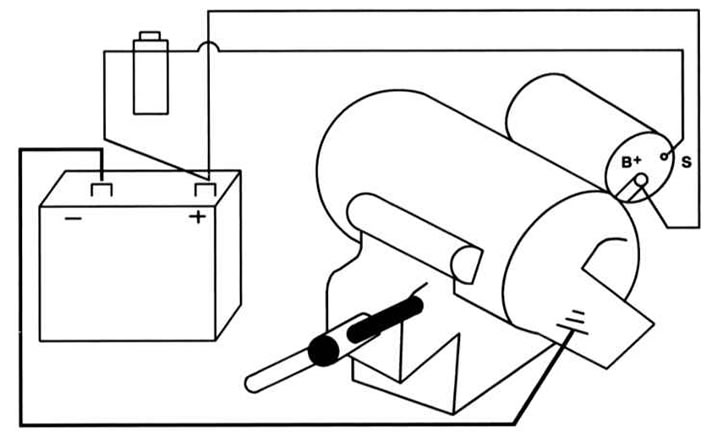
4. If the starter does not rotate, despite the correct power supply to it, remove the assembly and transfer it to the workbench. Most likely, there is an internal defect in the electric motor. In some cases, the cause is a jammed engine and to eliminate this, it is necessary to check the correct operation of turning the crankshaft manually by the pulley (see Engine Repair Without Removing It From The Car - Civic Models or Engine Repair Without Removing It From the Vehicle - Integra Models). Clamp the starter assembly with the traction relay in a vice with soft jaws and connect its negative terminal (-) to the housing with a jumper wire (see accompanying illustration). Connect the second jumper wire from the positive battery terminal to the B terminal of the starter. Connect the starter switch and apply power to the S terminal of the traction relay (no more than 10 seconds). Make sure that the plunger of the traction relay extends forward, moving the drive lever and overrunning clutch accordingly, and that the extended starter pinion begins to rotate properly. If the pinion extends but does not rotate, then the electric motor is faulty. If the plunger does not extend, despite the correct clicking of the relay, any of the components of the assembly may be faulty. In a good condition of the starter, the pinion should extend and rotate when power is applied.