Contents: Service information ⇊ Examination ⇊
Service information
Note: For proper wheel alignment inspection/adjustment, check and adjust the following:
- Check that the suspension has not been modified,
- Check tire size and tire pressure.
- Check wheel and tire runout.
- Check the suspension ball joints (hold the wheel with your hands, then turn it up/down and right/left to check for play).
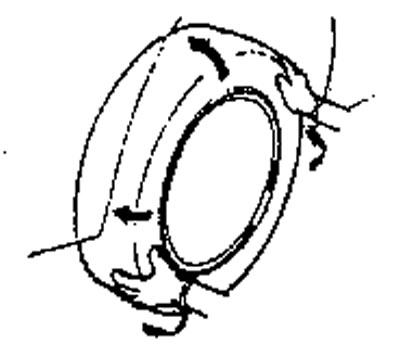
Procedure for adjusting the position of the wheels
Each wheel position element is linked to the other, so a total front/rear wheel position adjustment is required when one element is adjusted (Kingpin caster, camber, toe angle or steering angle).
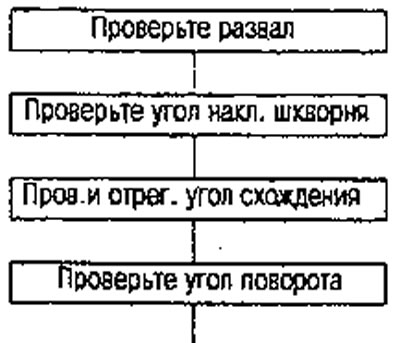
If any of the above requires adjustment, check all parameters again.
Information about special tools.
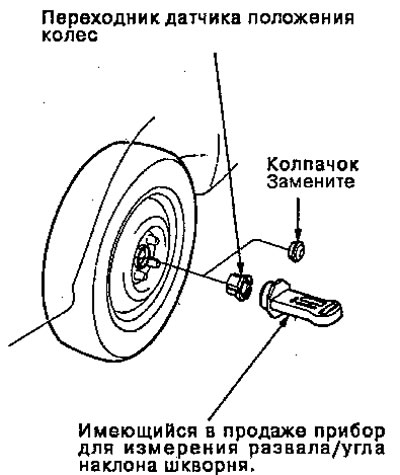
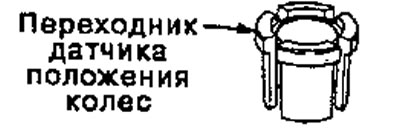
Wheel position sensor adapter.
Note:
- Since the sensor adapter can be installed by the magnetic force of the camber/kingpin sensor, make sure the wheel hubs are clean and free of rust before installing the toe sensor.
- When installing the special tool, align the groove of the special tool and the mating surface of the groove of the camber/kingpin sensor to obtain the greatest magnetic force of the camber/kingpin sensor
- For accurate readings, measure the position of the front wheels when the machine is parked on a level surface.
Examination
1. Remove the wheel cap.
2. Remove the cap from the rear wheel hub.
3. Install the wheel position sensor adapter and the camber/kingpin inclination sensor onto the hub and wheel.
4. Turn the front wheels to a strictly straight position.
5. Take readings when the bubble is in the center of the scale.
Camber angle:
Front:
- 0°00'±1°
- 0°15,±1° (for models KY, KT, KV, KK and MK)
Rear:
- -1°±1°
- 0°15' (for models KY, KT, KV, KK and MK)
6. If the measurements are not within specification, check the suspension part for bending or damage.