
Tightening the axle nuts will cause excessive bearing friction and result in difficult rotation and possible bearing failure. Therefore, carefully follow the procedures in Chapter 8, using the proper tools.
Cleaning and reinstallation
The only serviceable rear wheel bearings are on the 1984-85 Accord and 1984-87 Prelude. All other bearings, both rear and front, are press-fit. Press-fit bearings are considered life-long components and are replaced only in the event of mechanical failure. Replacing press-fit bearings is discussed in Chapter 7.
CAUTION: Servicing wheel bearings affects the brake pads or liners. Brake pads or liners contain asbestos, which can cause cancer. Never clean brake surfaces with compressed air.
Prelude (1984-87)
This procedure requires a torque wrench.
1. Slightly loosen the wheel bracket nuts. Raise and support the rear of the vehicle.
2. Release the parking brake. Remove the rear wheel assembly.
3. If equipped, remove the brake caliper. Disconnect the parking brake wire from the caliper. Remove the caliper mounting bolts from the suspension and hang the caliper on the wire; do not disconnect the brake hose.
4. Remove the caliper bracket mounting bolts and the brackets themselves.
5. Remove the grease cap, lock pin, lock nut, spindle nut, thrust washer and bearing. Pull the disc assembly off the spindle.
6. Using a hammer and punch will help release the bearing from the disc hub.
When removing bearing shells, use a cross template to avoid them getting into the hub holes.
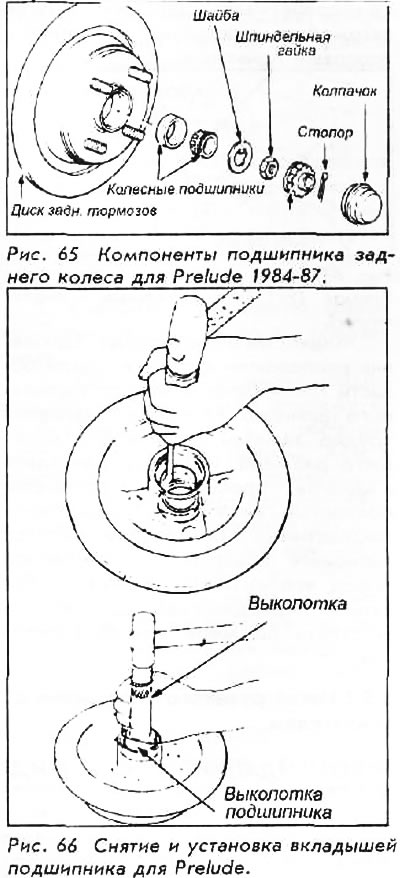
7. Rotate the hub and slide the inner bearing race and seal out of the hub; do not reuse the removed seal.
8. Using solvent, clean the hub, bearing shells and rings. Allow them to air dry; do not use compressed air for this purpose.
9. Using the correct size driver's tool, such as Honda tool 07749-0010000 and 07946-4920100 or equivalent, will guide the bearing races evenly into the hub.
10. Using multi-purpose grease, assemble the wheel hub and wheel bearings. The bearings must be completely and thoroughly assembled. Lightly grease the flanges. Install the inner race onto the hub.
11. Tap the seal (using a crisscross method) to force it back into the hub.
12. To install the hub, fit the outer bearing shell onto the disc. Holding the bearing loosely in place with your thumb, install the disc and bearing onto the hub.
13. Assemble and install the spindle washer and nut. Hand tighten the spindle nut.
14. Using a torque wrench, tighten the spindle nut as follows:
- a. Tighten the spindle nut to 25 Nm. Rotate the brake disc two or three times. Re-tighten the spindle nut. Continue these rotations and tightening the nut until complete stabilization, after rotating the disc, by 25 Nm.
- b. Loosen the spindle nut to 0. The nut should just become loose, not loosened more than necessary.
- c. Tighten the nut to 5.5 Nm.
- d. Install the lock nut and align the slot with the hole on the spindle.
If the stopper holes do not line up, try removing and re-installing the lock nut after rotating it a bit. If they still do not line up, tighten the spindle nut until they do.
- e. Using a new stopper, install it into the holes of the lock nut and axle.
15. To complete the installation, fill the cap with multi-purpose grease and install it on the disc. Make sure it is seated firmly and evenly.
16. Install the caliper bracket mounting bolts and the brackets themselves. Tighten the bolts to 38 Nm.
17. Install the caliper and brake pads. Tighten the caliper mounting bolts to 23 Nm.
18. Connect the parking brake cable to the caliper.
19. Install the brake caliper if it was removed.
20. Install the wheel and tighten the lug nuts evenly.
Accord (1884-87)
This procedure requires a torque wrench.
1. Slightly loosen the wheel nuts. Raise and support the rear of the vehicle.
2. Release the parking brake. Remove the rear wheel assembly.
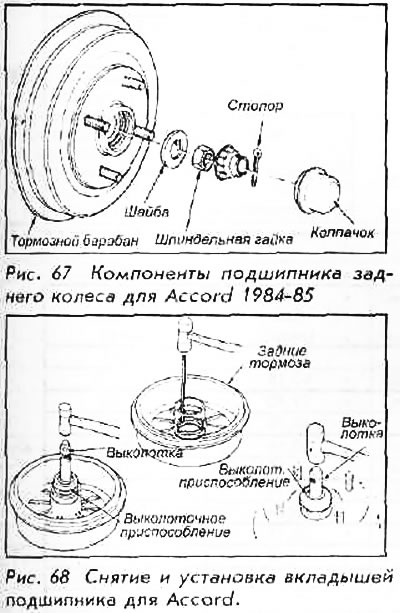
3. Remove the grease cap, lock pin, lock nut, spindle nut, thrust washer and bearing. Pull the rear drum off the spindle.
4. Remove the inner seal, then the inner bearing shell.
5. Using a hammer and punch will release the outer liner from the disc hub.
When removing bearing shells, use a cross template to avoid them getting into the hub holes.
7. Rotate the hub and slide the inner bearing race off the hub; do not reuse the removed seal.
8. Using solvent, clean the hub, liners, bearing rings and inner hub area of the drum. Allow them to air dry; do not use compressed air for this purpose.
9. Using the correct size driver's tool, such as Honda tool 07749-0010000 and 07946-4920100 or equivalent, will guide the bearing races evenly into the hub.
10. Using multi-purpose grease, assemble the wheel hub and wheel bearings. The bearings must be completely and thoroughly assembled. Lightly grease the flanges. Install the inner race onto the hub.
11. Tap the seal (using a crisscross method) to force it back into the hub.
12. To install the hub, fit the outer bearing shell onto the drum. Holding the bearing loosely in place with your thumb, install the drum and bearing onto the hub.
13. Assemble and install the spindle washer and nut. Hand tighten the spindle nut.
14. Using a torque wrench, tighten the spindle nut as follows:
- a. Tighten the spindle nut to 25 Nm. Turn the drum two or three turns.
- b. Loosen the spindle nut to 0. The nut should just become loose, not loosened more than necessary.
- c. Tighten the nut to 5.5 Nm.
- d. Install the lock nut and align the slot with the hole on the spindle.
If the stopper holes do not line up, try removing and re-installing the lock nut after rotating it a bit. If they still do not line up, tighten the spindle nut until they do.
- e. Using a new stopper, install it into the holes of the lock nut and axle.
13. To complete the installation, fill the cap with multi-purpose grease and install it on the disc. Make sure it is seated firmly and evenly.
14. Install the wheel and hand tighten the lug nuts.
15. Lower the vehicle to the ground and tighten the nuts evenly.