
Contents: General description ⇊ Control ⇊
General description
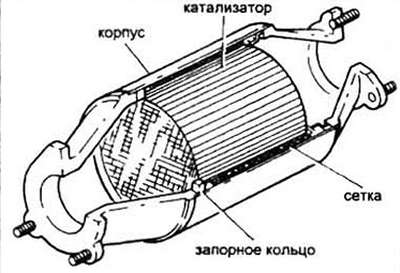
1. A neutralizer is a device installed in the exhaust system to reduce emissions of harmful substances.
Neutralizers can be of two types:
- a) to reduce emissions of carbon monoxide (CO), hydrocarbons (CH);
- b) CO+CH+ nitric oxide NO.
Control
2. To control the correct operation of the neutralizer, special equipment is required. Contact a service station.
3. At home, the inspection consists of a visual inspection of the integrity of the neutralizer housing and its fastening.
4. The neutralizer may be clogged with deposits. The simplest way to determine the resistance to gas flow through the neutralizer is to measure the vacuum at the outlet:
- a) bring the engine to 2000 rpm;
- b) quickly close the throttle.
- c) if the exhaust resistance is normal, the vacuum will quickly decrease by approximately 2 mm Hg from its normal value.
- d) if the vacuum gauge shows a decrease of 5 mm Hg or fluctuates around the vacuum value at the moment the valve closes, the exhaust resistance is increased.
Replacing components - see Chapter 4.