
Note: To avoid voiding the warranty on emission control system components, have the catalytic converter inspected and serviced by an authorized vehicle service center.
General information
A catalytic converter is a component of exhaust gas toxicity reduction systems, is included in the exhaust system and serves to reduce the emission of toxic components into the atmosphere. The vehicles discussed in this Manual use two types of catalytic converters. A conventional oxidation converter reduces the content of hydrocarbons and carbon monoxide in the exhaust gases. A three-function catalytic converter additionally reduces the emission of nitrogen oxides (NOX).
Examination
1. Diagnostic equipment for checking the catalytic converter is expensive and extremely difficult to operate. If you suspect a converter failure, take the car to a service station for inspection.
2. Every time the vehicle is raised above the ground for any reason, inspect the converter for signs of mechanical damage, leaks and corrosion. Check the condition of the welds and the tightness of the flange bolts that secure the device to the exhaust system sections. A defective catalytic converter must be replaced.
3. Despite the reliability of the converter design, there is a fairly high probability of its blockage. The simplest way to check the patency of the converter is to check using a vacuum gauge:
- a) Connect a vacuum gauge to the vacuum source of the intake manifold (see Chapter Engine);
- b) Warm up the engine to normal operating temperature, move the selector lever to the "P" position (models with automatic transmission), or engage neutral gear (models with manual transmission) and apply the parking brake;
- c) Read the vacuum gauge readings with the engine idling;
- d) Quickly open the throttle valve almost to the stop, then immediately release it, dropping the speed to idle. Read and record the vacuum gauge readings;
- e) Repeat the described test three more times, recording the result each time;
- f) If the result of the fourth measurement is more than 2.54 mm Hg lower than the reading taken at idle speed, then there is a possibility that the converter or muffler is not working properly.
Replacement of components
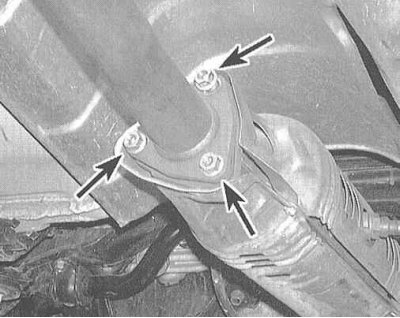
1. Before loosening, the threads of the flange fastener of the catalytic converter should be impregnated with a penetrating compound.
 |
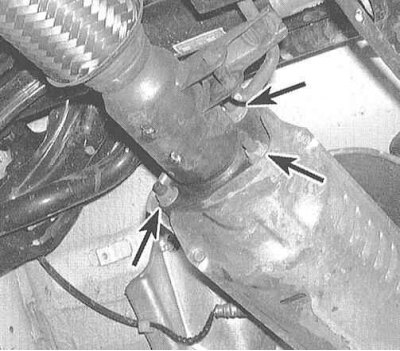 |
2. Remove the mounting nuts and remove the catalytic converter from under the vehicle.
3. Installation is carried out in reverse order.
(The text was taken from the website «www.hondabook.ru»)