
- a) The indicator lights up if:
- parking brake engaged;
- low brake fluid level;
- the electrical circuit of the indicator is faulty.
- b) If the indicator lights up while driving, you need to slow down, pull off the road and carefully stop the car. You can slow down by braking the engine and applying the parking brake, but do not forget to press the brake pedal to turn on the brake lights to warn drivers behind you about braking. Check the parking brake, it may be on. If the parking brake is off and the indicator lights up after it is turned off, then there is a malfunction in the brake system. Check the brake fluid level in the reservoir. If the brake fluid level is low, add fluid and check the braking efficiency of the car in a safe place. If you think that the brakes are still working effectively enough, carefully drive the car to the nearest repair shop. If the brakes do not work, then the car must be towed or evacuated for repair.
Warning: Driving a vehicle with low brake fluid is dangerous.
- If the brake fluid level is normal, then the electrical circuit of the indicator may be faulty.
2. Anti-lock braking system (ABS) indicator.
After turning on the ignition, the indicator lights up for a few seconds and then goes out. If the indicator lights up while driving or the indicator does not light up or does not go out when the engine is turned on, there may be a malfunction in the anti-lock system.
Caution: Pressing the brake pedal repeatedly may cause the indicator to come on for a few seconds.
3. Battery charge indicator.
- a) The indicator lights up when the ignition key is turned to the "ON" position and should go out after the engine starts.
- b) If the indicator lights up while driving, the charging system is faulty or the alternator drive belt is loose (broken). However, the engine will continue to run until the battery is completely discharged. Turn off additional equipment (air conditioner, fan, radio, etc.) and move to the repair site.
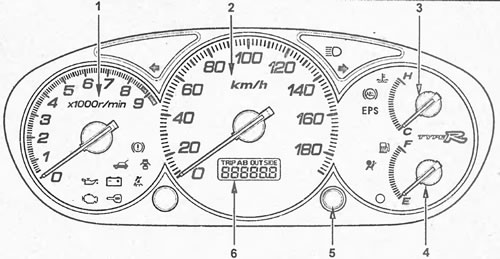
Instrument cluster (type 4): 1 - tachometer, 2 - speedometer, 3 - coolant temperature gauge, 4 - fuel gauge, 5 - button for resetting the trip counters to zero and switching modes "ODO" - "TRIP A" - "TRIP B", 6 - odometer and trip counter.
Table. Instrument cluster indicators
 | Parking brake status indicator |  | Direction indicator lights |
 | Anti-lock Brake System (ABS) Indicator |  | Airbag System (SRS) Indicators |
 | Battery charge indicator |  | Driver seat belt indicator |
 | Low Engine Oil Pressure Indicator |  | Trunk lid open indicator |
 | Indicator "check engine" (CHECK ENGINE) |  | Front fog light indicator |
 | Low fuel indicator |  | Indicator of open or not tightly closed door |
 | High beam indicator |  | Electric Power Steering Indicator |
 | Manual gear shift mode indicator |  | Engine immobilizer system indicator |
 | Front passenger side airbag off indicator |  | Indicator of the active range in manual switching mode |
4. Low engine oil pressure indicator.
- a) The indicator lights up when the ignition key is turned to the "ON" position and should go out after the engine starts.
- b) The indicator lights up if the engine oil pressure is too low.
- c) If the indicator flashes or lights up while driving, you must pull over to the side of the road and turn off the engine.
- The indicator may flash after sudden braking or when the engine is idling. There is no malfunction if the indicator goes out with a slight increase in engine speed.
- The light may come on when the engine oil level is too low. However, this light is not intended to indicate low oil levels, so check the level periodically with the dipstick.
Check the oil level and make sure there are no leaks.
- If the oil level is within acceptable limits and there are no leaks, have the vehicle towed or removed for repair.
- If the oil level is below the minimum and there are no leaks, add oil and start the engine. If the indicator light is flashing or on, turn off the engine and have the vehicle towed or removed for repair.
5. "check engine" indicator (CHECK ENGINE).
The indicator lights up when the ignition key is turned to the "ON" position for a few seconds and then goes out, informing the driver that the engine management system is being checked. If the indicator continues to light or lights up while driving, this indicates that there are faults in the electronic engine management system. In this case, it is necessary to go to the repair shop and diagnose the engine management system.
6. Low fuel indicator. The indicator lights up when the ignition key is in the "ON" position and the amount of fuel in the tank is less than 8 liters. Depending on the vehicle's configuration, the fuel may be enough for 40-60 km on a good road. On slopes or when turning, the indicator may light up due to fluctuations in the fuel in the tank.
Warning: Do not drive with very low fuel level in the tank. Running out of fuel can damage the catalytic converter
7. The high beam indicator lights up when the high beam headlights are turned on.
8. Turn signal indicators. The indicators flash when the turn signals or hazard warning lights are on. Excessive flashing of the indicators indicates a poor connection in the turn signal circuit or a failure of the turn signal bulb.
9. Airbag system (SRS) indicator.
The indicator lights up when the ignition key is in the "ON" position. The indicator goes out after a few seconds. If the indicator does not light up or lights up/flashes while driving, there is a malfunction in the SRS components.
10. Driver's seat belt indicator.
The indicator lights up when the ignition is turned on for a few seconds and then goes out if the driver is wearing a seat belt. If the driver is not wearing a seat belt, the indicator remains on.
11. Trunk lid open indicator.
The indicator lights up when the trunk lid is opened and remains on until the trunk lid is closed.
12. Front passenger side airbag deactivation indicator.
The indicator lights up for a few seconds when the ignition key is turned to position "II", and then goes out. If the indicator does not go out or lights up while driving, this indicates that the front passenger airbag has been automatically deactivated.
13. Indicator of open or not tightly closed door.
The indicator remains on until all doors are securely closed.
14. Electric power steering indicator.
The indicator lights up when there is a fault in the electric power steering. Stop the car in a safe place and turn off the engine. Wait a few minutes and start the engine again, if the indicator stays on, have your car towed to a repair shop.
15. Front fog light indicator.
The indicator lights up when the front fog lights are turned on.
16. Engine immobilizer system indicator.
The indicator lights up for a few seconds when you turn the ignition key to the "I" position, and then goes out. The indicator starts flashing if the immobilizer sensor cannot recognize the signal from the key. In this case, you will not be able to start the engine.
17. The manual shift mode indicator lights up when the CVT selector is in the "D" position and the manual shift mode switch is pressed. For a more detailed description, see the "Driving a car with a CVT" If the indicator flashes while driving, there may be a malfunction in the system.
18. Indicator of the selected range in manual switching mode.
The indicator shows the range engaged if the variator selector is in position "D" and manual gear shift mode is engaged. For a more detailed description, see the section "Driving a car with a CVT".
(Original published on this resource: «Hondabook.ru»)