
Contents: Examination ⇊ Replacement ⇊
Examination
1. Follow the wiring harness from the TPS to the rear of the intake manifold and remove it from the engine compartment bulkhead to provide additional work space to check the tightness of the connectors. Check the tightness of the connector lock to the sensor. Check the tightness of the terminal connector fit and the tightness of the wires to the terminals.
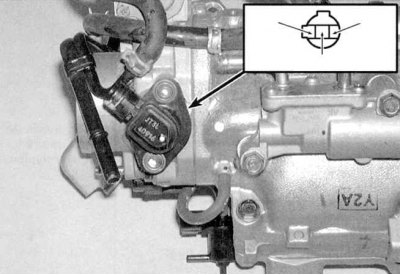
2a. Using a voltmeter, measure the reference voltage supplied by the ECM/PCM. Connect the positive probe of the meter to the yellow/blue wire terminal, and ground the negative probe to ground. The voltmeter should register a reading of 5.0 V (see accompanying illustrations): TPS (Civic).
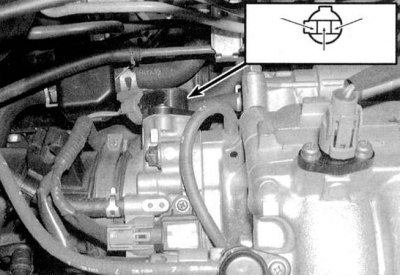
2b. TPS (Integra).
3. Now check the TPS signal voltage. With the engine off and the throttle fully closed, connect the voltmeter probes to the red/black wire terminal and ground (see illustrations above). Gradually open the throttle, observing the voltmeter readings. With the throttle closed, the signal voltage should be 0.5 V and gradually increase to reach 4.5 V when the throttle is fully open, otherwise replace the TPS.
Note: To connect the voltmeter to the back of the connector terminals, it is convenient to use an unbent metal paper clip.
4. If a fault is detected in the TPS circuit, the self-diagnosis system records a corresponding fault code in the ECM/PCM memory (see On-Board Diagnostics (OBD) System - Operating Principle and Error Codes). In this case, the control module switches the system to emergency mode. Instead of the TPS signal, some average value is used, which allows maintaining adequate engine output efficiency.
Replacement
The TPS is built into the throttle bodies and is only replaced as part of the entire assembly (see Chapter Power and exhaust systems).
Refer to the original source on the website hondabook.ru