
Contents: Examination ⇊ Replacement ⇊
Examination
1. The TPS is mounted on the throttle body and connected to the throttle shaft. Based on the analysis of signals received from the TPS, the PCM determines the exact current position of the throttle, determined by the degree to which the driver depresses the gas pedal. Failure of the sensor can lead to uncontrolled emissions from the fuel injectors and disruption of the stability of engine speed. If a TPS malfunction is detected, the code P0122 or P0123 is entered into the self-diagnostic system memory (see Section On-Board Diagnostics (OBD) System - Operating Principle and Error Codes).
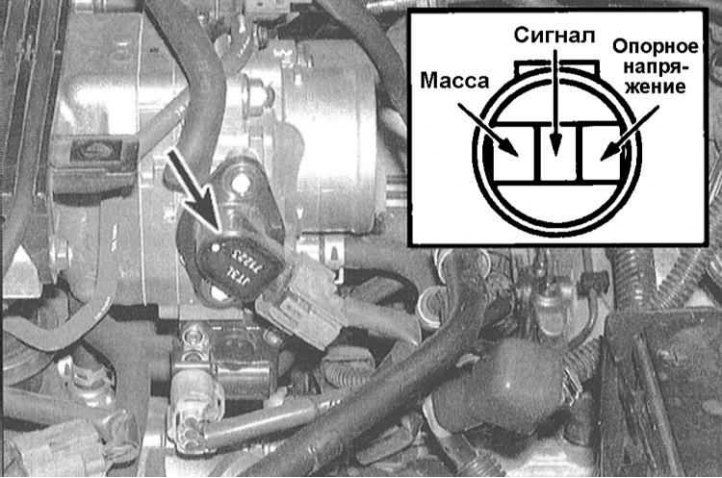
2. Using a voltmeter, measure the reference voltage supplied to the sensor from the PCM. Disconnect the wiring harness from the sensor and connect the voltmeter probes to the REF (+) and GND (-) terminals of the connector. With the ignition on (do not start the engine), the device should register about 5.0 V. The absence of voltage indicates an open circuit in the PCM circuit or failure of the module itself.
3. Now check the sensor signal voltage. With the engine off and the throttle fully closed, connect a voltmeter between the SIG (+) and GND (-) terminals of the TPS connector.
Note. It is convenient to use an unbent metal paper clip to connect the voltmeter to the back of the terminals. Gradually open the throttle, observing the voltmeter readings. With the throttle closed, the signal voltage should be 0.5÷1.5 V and gradually increase to reach 4.5 V when the throttle is fully open, otherwise replace the TPS.
Replacement
The TPS is permanently attached to the throttle body and can only be replaced as part of the entire assembly (see Chapter Power and exhaust systems).
[Based on materials from the website «hondabook.ru»]