
HondaBook.ru
Auto companies Volkswagen Auto companies Ford Auto companies Lada Auto companies Skoda Auto companies BMW Auto companies Mazda Auto companies Peugeot
English Русский
Български
Беларускі
Український
Српски
Hrvatski
Română
Polski
Slovenský
Magyar
Bookmark Contacts Sitemap   


Accord Civic Fit / Jazz CR-V HR-V Others Articles
Civic 3 and 4 (1983-1991) Civic 5 and 6 (1991-2000) Civic 6 (1995-2000) Civic 7 (2000-2005) Civic 8 (2005-2011)

Starting the engine from an auxiliary power source (Honda Civic 6)

  • Main
  • Honda Civic
  • 6 (1995-2000)
  • General information
  • Introduction to guide
  • Starting the engine from an auxiliary power source
0
Using an auxiliary power source will help start the engine in an extreme situation, but then you should find out and eliminate the cause of the battery drain, the most typical are:

1. Making repeated unsuccessful attempts to start the engine, or leaving the lights on for a long time with the engine off;

2. Malfunction of the charging system (the alternator drive belt is loose or broken, the connecting wiring is damaged, or the alternator itself is faulty).

3. Malfunction of the battery itself (the electrolyte level has dropped or the battery's service life has expired).

When performing engine starting from an external power source, attention should be paid to observing some special precautions:
  • a) Before connecting the auxiliary battery, make sure the ignition is off;
  • b) Ensure that all electricity consumers (lighting and heating devices, windshield wipers, etc.) were also turned off;
  • c) Wear protective gloves and glasses;
  • d) Make sure that the auxiliary battery has the same output voltage as the one installed in your vehicle;
  • e) If a battery installed in another vehicle is used as an auxiliary power source, ensure that the vehicles NEVER come into contact with each other;
  • f) Make sure that the transmission is in neutral (manual transmission) or in position "P" (automatic transmission);
  • g) Remove the ventilation caps from the battery to be serviced and cover the openings with a rag.

Connect the end of the red wire from the special kit to the positive terminal of the dead battery. Connect the other end of the red wire to the positive terminal of the auxiliary battery.
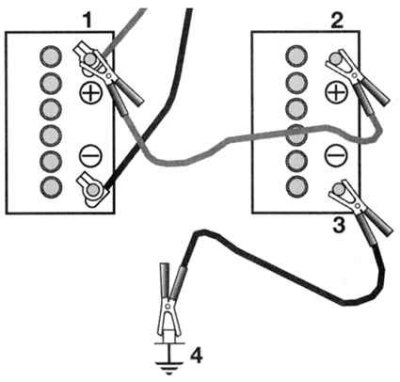


Connect the cable in the sequence shown

Connect the cable in the sequence shown


Connect one end of the black wire from the kit to the negative terminal of the booster battery. Connect the other end of the black wire to a reliable ground point on the block of the engine being started (bolt or bracket), as far away from the battery as possible.

Make sure that the connecting wires do not come into contact with moving components in the engine compartments of both vehicles (fan impeller, drive belts, etc.).

Perform the standard engine starting procedure. Leave the engine idling. Turn on the headlights, rear window defroster and heater fan, then disconnect the wires in the reverse order of their connection (see above). When the procedure is complete, turn off unnecessary electrical consumers.

Note: Auxiliary power consumers are switched on to prevent voltage surges when the electrical wiring is disconnected.


(The original is located on the website «HondaBook.ru»)
This article is available at: russian, bulgarian, belarusian, ukrainian, serbian, croatian, romanian, polish, slovak, hungarian
This information has been verified: Timofey Goryachev
Share with friends:
◀ Previous
Civic 6: Introduction to guide
Next ▶

Towing a car
Jacking up a car
The tools and equipment used in the workplace
Service technology — general recommendations
Purchase of spare parts
Automotive chemicals, oils and lubricants
Diagnostics of faults in vehicle components and systems
See also other articles from Honda manuals:
Starting the engine from an auxiliary power source Honda Accord 6 (1997-2002)
Starting the engine Honda Fit 1 (2001-2008)
Starting and running in the repaired engine Honda CR-V 1 (1995-2001, petrol)
Engine Starting Procedure Honda HR-V 1 (1998-2006, petrol)
Starting the engine Honda Avancier 1 (1999-2003, petrol)
Link in different formats to this article
Comments and feedback from visitors
No comments yet


How much will 21 + 12 ?


Civic 8 (2005-2011) 
  • General information
  • Technical data
  • Governing bodies
  • Driving and maintenance
  • Power unit
  • Gasoline engines (L13A)
  • Gasoline engines (R18A)
  • Diesel engines (N22A)
  • Cooling and lubrication (L13A)
  • Cooling and lubrication (R18A)
  • Cooling and lubrication (N22A)
  • Injection system (gasoline)
  • Injection system (diesel)
  • Toxicity reduction system
  • Troubleshooting
  • Transmission
  • Clutch and drive shafts
  • Mechanical gearbox
  • Chassis and running gear
  • Suspension and wheels
  • Steering
  • Brake system
  • Body and interior
  • Exterior (external elements)
  • Doors, locks and windows
  • Electrical equipment
  • Equipment and devices
  • Headlights and lighting
  • Power devices
  • Electrical circuits
Civic 7 (2000-2005) 
  • General information
  • User manual
  • Maintenance
  • Power unit
  • Engines D15B and D17A
  • K20A Engines
  • Overhaul engine
  • Cooling system
  • Lubrication system
  • Fuel injection system
  • Toxicity reduction system
  • Engine electrical equipment
  • Transmission
  • Clutch
  • Manual gearbox
  • Automatic gearbox
  • Variator (CVT)
  • Drive shafts
  • Chassis and running gear
  • Car suspension
  • Steering
  • Brake system
  • Body and interior
  • Exterior (external elements)
  • Interior (internal elements)
  • Doors, locks and windows
  • Heater and air conditioner
  • Manual air conditioner
  • Automatic air conditioner
  • Security system
  • Electrical equipment
  • Equipment and devices
  • Headlights and lighting
  • Windscreen wipers
  • Audio system
  • Electrical diagrams
Civic 6 (1995-2000) 
  • General information
  • Introduction to guide
  • User manual
  • Maintenance
  • Power unit
  • Engine in car (Civic)
  • Engine in car (Integra)
  • Engine overhaul
  • Cooling and heating
  • Power and exhaust systems
  • Engine electrical equipment
  • Engine management systems
  • Transmission
  • Manual gearbox
  • Automatic transmission (AT/CVT)
  • Clutch and drive shafts
  • Chassis and running gear
  • Brake system
  • Car suspension
  • Steering
  • Body and interior
  • Exterior (external elements)
  • Interior (internal elements)
  • Doors, locks and windows
  • Electrical equipment
  • Equipment and devices
  • Electrical circuits
Civic 5 and 6 (1991-2000) 
  • Power unit
  • SOHC engines
  • DOHC engines
  • Engine overhaul
  • Cooling and lubrication system
  • Intake and exhaust system
  • Fuel injection system (SOHC)
  • Fuel injection system (DOHC)
  • Carburetor
  • Transmission
  • Clutch
  • Manual gearbox S4C
  • Manual gearbox S40
  • Automatic gearbox
  • Drive shafts
  • Chassis and running gear
  • Car suspension
  • Steering
  • Brake system
  • Body and interior
  • Body elements
  • Heater and air conditioner
  • Electrical equipment
  • Power devices
  • Equipment and instruments
  • Electrical circuits
Civic 3 and 4 (1983-1991) 
  • General information
  • Maintenance
  • Power unit
  • Engine in a car
  • Engine overhaul
  • Cooling system
  • Power and exhaust system
  • Engine electrical equipment
  • Emission control system
  • Transmission
  • Mechanical gearbox
  • Automatic gearbox
  • Clutch and drive shafts
  • Four-wheel drive
  • Chassis and running gear
  • Brake system
  • Car suspension
  • Steering
  • Body and interior
  • Body elements
  • Electrical equipment
  • Equipment and devices
  • Electrical circuits
HondaBook.ru © 2018–2026 • Mobile version • Sitemap: EN BG BY UA RS HR RO PL SK HU • Feedback • Driver Information • Search system • Bookmark
Accord 3 (1985-1989) • Accord 6 (1997-2002) • Civic 3 and 4 (1983-1991) • Civic 5 and 6 (1991-2000) • Civic 6 (1995-2000) • Civic 7 (2000-2005) • Civic 8 (2005-2011) • Fit 1 (2001-2008) • CR-V 1 (1995-2001) • CR-V 2 (2002-2006) • HR-V 1 (1998-2006) • Avancier 1 (1999-2003) •
 
This website uses cookies to ensure proper functioning. By clicking "OK," you agree.