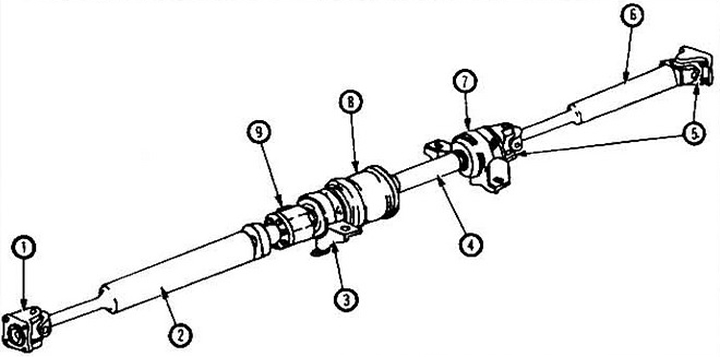
Fig. 3.1 Cardan shaft of the 1987 model (on models before 1987 there is no viscous coupling, on models from 1988 - a middle pipe): 1 - cardan joint; 2 - front pipe; 3 - front support; 4 - middle pipe; 5 - cardan joint; 6 - rear pipe; 7 - rear support; 8 - viscous coupling; 9 - CV joint.
2. On models produced in 1985-1987, the differential is a common part of the solid beam of the rear axle. On models produced since 1988, independent rear wheel suspension was introduced and the middle tube of the propeller shaft was eliminated.
3. The cardan shaft assembly fails extremely rarely. Only the cardan joints, CV joint and its boot require periodic inspection and lubrication. If the viscous coupling fails, it is simply replaced.
Roadside inspection
4. Problems with the driveshaft usually manifest themselves in the form of noise and vibrations when the vehicle is moving.
- a) select a section of road, preferably without heavy traffic, and note the engine speed at which vibration occurs;
- b) accelerate the car in 1st, 2nd, 3rd, etc. gears to the same engine speed at which the malfunction was noted;
- c) if noise or vibration occurs at the same engine speed, the driveshaft is not to blame for the problems that have arisen.
- d) If the noise increases or disappears, visually determine the location of damage to the driveshaft, loss of balancing weights or damage to the cardan joints.
However, poor tire balancing can be the cause of noise and vibration.
5. Checking the wear of the cardan joint:
- a) On a road with little traffic, drive slowly in top gear. Release the gas pedal and press it sharply. A clicking sound indicates wear of the universal joints.
Inspection from the bottom
6. For checking, the rear wheels must be suspended. When checking the operation of the viscous coupling, all wheels must be suspended.
7. Inspect the driveshaft. Make sure that the shaft balance is not disturbed by the loss of balancing weights or stuck dirt. If you decide to remove the shaft, mark its relative position to avoid imbalance during assembly/disassembly.
8. Inspect for oil leaks from the front and rear ends of the shaft. Oil leaks from the front indicate a defective transfer case oil seal, while leaks from the rear indicate a defective main gear pinion oil seal. Replacing these oil seals is described in Sections 9 and 10.
9. Engage neutral gear. Rotate the shaft by the rear wheel, holding the second one. You will need an assistant for this.
- a) Listen to the cardan joints - they should work silently. Check the tightening of the joint bolts. Check the wear of the cardan crosspiece by relative twisting of its two parts. Any gap indicates wear of the joint. If the cardan joint is damaged or worn, you will have to replace the entire shaft, since replacing only the joints is not provided.
- b) Listen to the operation of the CV joint: noise in combination with damage to the boot indicates the need for repair or replacement of the joint, see Section 6.
- d) Using an indicator head installed approximately in the middle of each pipe, check the runout of the shaft components. It should not exceed 1.5 mm. If the runout exceeds the specified value, then either the cardan joint is bent or worn, or the CV joint is worn.
- d) To check the viscous coupling, hang all the wheels on stands, start the engine. At idle, engage a low gear and slowly release the clutch pedal. Then fully engage the parking brake. If the engine stalls, the viscous coupling is OK. Otherwise, the coupling needs to be replaced (see Section 8).
10. Turn off the engine. Inspect all CV joints and check their fastening. Check for oil leaks at the ends of the drives. If there are leaks, the seals are damaged. The presence of grease on the outer surfaces indicates that the drive boots are torn.