
Contents: Cars with gasoline engines ⇊ Cars with diesel engines ⇊ Periodic control operations…⇊ Heavy vehicle operating conditions ⇊
The periodic maintenance schedule includes a full list of works necessary to maintain the vehicle in good technical condition. All maintenance operations must be performed using a specific technology and in compliance with the standards adopted in the Honda service network. Maintenance must be performed only by qualified personnel using the appropriate technological equipment.
Note: The maintenance regulations for vehicles intended for European countries are provided in a separate Warranty and Service Booklet, which is part of the documentation supplied with the vehicle in these countries.
The list of maintenance operations and their frequency are based on the assumption that the vehicle is used as an individual vehicle for the transportation of passengers and luggage. During the operation of the vehicle, adhere to the rules listed below.
Do not overload the vehicle. Exceeding the maximum permitted vehicle weight causes additional loads on the engine, brakes and other units and parts of the vehicle.
Operate your vehicle on roads with improved surfaces, observing maximum speed limits.
Use your car regularly, trying to avoid frequent short-distance trips (several kilometers away).
Cars with gasoline engines
Operate your vehicle only on the recommended type and quality of gasoline.
Cars with diesel engines
Operate your vehicle only on diesel fuel of the recommended type and quality.
When servicing your vehicle, we recommend that you use only genuine Honda brand spare parts and operating fluids recommended by Honda or their equivalent substitutes. Spare parts and operating materials supplied to the Honda service network do not differ in quality from similar products and products used at assembly plants.
Caution! On vehicles with diesel engines: Do not force the engine cover closed. This may damage the cover or other parts.
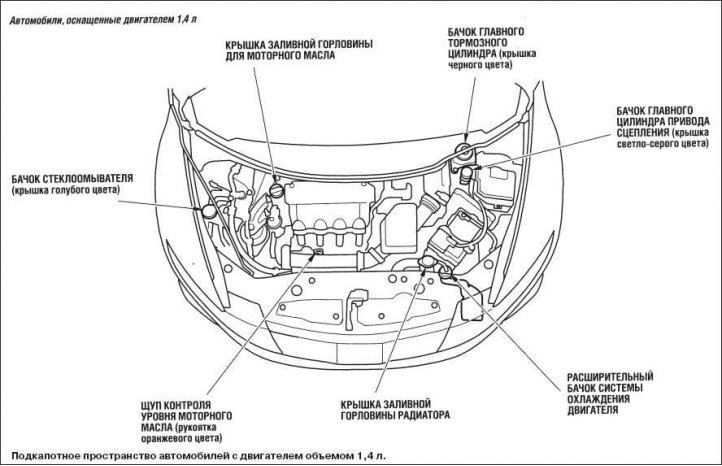
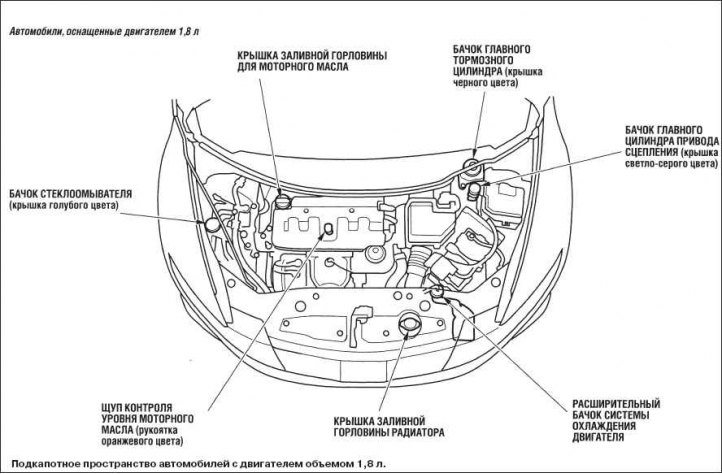
Periodic control operations performed by the vehicle owner
During the operation of the car regularly (not less than the specified frequency) perform all of the following checks on the vehicle's most important components and systems.
The oil level in the engine crankcase must be checked every time the vehicle is filled with fuel.
Engine coolant level - must be checked every time you refuel your vehicle.
Windshield washer fluid level - checked monthly. If you use the windshield washer frequently, check the fluid level in the reservoir every time you fill up your car with fuel.
Windscreen wiper blades - Check monthly. If the windscreen cleaning quality has deteriorated, check the blades for signs of wear, cracks, and other defects.
Brake hydraulic drive and clutch hydraulic drive - checked monthly.
Brake pedal - check the smoothness of the forward and reverse travel of the brake pedal.
Parking brake - check the smooth forward and reverse movement of the parking brake lever.
Tires - Check the air pressure in your tires monthly. At the same time, check the degree of wear on the tire treads and the absence of small stones or other objects embedded in the tread.
Battery - check the battery charge level and the absence of corrosion on the terminals and the "MAX" terminal of the battery monthly.
Air conditioning system (if present on the vehicle) - check the system's operation weekly.
Windshield defroster system - turn on the heater and air conditioner. Check the operation of the windshield defroster nozzles. This should be checked monthly.
Outdoor lighting and signaling devices - monthly check the serviceability of headlights, front and rear side lights, brake lights (including the high brake light), direction indicators and license plate lighting.
Doors and door locks - Check that all doors open and close smoothly and that door locks lock securely.
Sound signal - check the functionality of the sound signal.
Note: Please refer to this maintenance schedule, which only provides the required minimum level of maintenance. Additional maintenance may be required depending on regional and climatic conditions of vehicle operation. For more detailed information, please refer to the vehicle's Warranty Book.
Note: If any of the following signs of severe vehicle operating conditions are present, maintenance operations must be performed according to the regulations for which the following entry is made in the previous tables or footnotes: "severe conditions".
Heavy vehicle operating conditions
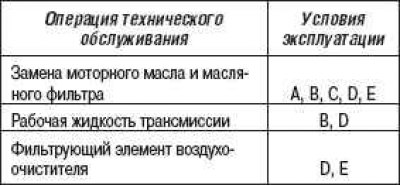
A: frequent short trips over short distances (up to 8 km, at sub-zero ambient temperatures - up to 16 km).
B: Frequent trips in hot weather (at temperatures above 35°C).
C: Long periods of engine idling or prolonged driving in heavy traffic with frequent acceleration and braking.
D: towing a trailer (for vehicles suitable for towing a trailer), transporting cargo on the roof rack or constant use of the vehicle in mountainous areas.
E: driving on unpaved roads, on dirty roads, on roads that are being treated with anti-icing agents.