
Examination (engine D15Z7, D16Y6, B16A4, B16A5, B16A6)
1. Remove the fuel tank cap.
2. Start the engine and let it idle.
3. Disconnect the vacuum hose from the EVAP purge control valve and attach a vacuum gauge to the hose.
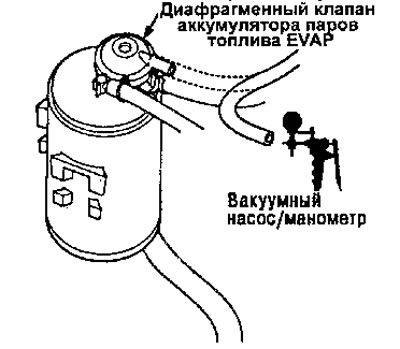
If there is no vacuum, check for blockages, cracks, or disconnections in the vacuum hose, and check for a clogged vacuum port.
4. Disconnect the vacuum gauge and connect the hose.
5. Attach a vacuum gauge to the EVAP canister purge hose.
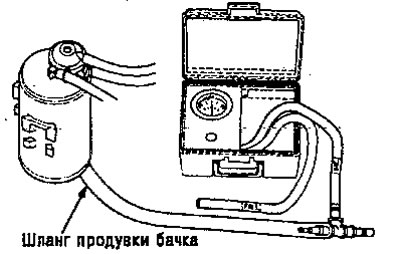
6. Increase engine speed to 3500 rpm. A vacuum should appear on the pressure gauge within 1 minute.
If vacuum appears on the pressure gauge after 1 minute, remove the pressure gauge, the test is complete. If there is no vacuum, disconnect the vacuum gauge and install the fuel tank cap.
7. Remove the fuel Vapor Storage tank (EVAP) and check for any signs of damage or defect.
If damaged, replace the barrel.
8. Stop the engine. Disconnect the vacuum hose from the EVAP diaphragm valve. Connect a vacuum pump to the lower hose as shown and apply vacuum.
The vacuum must be stable (unchanged).
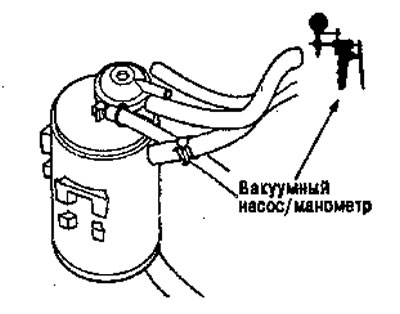
If the vacuum drops, replace the EVAP control canister and check again.
9. Start the engine. Connect the upper vacuum hose to the EVAP diaphragm valve. The vacuum (lower vacuum hose side) should drop to 0.
If the vacuum does not drop to 0, replace the EVAP canister and check again.
Checking the dual function valve (EVAP) of the fuel vapor canister.
1. Remove the fuel tank cap.
2. Remove the steam line from the dual function valve on the fuel tank and connect the T-piece from the vacuum gauge and vacuum pump as indicated.
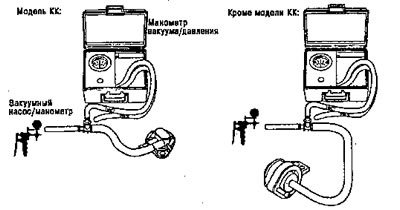
3. Slowly create a vacuum while watching the pressure gauge.
The vacuum should stabilize for a moment at 0.7-2.0 kPa.
If the vacuum has stabilized (the valve opens) below 0.7 kPa or above 2.0 kPa, install a new valve or check again.
4. Switch the hose to the discharge outlet of the pump and switch the vacuum gauge hose from the pressure side as the reading.
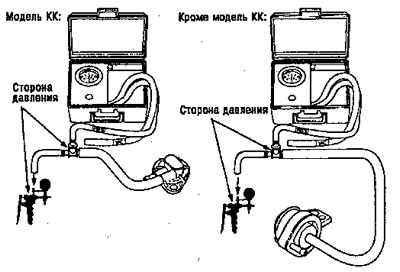
5, Slowly increase the pressure in the steam line, watching the pressure gauge.
The pressure should stabilize at 1.3-4.7 kPa. If the pressure stabilizes for a moment (the valve opens) 1.3-4.7 kPa, the valve is OK. If the pressure stabilizes below 1.3 kPa or above 4.7 kPa, install a new valve and check again.