
Attention.
- Replace the self-locking nuts after removal.
- The vehicle should be lowered to the ground before tightening the bolts and nuts associated with the rubber mounts and bushings.
- Tighten the lock nut to the lower rated torque, then tighten until the slot in the nut aligns with the hole for the cotter pin. Do not align the nut by loosening it.
Note:
- Use only genuine Honda aluminum wheel weights. Non-genuine weights may corrode or damage aluminum wheels.
- On aluminum wheels, remove the center cap from the inside of the wheel after removing the wheel.
- Before installing the brake discs, clean the mating surfaces of the front hub and brake discs.
- Before installing the wheel, clean the mating surfaces of the brake disc and wheel and remove any grease before tightening the nut on the ball joint.
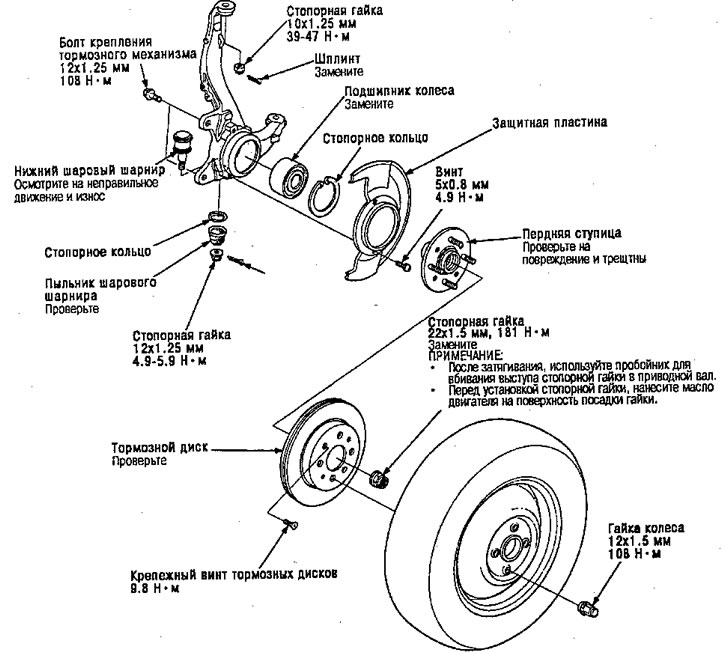
1. Loosen the wheel nuts slightly.
2. Raise the front of the machine off the ground and secure it to safety stands in appropriate locations.
3. Remove the wheel nuts and wheels.
4. Lift the locking tab on the lock nut, then remove the nut.
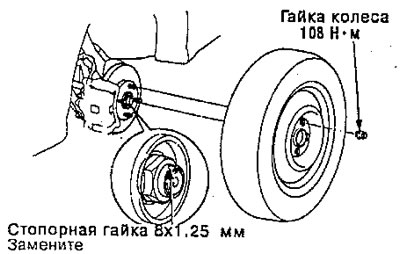
Note:
- After tightening, use a drift to drive the tab of the lock nut into the drive shaft.
- Before installing the lock nut, apply engine oil to the seating surface of the nut.
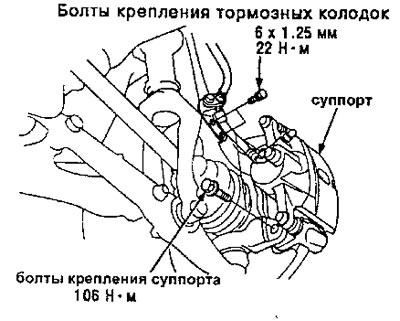
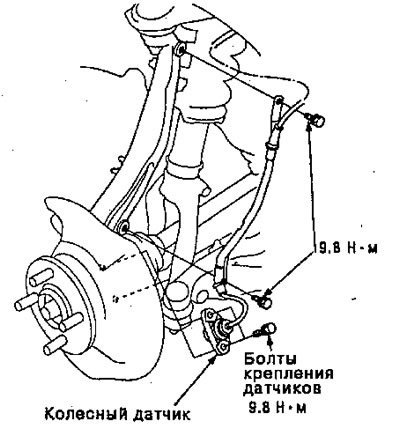
5. Remove the brake hose mounting bolts.
6. Remove the brake pad mounting bolts and hang the caliper on one side.
Caution: To prevent accidental damage to the caliper or brake hoses, suspend the brake assembly from the chassis using a short piece of wire.
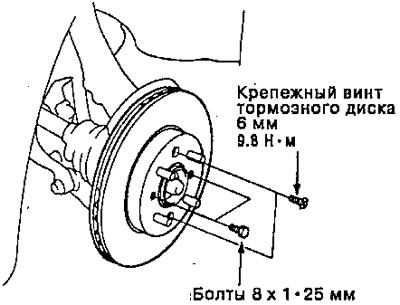
7. Remove the M6 screws securing the brake discs.
8. Screw M8 x 1.25 bolts into the disc to push it away from the hub.
Note: Tighten each bolt two turns at a time to prevent excessive bending of the disc.
9. Remove the brake disc from the steering knuckle.
10. Remove the wheel sensor from the steering knuckle.
Note: Do not disconnect the sensor connector.
Note: Use a special tool to separate the ball joints from the suspension or steering arm.
Caution: Be careful not to damage the ball joint boot.
11. Remove any dirt or grease from the ball joint.
12. Remove the cotter pin from the steering arm and remove the nut.
13. Screw the M10 hex nut onto the ball joint pin. Make sure that the nut is seated flush with the end of the ball joint pin to prevent damage to the threaded portion of the ball joint by the puller.
14. Apply grease to the special tool in the indicated places. This will facilitate the installation of the tool and prevent damage to the threads of the tightening bolt
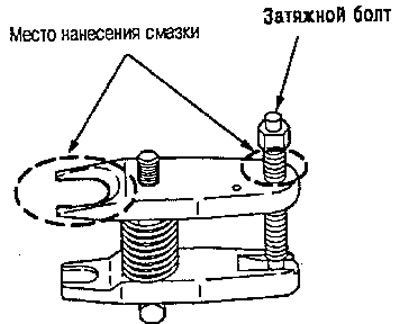
15. Install the special tool as shown. Insert the claws carefully, being careful not to damage the ball joint boot. Adjust the claw clearance by turning the tightening bolt.
Note: If necessary, apply penetrating lubricant to loosen the ball joint fit.
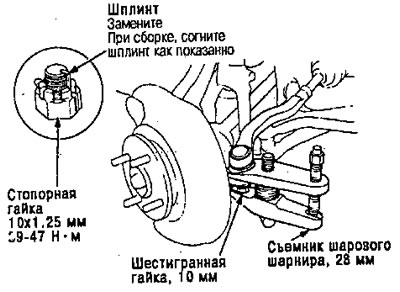
16. With the tool in place, turn the adjusting bolt to align the jaws parallel. Then tighten the clamping bolt by hand and check the jaws again to make sure they are still parallel.
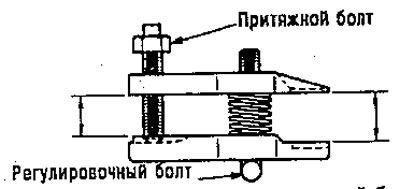
7. Using a wrench, tighten the clamp bolt until the ball joint pin pops out of the steering arm.
Warning: The ball joint may suddenly pop out or break and spray dirt or debris into your eyes.
18. Remove the tool, then remove the nut from the end of the ball joint and slide the ball joint out of the steering/suspension arm. Inspect the ball joint boot and replace it if damaged.
19. Remove the cotter pin and nut of the lower arm ball joint.
20. Screw the M12 hex nut onto the ball joint pin. Make sure the nut is flush with the end of the ball joint pin, otherwise the threaded portion of the ball joint may be damaged by the ball joint puller.
21. Use a special tool to separate the ball joint and lower arm. APPLICATION: If necessary, apply penetrating lubricant to loosen the ball joint fit.
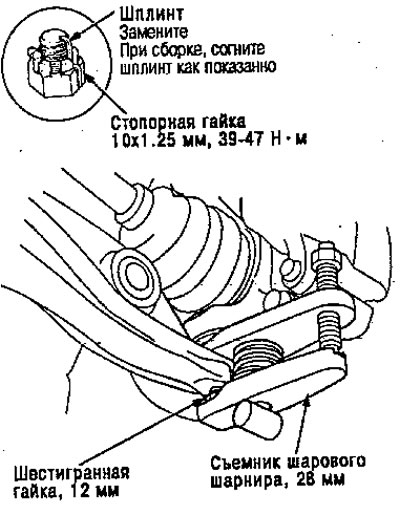
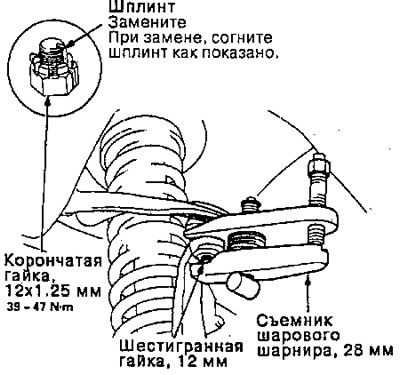
22. Remove the cotter pin and the upper nut of the ball joint.
23. Screw the M12 hex nut onto the ball joint. Make sure that the nut is seated flush with the end of the ball joint pin to prevent damage to the threaded portion of the ball joint by the ball joint puller.
24. Use a special tool to separate the ball joint from the steering knuckle.
Note: If necessary, apply penetrating lubricant to loosen the ball joint fit.
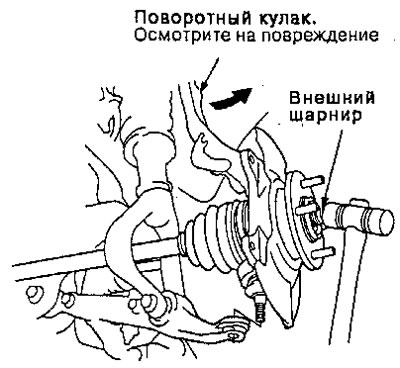
25. Slide the steering knuckle outward and remove the outer drive shaft joint from the cam by tapping the end of the drive shaft with a plastic hammer, then remove the steering knuckle.
Replacing the wheel bearing.
Note: Replace the bearing with a new one after removing.
26. Separate the hub from the steering knuckle using a special tool and a hydraulic press.
Attention.
- Be careful not to deform the protective plate.
- Hold the hub so it does not fall while pressing it out.
- To prevent damage to the tool, ensure that the threads are fully tightened before pressing out.
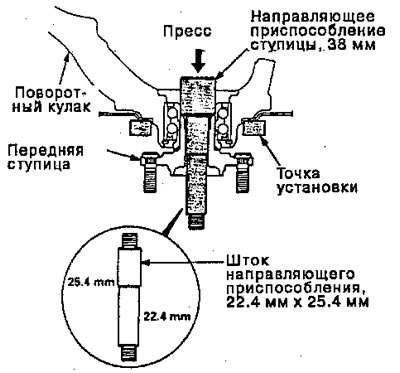
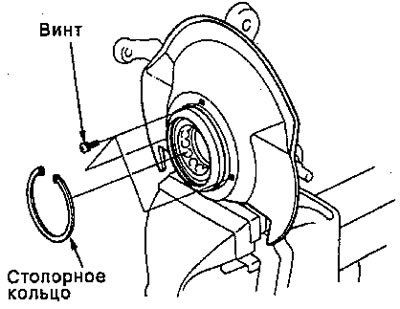
27. Remove the snap ring and protective plate from the steering knuckle.
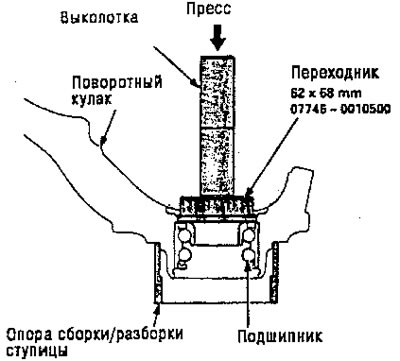
28. Press the wheel bearing out of the steering knuckle using a special tool and a press.
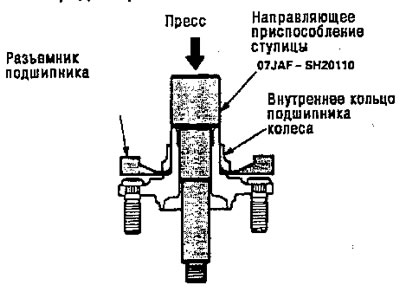
29. Remove the bearing inner race from the hub using the special tool shown and a commercially available bearing splitter.
Caution: To prevent damage to the tool, ensure that the threaded parts are fully tightened before pressing out.
Note: Wash the steering knuckle and hub thoroughly in solvent before assembly.
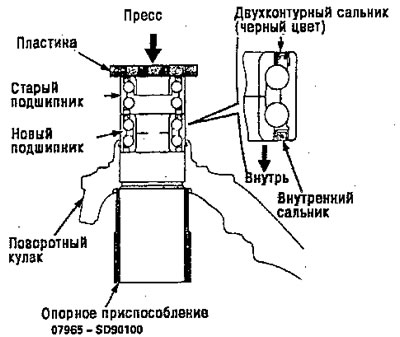
30. Press the new wheel bearing into the steering knuckle using the old bearing, plate and press.
Note: Place the wheel bearing on the steering knuckle with the inner oil seal (metallic color) into the inside of the fist. Be careful not to damage the inner seal.
31. Securely install the retaining ring into the groove of the steering knuckle.
32. Install the protective plate and tighten the screws.
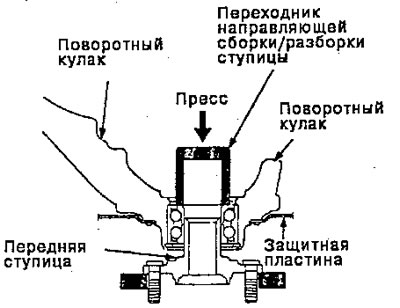
33. Install the hub onto the steering knuckle using the special tools as a guide.
Caution: Be careful not to damage the protective plate.
34. Install the parts in the reverse order of removal.
(Information obtained from this source: hondabook)