
Contents: Preliminary check ⇊ Checking the kingpin angle ⇊ Checking the angle of the front…⇊ Adjusting the angle of the front…⇊ Checking the rear wheel camber angle ⇊ Checking and adjusting the front…⇊ Checking the rear wheel alignment ⇊ Checking the wheel steering angle…⇊ Angle of rotation ⇊
The suspension allows for adjustment of the front and rear wheel alignment. However, each of these adjustments is interconnected with the other. For example, when you adjust the camber, the wheel alignment changes. Therefore, it is necessary to adjust the position of the front wheels every time you adjust the camber or toe.
Preliminary check
To properly check and correct wheel alignment, perform the following checks.
1. Release the parking brake to avoid measurement error.
2. Make sure the suspension has not been modified.
3. Check the tire size and adjust the tire pressure to the recommended one.
4. Check the runout of the wheels and tires.
5. Check the condition of the suspension ball joints. Hold the wheel with your hands and rock it up and down and from side to side, checking for play.
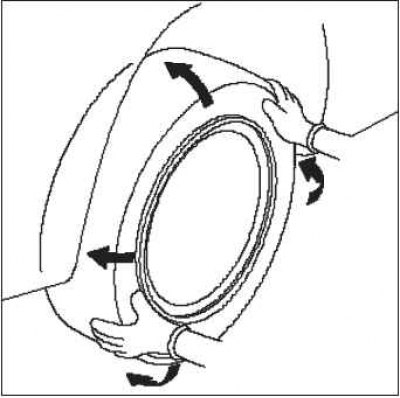
6. Rock the car up and down several times to stabilize the suspension.
Checking the kingpin angle
1. Raise the front of the vehicle and remove the wheel caps.
Note: Press out the cover on the aluminum disc from the inside after removing the disc.
2. Place the steering angle measuring devices under the front wheels and wooden blocks of the same thickness with the steering angle measuring devices under the rear wheels. Lower the vehicle.
Note: Make sure the vehicle is level on the steering angle measuring devices and wooden blocks.
3. Fit the wheel alignment tool and the camber/kingpin angle measuring tool to hub A and press the brake pedal.
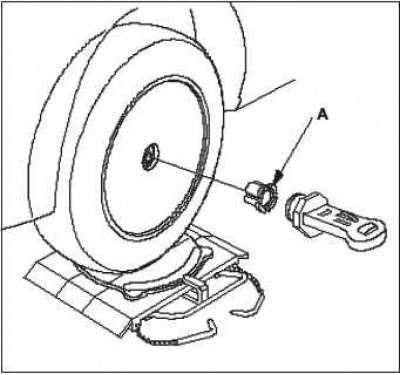
4. Turn the front wheel 20° outward, then turn the caster/camber adjusting screw to set the bubble to 0°.
5. Turn the wheel 20° inward and read the kingpin angle value on the bubble on the scale of the device. If the kingpin angle value is not within the standard tolerance, check the suspension for warped or damaged components.
Kingpin angle: 4°14'±30'.
Checking the angle of the front suspension kingpin
1. Set the front wheels to the straight-ahead position.
2. Raise the front of the vehicle and remove the wheel caps.
Note: Press out the cover on the aluminum disc from the inside after removing the disc.
3. Install the toe-in measuring tool A and the camber/kingpin angle measuring tool onto the hub.
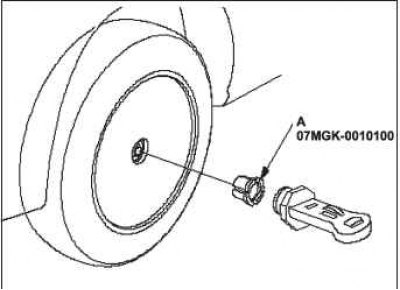
4. Check the wheel camber angle on the scale of the device. If the wheel camber angle is not within the standard, adjust it.
Front wheel camber angle.
Maximum gap between right and left edge: 0°00'±30'0°30'.
Adjusting the angle of the front suspension kingpin
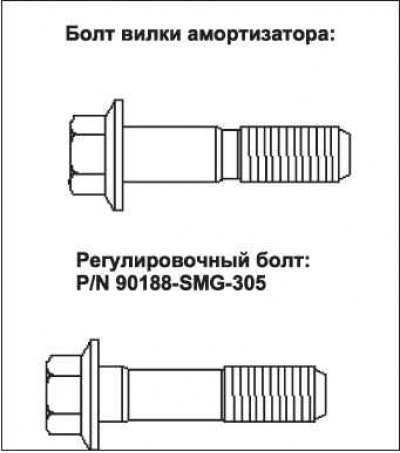
The front suspension kingpin angle can be adjusted by replacing one of the shock absorber fork bolts with a smaller diameter adjusting bolt. The difference between the diameter of the adjusting bolt and the diameter of the mounting bolt hole allows a small adjustment range.
1. Raise the front of the vehicle and place safety stands in appropriate places.
2. Remove the front wheels.
3. Loosen the shock absorber fork bolts A and adjust the camber angle by moving the lower part of the shock absorber within the free play range of the shock absorber mounting bolt.
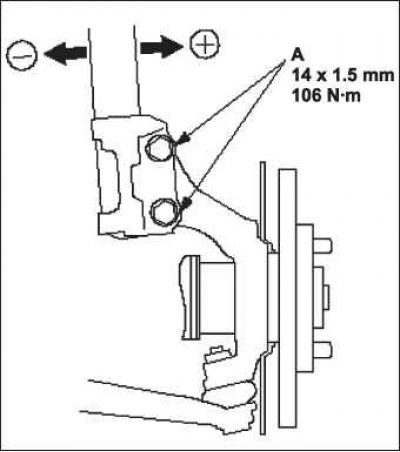
4. Tighten the shock absorber mounting bolts to the recommended torque. Make sure the shock absorber mounting bolts are securely tightened.
5. Reinstall the front wheels. Lower the front of the car to the ground, and bounce the front of the car up and down several times to stabilize the suspension.
6. Measure the camber angle of the wheels.
If the measurement results are within the norm, check the wheel alignment.
If the measurement results are not within the norm, proceed to step 7.
7. Raise the front of the vehicle and place safety stands in appropriate places.
8. Remove the front wheels.
9. Replace the shock absorber fork bolts with adjusting bolts A, and adjust the camber angle.
Note: The camber angle can be adjusted up to ±20' by replacing both shock absorber fork bolts with adjuster bolts.
If the measurement results are below ±50' (midpoint of acceptable limits), replace one fork bolt with an adjuster bolt.
If the measurement results are below ±50' (midpoint of acceptable limits), replace one fork bolt with an adjuster bolt.
The camber angle of the wheels can be adjusted up to 1°, (midpoint of acceptable limits) by replacing both (upper and lower) shock absorber fork bolts with adjusting bolts. However, the maximum clearance between the right and left edges is 2°.
Use new B nuts when installing.
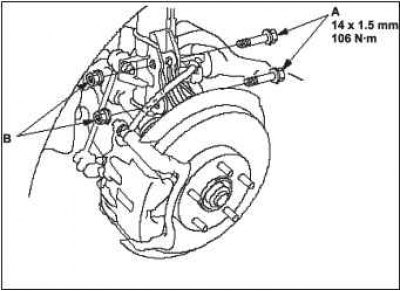
10. Tighten the adjusting bolts to the recommended torque.
11. Reinstall the front wheels. Lower the front of the car to the ground and bounce the front of the car several times to stabilize the suspension.
12. Measure the camber angle. If the camber angle is not within the standard, repeat steps 6 through 11 to readjust the camber angle. If the camber measurement is correct, measure the toe-in and adjust if necessary.
Checking the rear wheel camber angle
1. Raise the rear of the vehicle and remove the wheel covers.
Note: Press out the cover on the aluminum disc from the inside after removing the disc.
2. Install the toe-in measuring tool A and the camber/kingpin angle measuring tool onto the hub.
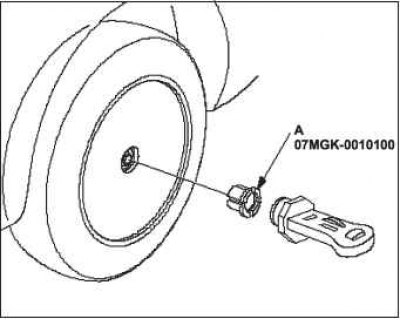
3. Check the wheel camber angle value on the scale of the device. If the camber angle value is not within the standard tolerance, check for any deformed or damaged components in the suspension.
Rear wheel camber angle: -1° 00'±30'.
Checking and adjusting the front wheel alignment
1. Set the steering wheel to the center position.
2. Check the wheel alignment. If it is not within the standard tolerance, proceed to step 3.
Front wheel alignment: 0±2 mm.
3. Loosen lock nut A while holding steering rod end B with a wrench.
Note: Hold the rack tip with the key to prevent it from turning.
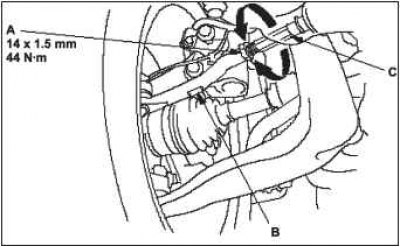
4. Turn the steering rods C until the correct toe-in value is set.
Note: The right and left wheels should be adjusted simultaneously, turning them in opposite directions by the same angle, so that the steering wheel remains in the center position when the toe is correct.
5. After adjusting the toe, tighten the lock nut while holding the steering rod. Make sure that the toe value does not change.
Checking the rear wheel alignment
1. Release the parking brake lever.
2. Check the wheel alignment. If the camber angle value is not within the standard, check the suspension for any warped or damaged components.
Rear wheel alignment: 4±2 mm.
Checking the wheel steering angle ratio
1. Raise the vehicle and place the wheel angle measuring devices under the front wheels and wooden blocks of the same thickness with the wheel angle measuring devices under the rear wheels. Lower the vehicle.
Note: Make sure the vehicle is level on the steering angle measuring devices and wooden blocks.
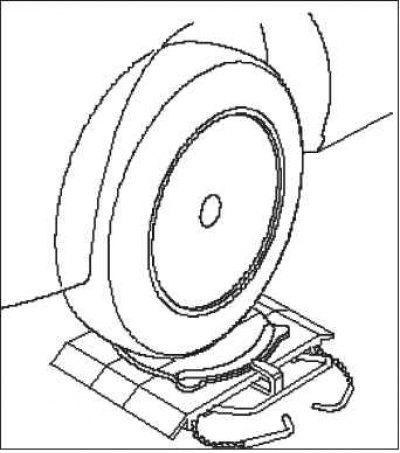
2. With the brake pedal depressed, turn the steering wheel fully left and right and check the wheel turning angles. If the turning angles are not within the permissible limits or there is a difference in the maximum turning angles of the right and left inner wheels, proceed to step 3.
Angle of rotation
Internal
16-inch diameter wheel: 38° 32 ' ±2°.
17-inch diameter wheel: 36° 32 ' ±2°.
External (example)
Wheel diameter 16 inches: 32°31'.
Wheel diameter 17 inches: 31°16'.
3. Check the wheel alignment. If the wheel alignment is normal, but the difference in steering angles is outside the permissible values, check the suspension for deformed or damaged components.
[The article was taken from the website «HONDABOOK.ru»]