
Examination
1. If it is not possible to find out how to connect the relay to the corresponding electrical circuit using the electrical connection diagrams (see Electrical Wiring Diagrams - General Information), it should be remembered that the approach to testing any relay is, in principle, the same in all cases (see below).
2. In most relays, the control circuit is always connected to two of the contact terminals. When low-voltage voltage is applied to these terminals, the current begins to circulate through the relay control winding, which results in the closing of the large contacts of the working circuit of the consumer of electrical energy. The remaining terminals are the terminals of the working (high-voltage) circuit.
3. In order to facilitate the identification of the relay terminals, explanatory markings with an image of the key connection diagram are usually applied to its body.
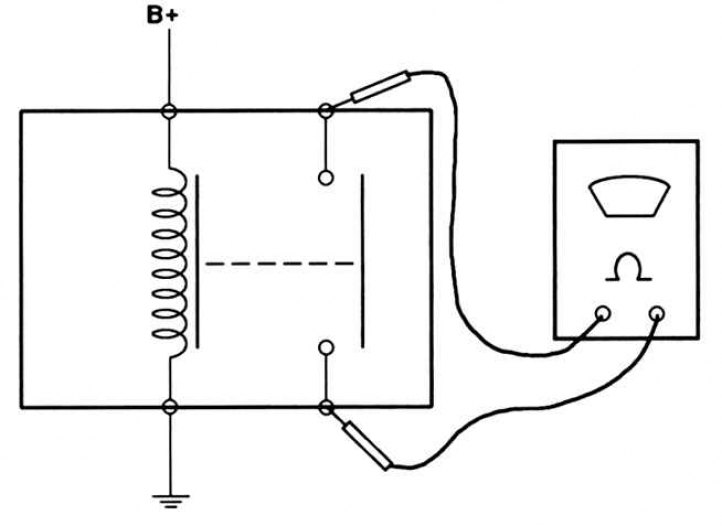
4. Connect a fused jumper wire between one of the relay control terminals and the positive battery terminal. Using the second jumper wire, ground the second control terminal – the relay should click. Some relays require polarity – if there is no click, try changing the polarity of the control terminals. With the jumper wires connected, check for continuity between the terminals of the high-voltage circuit by connecting an ohmmeter in accordance with the key diagram on the relay body (see accompanying illustration).
5. If the test result is negative, replace the relay.