
HondaBook.ru
Auto companies Volkswagen Auto companies Ford Auto companies Lada Auto companies Skoda Auto companies BMW Auto companies Mazda Auto companies Peugeot
English Русский
Български
Беларускі
Український
Српски
Hrvatski
Română
Polski
Slovenský
Magyar
Bookmark Contacts Sitemap   


Accord Civic Fit / Jazz CR-V HR-V Others Articles
Civic 3 and 4 (1983-1991) Civic 5 and 6 (1991-2000) Civic 6 (1995-2000) Civic 7 (2000-2005) Civic 8 (2005-2011)

Fuel vapor removal system (Honda Civic 5)

  • Main
  • Honda Civic
  • 5 (1991-2000)
  • Power unit
  • Fuel injection system (SOHC)
  • Fuel vapor removal system
0
Contents: Examination (except for engines…⇊ Checking the Dual-Way EVAP Valve ⇊

Examination (except for engines D14A3, D14A4)


1. Remove the fuel tank cap.

2. Start the engine and let it idle.

3. Disconnect the vacuum hose from the evaporative emission control valve and connect the vacuum gauge to the hose.
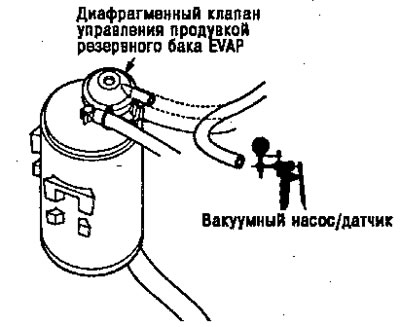
3. Disconnect the vacuum hose from the…


If there is no vacuum, check the vacuum hose and fitting for blockages, leaks, or damage.

4. Disconnect the vacuum sensor and reconnect the hose.

5. Connect the vacuum sensor to the air hose of the ventilation system.
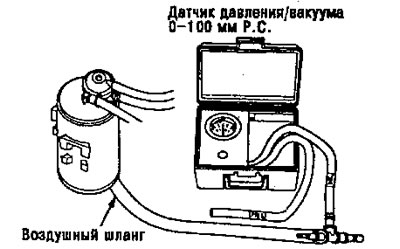
5. Connect the vacuum sensor to the air hose of…


6. Increase engine speed to 3500.

The gauge should show a vacuum within one minute.

If a vacuum appears, remove the sensor - the test is complete.

If there is no vacuum, disconnect the vacuum sensor and replace the tank cap.


7. Remove the EVAP reserve tank and inspect for signs of defects or damage.

8. Stop the engine. Disconnect the upper hose from the diaphragm purge control valve. Attach a vacuum pump to the lower hose and apply vacuum.

The vacuum must be stable.
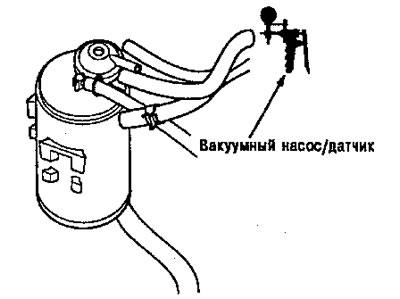
The vacuum must be stable.


Vacuum is dropping, replace EVAP reserve tank and recheck.

9. Start the engine, connect the upper vacuum hose to its place. Vacuum (in the lower hose) should drop to zero.

* If the vacuum does not drop to zero, replace the EVAP reserve tank and recheck.

Checking the Dual-Way EVAP Valve


1. Remove the fuel tank cap.

2. Disconnect the vapor discharge hose from the two-way valve and connect it to the pressure/vacuum sensor and vacuum pump via a T-piece as shown in the figure.
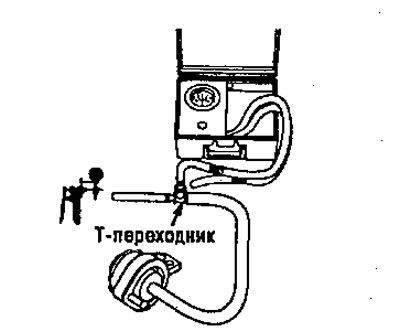
2. Disconnect the vapor discharge hose from the…


3. Pump the vacuum slowly and continuously, while monitoring the gauge. The vacuum should stabilize for short intervals at a value of 0.7-2.0 kPa (5-15 mm R.S.).


If the vacuum stabilizes (the valve opens) at a value below 0.7 kPa or above 2.0 kPa, replace the valve and recheck.

4. Switch the hose to the vacuum pump discharge port and the pressure input from the sensor to the T-piece as shown in the figure.
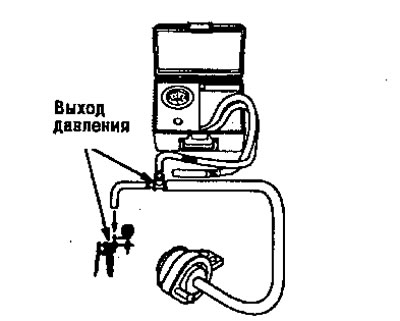
4. Switch the hose to the vacuum pump discharge…


5. Slowly pump up the pressure, watching the gauge. The pressure should stabilize at a value of 1.3-47 kPa (10-35 mm R.S.).

If the pressure stabilizes briefly (the valve opens) within the specified limits, the valve is OK.

If the pressure stabilizes below or above the specified zone, replace the valve and recheck.
This article is available at: russian, bulgarian, belarusian, ukrainian, serbian, croatian, romanian, polish, slovak, hungarian
This information has been verified: Mikhail Kopasov
Share with friends:
◀ Previous
Civic 5 and 6: Fuel injection system (SOHC)
Next ▶

Crankcase ventilation system
Three-way catalytic converter
Emission Control System — Exhaust
Description of the exhaust gas toxicity reduction system
Throttle body — removal and disassembly
 
See also other articles from Honda manuals:
Gasoline vapor recovery system Honda Accord 3 (1985-1989)
Fuel vapor recovery system Honda Fit 1 (2001-2008)
Gasoline vapor recovery system Honda CR-V 1 (1995-2001, petrol)
Fuel lines of the power supply system Honda HR-V 1 (1998-2006, petrol)
Checking the fuel vapor recovery system Honda Avancier 1 (1999-2003, petrol)
Link in different formats to this article
Comments and feedback from visitors
No comments yet


How much will 36 + 19 ?


Civic 8 (2005-2011) 
  • General information
  • Technical data
  • Governing bodies
  • Driving and maintenance
  • Power unit
  • Gasoline engines (L13A)
  • Gasoline engines (R18A)
  • Diesel engines (N22A)
  • Cooling and lubrication (L13A)
  • Cooling and lubrication (R18A)
  • Cooling and lubrication (N22A)
  • Injection system (gasoline)
  • Injection system (diesel)
  • Toxicity reduction system
  • Troubleshooting
  • Transmission
  • Clutch and drive shafts
  • Mechanical gearbox
  • Chassis and running gear
  • Suspension and wheels
  • Steering
  • Brake system
  • Body and interior
  • Exterior (external elements)
  • Doors, locks and windows
  • Electrical equipment
  • Equipment and devices
  • Headlights and lighting
  • Power devices
  • Electrical circuits
Civic 7 (2000-2005) 
  • General information
  • User manual
  • Maintenance
  • Power unit
  • Engines D15B and D17A
  • K20A Engines
  • Overhaul engine
  • Cooling system
  • Lubrication system
  • Fuel injection system
  • Toxicity reduction system
  • Engine electrical equipment
  • Transmission
  • Clutch
  • Manual gearbox
  • Automatic gearbox
  • Variator (CVT)
  • Drive shafts
  • Chassis and running gear
  • Car suspension
  • Steering
  • Brake system
  • Body and interior
  • Exterior (external elements)
  • Interior (internal elements)
  • Doors, locks and windows
  • Heater and air conditioner
  • Manual air conditioner
  • Automatic air conditioner
  • Security system
  • Electrical equipment
  • Equipment and devices
  • Headlights and lighting
  • Windscreen wipers
  • Audio system
  • Electrical diagrams
Civic 6 (1995-2000) 
  • General information
  • Introduction to guide
  • User manual
  • Maintenance
  • Power unit
  • Engine in car (Civic)
  • Engine in car (Integra)
  • Engine overhaul
  • Cooling and heating
  • Power and exhaust systems
  • Engine electrical equipment
  • Engine management systems
  • Transmission
  • Manual gearbox
  • Automatic transmission (AT/CVT)
  • Clutch and drive shafts
  • Chassis and running gear
  • Brake system
  • Car suspension
  • Steering
  • Body and interior
  • Exterior (external elements)
  • Interior (internal elements)
  • Doors, locks and windows
  • Electrical equipment
  • Equipment and devices
  • Electrical circuits
Civic 5 and 6 (1991-2000) 
  • Power unit
  • SOHC engines
  • DOHC engines
  • Engine overhaul
  • Cooling and lubrication system
  • Intake and exhaust system
  • Fuel injection system (SOHC)
  • Fuel injection system (DOHC)
  • Carburetor
  • Transmission
  • Clutch
  • Manual gearbox S4C
  • Manual gearbox S40
  • Automatic gearbox
  • Drive shafts
  • Chassis and running gear
  • Car suspension
  • Steering
  • Brake system
  • Body and interior
  • Body elements
  • Heater and air conditioner
  • Electrical equipment
  • Power devices
  • Equipment and instruments
  • Electrical circuits
Civic 3 and 4 (1983-1991) 
  • General information
  • Maintenance
  • Power unit
  • Engine in a car
  • Engine overhaul
  • Cooling system
  • Power and exhaust system
  • Engine electrical equipment
  • Emission control system
  • Transmission
  • Mechanical gearbox
  • Automatic gearbox
  • Clutch and drive shafts
  • Four-wheel drive
  • Chassis and running gear
  • Brake system
  • Car suspension
  • Steering
  • Body and interior
  • Body elements
  • Electrical equipment
  • Equipment and devices
  • Electrical circuits
HondaBook.ru © 2018–2026 • Mobile version • Sitemap: EN BG BY UA RS HR RO PL SK HU • Feedback • Driver Information • Search system • Bookmark
Accord 3 (1985-1989) • Accord 6 (1997-2002) • Civic 3 and 4 (1983-1991) • Civic 5 and 6 (1991-2000) • Civic 6 (1995-2000) • Civic 7 (2000-2005) • Civic 8 (2005-2011) • Fit 1 (2001-2008) • CR-V 1 (1995-2001) • CR-V 2 (2002-2006) • HR-V 1 (1998-2006) • Avancier 1 (1999-2003) •
 
This website uses cookies to ensure proper functioning. By clicking "OK," you agree.