
Contents: Ignition timing control ⇊ Start moment and duration of fuel…⇊ Knock sensor ⇊ Manifold Absolute Pressure (MAP)…⇊ Mass Air Flow (MAF) Sensor/Intake…⇊ Secondary heated oxygen sensor…⇊
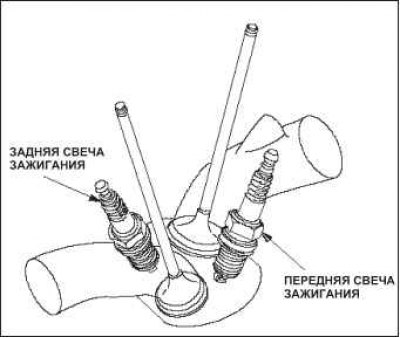
The ECM controls the timing of ignition timing between the front and rear spark plugs based on engine speed and intake manifold vacuum.
At idle, the front and rear spark plugs fire simultaneously to increase combustion speed, resulting in improved fuel consumption.
At low speed, under light load conditions, the ECM shifts the ignition timing to the front spark plug, where combustion chamber temperatures are relatively low, to improve fuel economy.
At low speed under high load conditions, ignition timing advance is moved to the front spark plug and retarded on the rear side to improve torque while controlling engine knock.
At high speed, both the front and rear spark plugs fire simultaneously to increase combustion speed, resulting in improved power.
Ignition timing control
The ECM contains in its memory the basic dependencies of the ignition timing at various engine speeds and absolute pressures. The computer also corrects the ignition timing depending on the coolant temperature and the intake air temperature.
Start moment and duration of fuel injection
The ECM contains in its memory the basic dependencies of the fuel injection duration at different engine speeds and air pressure in the intake manifold. The basic value of the fuel injection duration, after it is read from the computer's memory, is then corrected in accordance with the signals sent from the various sensors to obtain the final value of the injection duration.
By monitoring the fuel injection process parameters over a long period of time, the ECM detects faults that occur in the fuel injection system over a long period of time and generates a diagnostic trouble code (DTC).
Knock sensor
The anti-knock system adjusts the ignition timing to reduce detonation to a minimum level.
Manifold Absolute Pressure (MAP) Sensor
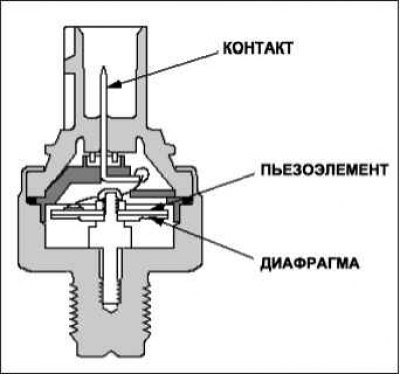
The MAP sensor converts absolute air pressure in the intake manifold into electrical signals that are sent to the ECM.
Mass Air Flow (MAF) Sensor/Intake Air Temperature (IAT) Sensor
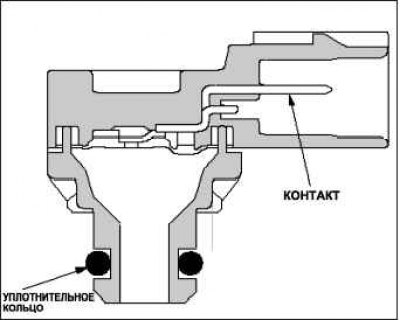
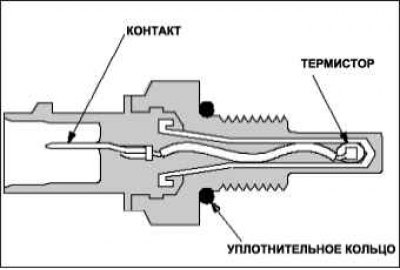
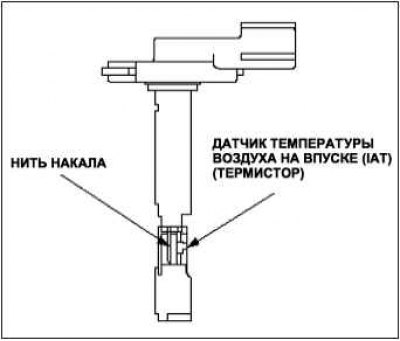
The mass air flow (MAF) sensor/intake air temperature (IAT) sensor contains a filament and a thermistor. It is located in the intake air duct. The resistance of the filament and thermistor changes depending on the intake air temperature and air flow. A regulation circuit in the MAF sensor controls the current to maintain the set filament temperature. The regulation circuit converts the current to a voltage that is supplied to the ECM.
Secondary heated oxygen sensor (secondary HO2S sensor)
 |
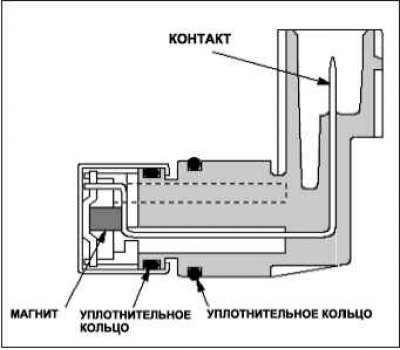 |
The secondary oxygen sensor (HO2S) detects the oxygen content in the exhaust gas at the outlet of the three-way catalytic converter (TWC) and sends signals to the ECM, which accordingly changes the duration of fuel injection. To stabilize its output signal, the sensor has a built-in heater. The ECM compares the HO2S signal with the A/F sensor signal to determine the efficiency of the catalytic converter. The secondary oxygen sensor (HO2S) is located in the three-way catalytic converter.