
Inspection
Drive shaft boot
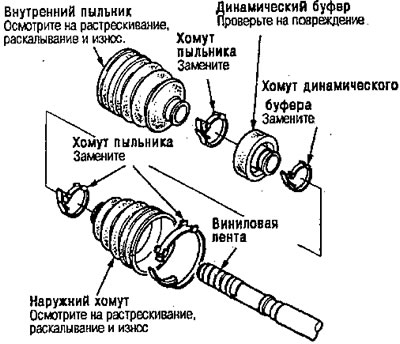
Check the drive shaft boots for cracks, damage, grease leaks, or loose boot clamps.
If any damage is found, replace the boot and boot clamps.
Loosening of splined connections
Rotate the drive shaft by hand and make sure the splines and joints are not excessively loose (do not have excessive play).
If damage is found, replace the inner joint.
Twisting and cracking
Make sure the drive shaft is not twisted or cracked. Replace if necessary.
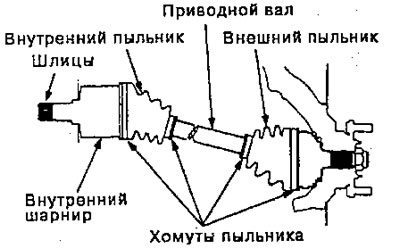
Removal
1. Loosen the wheel nuts slightly.
2. Raise the front of the machine and secure it with safety stands in appropriate places.
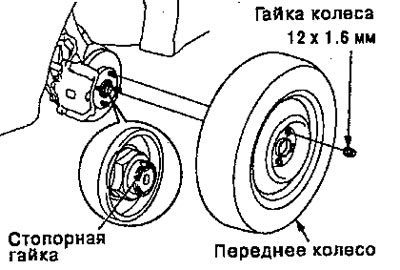
3. Remove the wheel nuts and front wheels.
4. Drain the transmission fluid or oil.
Note: It is not necessary to drain the transmission oil when removing the drive shaft from the intermediate shaft side (for machines with intermediate shaft).
5. Unclip the locking tab on the lock nut, then remove the nut.
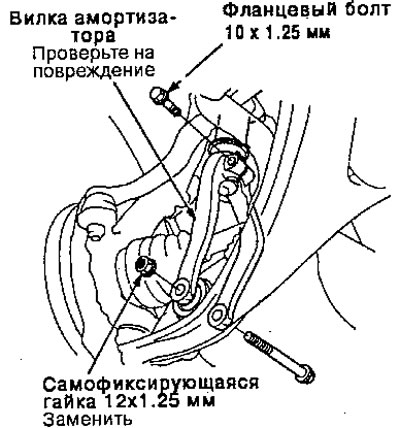
6. Remove the self-locking nut and flange bolts.
7. Remove the shock absorber fork.
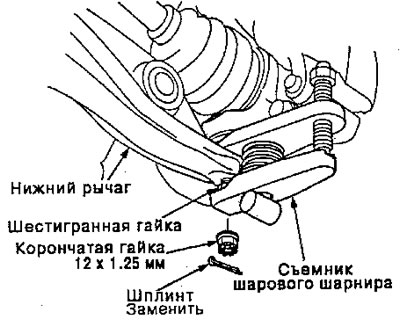
8. Remove the cotter pin from the lower arm ball joint castle nut and remove the nut.
9. Install the M12 hex nut on the ball joint. Make sure the hex nut is in contact with the thread of the ball joint, otherwise the threaded part of the ball joint pin may be damaged by the ball joint puller.
10. To separate the ball joint and lower arm, use the ball joint puller as shown in Section 18.
Caution: Be careful not to damage the ball joint boot.
Note: If necessary, apply penetrating lubricant to loosen the contact.
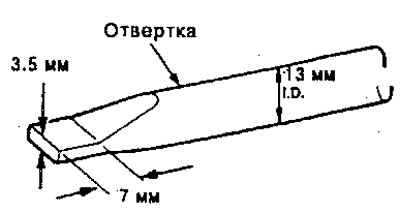
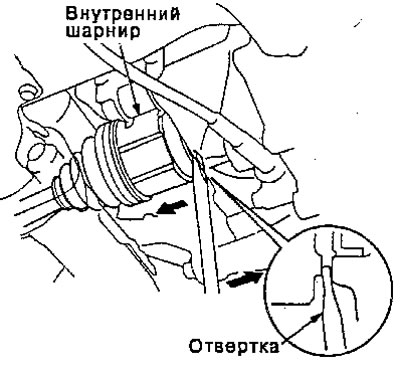
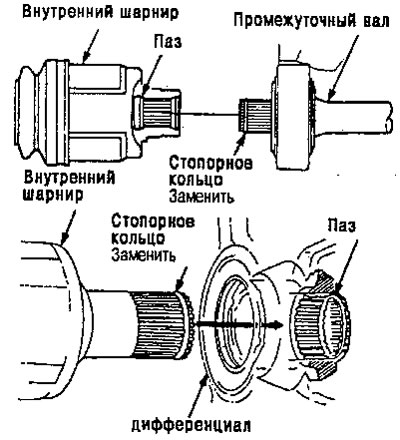
11. Pry the drive shaft joint with a screwdriver as shown to force the snap ring on the end of the drive shaft out of its groove.
12. Pull the inner joint drive shaft out of the differential housing as an assembly.
Attention.
- Do not pull on the drive shaft itself, as the inner joint may separate.
- Be careful when removing the assembly and pull it straight out to avoid damaging the differential seal or intermediate shaft outer seal.
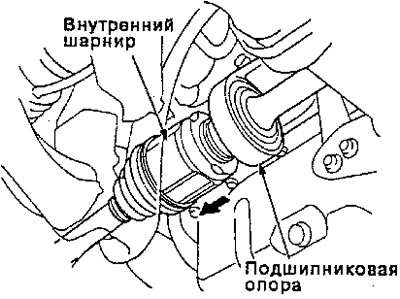
- With intermediate shaft:
Remove the left drive shaft from the bearing support by tapping the inner joint of the drive shaft with a plastic hammer
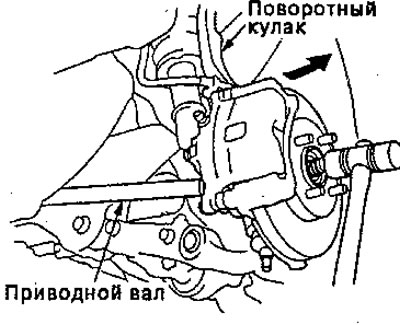
13. Pull the steering knuckle toward you and remove the outer joint of the drive shaft from the front wheel hub using a plastic hammer.
Disassembly
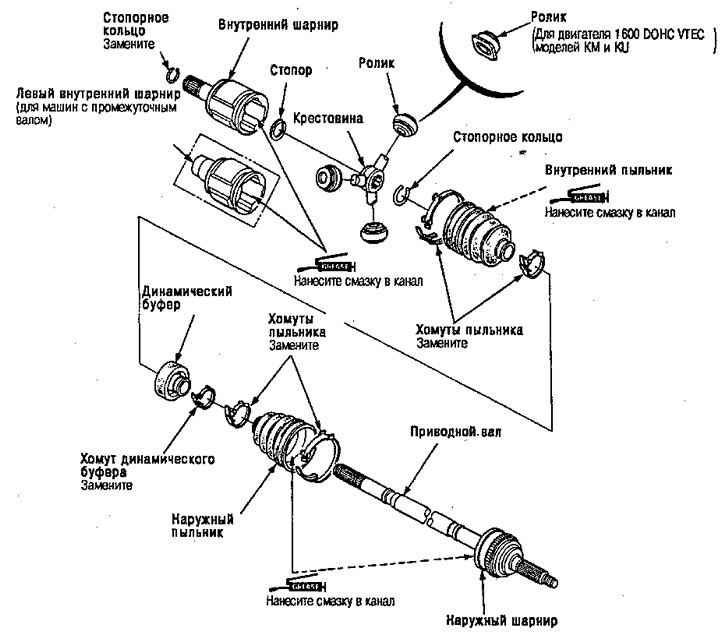
1. Remove the retaining ring from the inner joint groove.
2. To remove the boot clamp, lift the retaining tabs up with a screwdriver and lift the end of the clamp.
Note: Carefully clamp the drive shaft in a soft jaw vice.
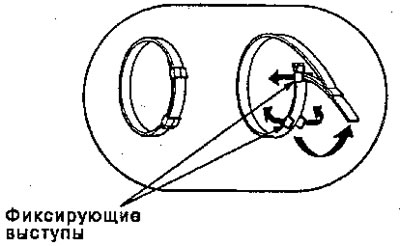
- If the boot clamp is a welded type, cut it as shown.
- If the boot clamp is a snap-on type, use a screwdriver to lift up the end of the boot.
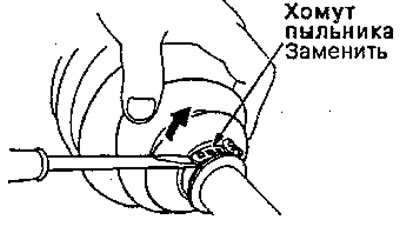
3. Mark each roller and groove of the inner hinge to determine the location of the rollers and grooves in the inner hinge. Then remove the inner hinge using a napkin.
Note: Be careful not to drop the rollers when separating them from the inner hinge.
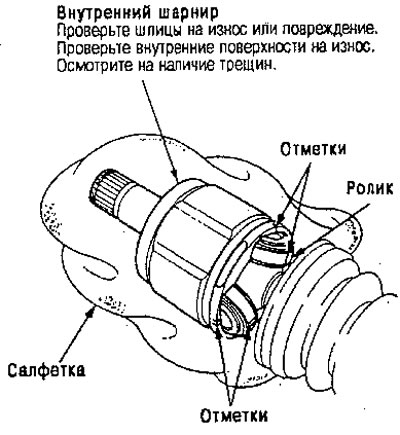
4. Mark the rollers to identify their locations, then remove the rollers.
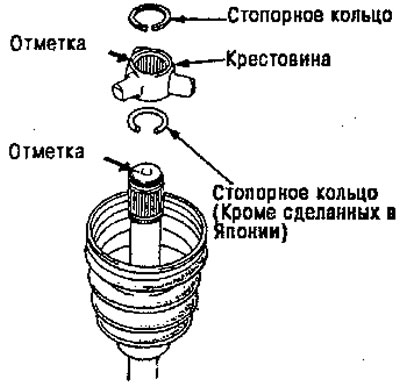
5. Remove the retaining ring.
6. Mark the crosspiece and drive shaft to determine their relative positions.
7. Remove the crosspiece using a commercially available bearing puller.
8. Remove the retaining ring (except cars made in Japan).
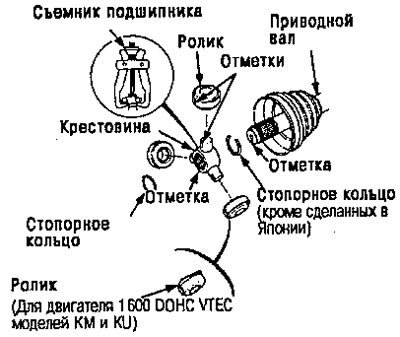
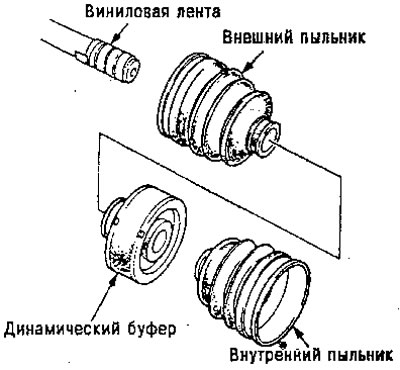
9. Wrap the splines on the drive shaft with vinyl tape to prevent damage to the boots and dynamic buffer.
10. Remove the boot clamp and inner boot.
Caution: Be careful not to damage the boot.
11. Remove the dynamic buffer clamp, if present.
Warning: Be careful not to damage the dynamic buffer.
12. Remove the boot clamps and outer boot, then remove the vinyl tape.
Caution: Be careful not to damage the boot.
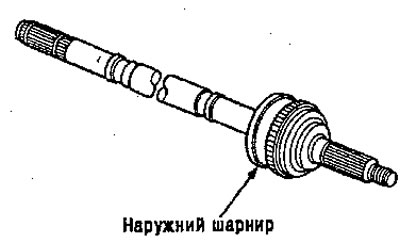
13. Inspect the outer joint for irregular movement and wear* If there is irregular movement and excessive play, replace the outer joint.
Assembly
Note:
- Clean disassembled parts with solvent and dry thoroughly with compressed air. Do not wash rubber parts with solvent.
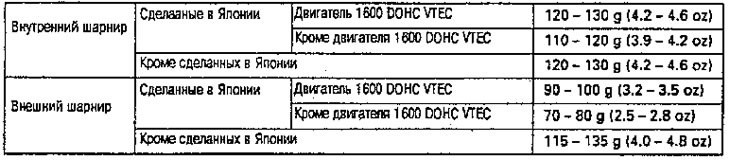
- Thoroughly coat the inner joint and both joint boots with the joint grease supplied with the new drive shaft.

Amount of grease:
1. Wrap the splines with vinyl tape to prevent damage to the boots and dynamic buffer.
2. Install the outer boot, dynamic buffer and inner boot onto the drive shaft, then remove the vinyl tape.
Caution: Be careful not to damage the dust boots and dynamic buffer.
3. Install the retaining ring into the groove of the drive shaft (except cars made in Japan).
Note: Always rotate the retaining ring in its groove to ensure it is fully seated.
4. Install the crosspiece onto the drive shaft, aligning the marks on it and the end of the drive shaft.
5. Install the retaining ring into the groove of the drive shaft.
Note: Always rotate the retaining ring in its slot to ensure it is fully seated.
6. Apply the joint grease supplied with the new drive shaft kit to the outer joint.
Amount of grease:
- Made in Japan
- Engine 1600 DOHC VTEC 90-100 g.
- Except for the 1600 DOHC UTES engine: 70-80 g.
- Except for those made in Japan 115-135.
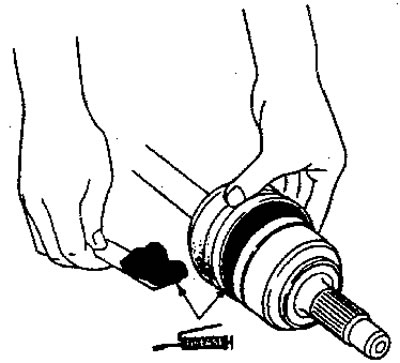
7. Place the rollers on the crosspiece so that their protrusions face outward.
Note:
- Install the rollers in their original place on the crosspiece, aligning the marks.
- Keep the drive shaft vertical to prevent the rollers from falling.
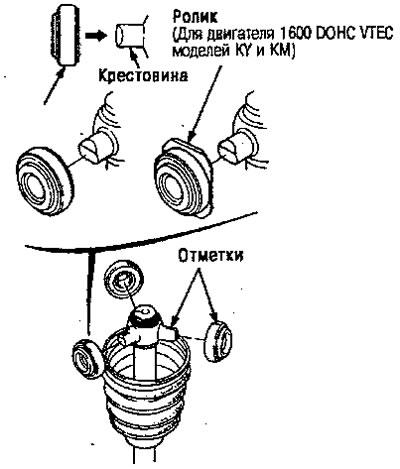
8. Apply the joint grease supplied with the new drive shaft kit to the inner joint.
Amount of grease:
- Made in Japan
- Engine 1600 DOHC VTEC 120-130 g.
- Except for the 1600 DOHC VTEC 110-120 engine.
- Except for those made in Japan 120-130 g.
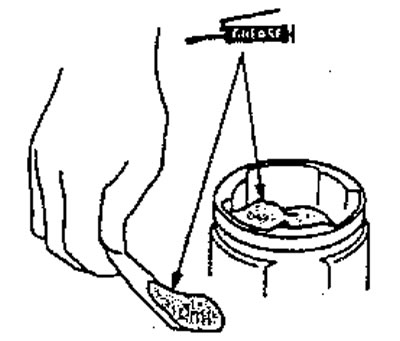
9. Insert the inner joint into the drive shaft.
Note:
- Install the inner joint onto the drive shaft, aligning the marks on the inner joint and rollers.
- Keep the drive shaft vertical to prevent the rollers from falling.
For the 1600 DOHC VTEC engine of the KU and KM models:
Align the direction of the roller locks along the grooves of the inner hinge as shown below
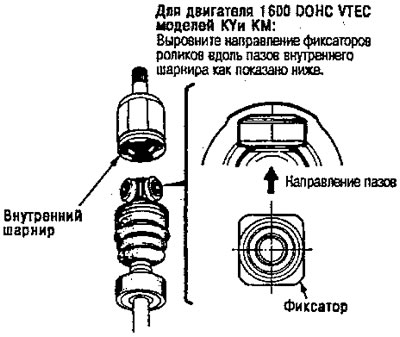
10. Adjust the length of the drive shafts as shown below, then adjust the boots midway between full compression and full tension.
Note: the ends of the dust boots fit into the holes of the drive shaft and joint.
Drive lengths are given for models produced since 1996
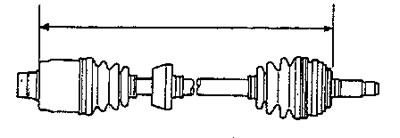
Left engine drive 1600 DOHC VTEC: 475-480 mm.
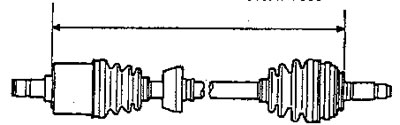
- Right engine drive 1800 DOHC VTEC: 475-480 mm.
- Left hand drive except 1600 DOHC VTEC engine: 774-779 mm.
- Right-hand drive except for 1600 DOHC UTES engine: 501-506 mm.
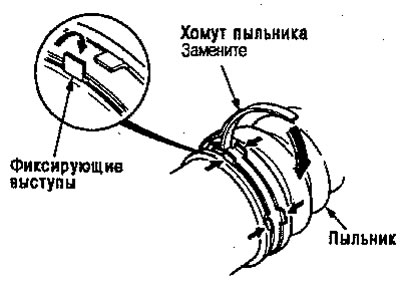
11. Install new boot clamps and bend both retaining tabs.
12. Tap the protrusions lightly to reduce their protrusion.
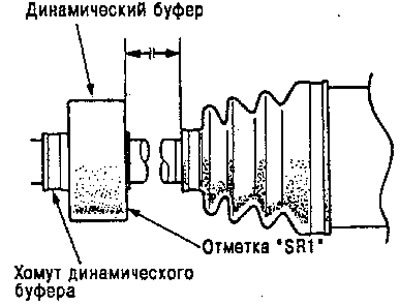
13. Place the dynamic buffer as shown below.
- Install the new dynamic buffer clamp and bend the retaining tabs down.
- Tap lightly to reduce their protrusion.
For models from 1996
Left:
- Engine 1600 DOHC UTES 26±2 mm.
- Except for the 1600 DOHCVTEC 94±2 mm engine.
- With the mark "SR1": 75±2 mm.
Right:
- Engine 1600 DOHC UTES 26 ±2 mm.
- Except for the 1600 DOHC VTEC 55±2 mm engine.
Installation
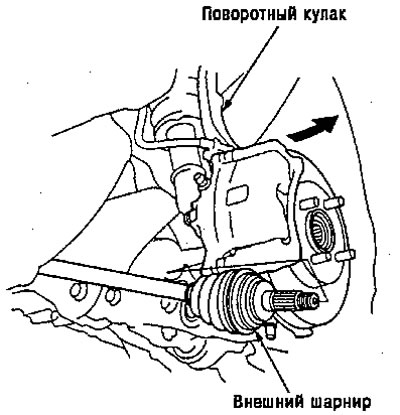
1. Install the outer joint into the steering knuckle.
2. Apply 0.5 - 1.0 g of the specified grease to the entire splined surface of the intermediate shaft,
Note: After applying grease, remove grease from the spline grooves at intervals of 2-3 splines and from the snap ring groove to allow air to escape from the inner joint.
3. Install a new snap ring into the drive shaft or intermediate shaft groove.
Caution: Whenever you install the drive shaft, always use a new snap ring.
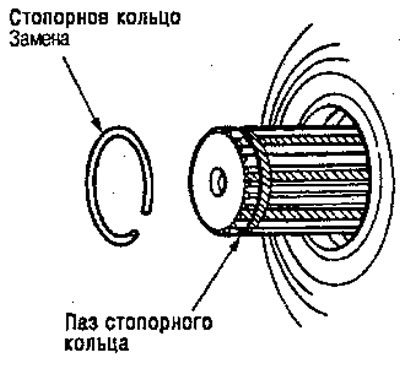
4. Insert the inner end of the drive shaft into the differential or intermediate shaft until the snap ring is locked in the slot.
Note: Clean the area where the transmission is thoroughly (differential) comes into contact with the drive shaft, solvent or carburetor cleaner and dry with compressed air.
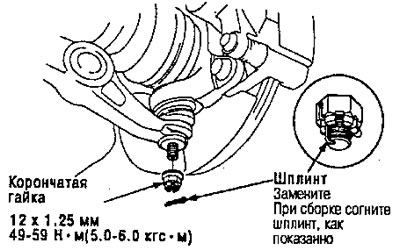
5. Install the steering knuckle onto the lower arm, then tighten the castle nut and install a new cotter pin.
Note: Remove grease before tightening the ball joint nut.
Attention:
- Be careful not to damage the ball joint boot.
- Tighten the nut to the lower rated torque, then tighten it until the slot aligns with the cotter pin hole.
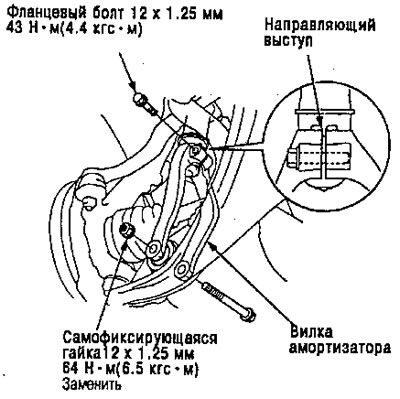
6. Install the shock absorber fork through the drive shaft onto the lower arm. Install the shock absorber into the shock absorber fork so that the guide lug aligns with the slot in the shock absorber fork.
7. Install the flange bolt and new self-locking nut without tightening.
Note: The bolt and nut must be tightened when the weight of the vehicle presses on the shock absorber strut.
8. Install the new lock nut, then tighten it.
9. Install the front wheel and wheel nut
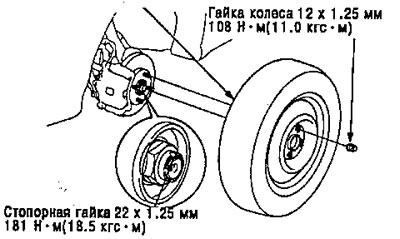
Note: After tightening, use a punch to tighten the lock nut on the drive shaft end.
10. Tighten the flange bolts and new self-locking nut with the vehicle's weight on the shock absorber.
11. Fill the trans with the recommended oil or fluid.
12. Check the front wheel alignment and adjust if necessary.